
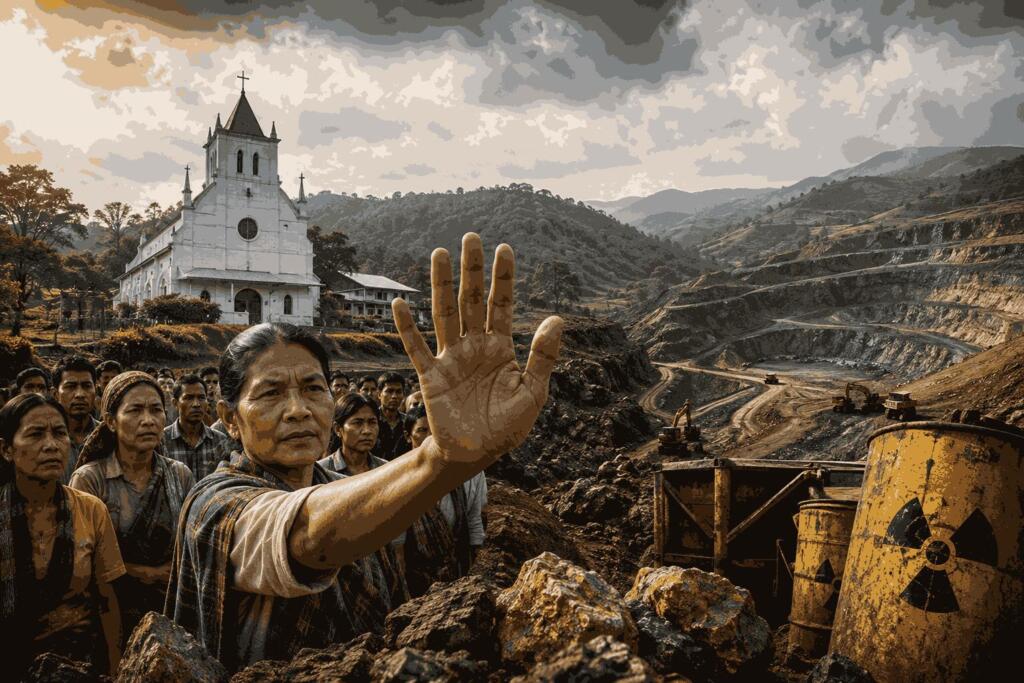
Meghalaya’s unanimous rejection of uranium mining has brought the Christian Church into the wider public conversation, although there is currently no publicly established evidence in the cited report proving that church organisations directed or funded the State’s anti-uranium campaign. On August 26, 2026, the Meghalaya Assembly unanimously adopted a resolution opposing uranium mining and the establishment of uranium ore-processing facilities in the State. Chief Minister Conrad K. Sangma moved the resolution, saying it reflected the concerns of communities living in uranium-bearing areas of West Khasi Hills.
The decision is significant because Meghalaya possesses some of India’s largest known uranium resources. The report estimates that the State has around 9.22 million tonnes of uranium resources, representing roughly 16% of India’s total and placing Meghalaya third among the States mentioned. Yet attempts to advance uranium exploration have faced sustained resistance for decades, particularly in areas such as Domiasiat, Lostoin, Mawthabah and Wahkaji.
The controversy is not new, nor can it simply be reduced to religious politics. Local communities have repeatedly raised concerns about land ownership, environmental consequences and potential health risks associated with mining. Meghalaya’s distinctive constitutional and customary land arrangements are particularly important. The Sixth Schedule provides protections concerning community, clan and individual ownership, while a 2019 Supreme Court judgment recognised the rights of private and community landowners over both the surface of land and minerals beneath it.
The Christian Church question arises largely because Christianity has a deep institutional and social presence in Meghalaya. According to the 2011 Census figures cited by the report, Christians constituted 74.59% of the State’s population, with Christianity particularly established among Khasi, Jaintia and Garo communities. Churches are therefore influential social institutions, but demographic influence by itself does not establish organisational involvement in a particular political or environmental campaign.
The history of the anti-uranium movement also predates the current political controversy by several decades. Opposition intensified during the 1990s after exploratory drilling began. Activist Spility Lyngdoh Langrin became an important figure in the movement after refusing a government offer concerning her land following exploration activity. She later led another phase of resistance in 2009 after permission was granted for exploration across 422 hectares. The State government eventually revoked that permission in 2016 following continuing protests.
The Christian Church connection is being discussed partly because of developments in other parts of India. Tamil Nadu, for example, witnessed visible participation by church institutions and clergy during the Kudankulam anti-nuclear agitation. The Idinthakarai church premises became a significant location for protests, while the government at the time raised allegations concerning foreign-funded organisations and their involvement. Those allegations became part of a broader political and regulatory controversy surrounding foreign funding.
The 2018 Sterlite protests in Thoothukudi provide another example cited in the report, with Catholic priests and nuns participating in demonstrations demanding closure of the copper plant. These episodes have consequently become part of the debate whenever environmental movements emerge in areas where Christian institutions have substantial social influence.
However, the Christian Church should not automatically be treated as synonymous with Meghalaya’s anti-uranium movement. The available account documents a long-standing local campaign involving land, environmental and community concerns, but it does not establish that church bodies organised, financed or controlled the movement. That distinction matters, particularly when questions about foreign funding or religious institutions are raised.
The Christian Church question nevertheless deserves scrutiny if credible evidence emerges. Transparency over funding, participating organisations and sources of mobilisation is legitimate in any major public campaign, regardless of whether the organisations involved are religious, political, environmental or community-based. At the same time, allegations should be supported by documentary evidence rather than assumptions based solely on Meghalaya’s religious demographics.
For the Christian Church, the issue therefore represents a broader test of how religious institutions interact with environmental and development questions. Churches may function as community centres and social organisations without necessarily determining political outcomes. In Meghalaya, where customary land rights and tribal institutions have considerable importance, the roots of opposition may be considerably more complex than any single institutional explanation.
The Christian Church debate will ultimately depend on evidence. Meghalaya’s Assembly has formally communicated its opposition to uranium extraction and processing, placing the issue before the Centre. Whether uranium development returns to the political agenda will depend on how the Union government, State authorities and affected communities respond. For now, the strongest established fact is that Meghalaya’s legislators have unanimously rejected uranium mining—not that any religious organisation has been proven responsible for that decision.