
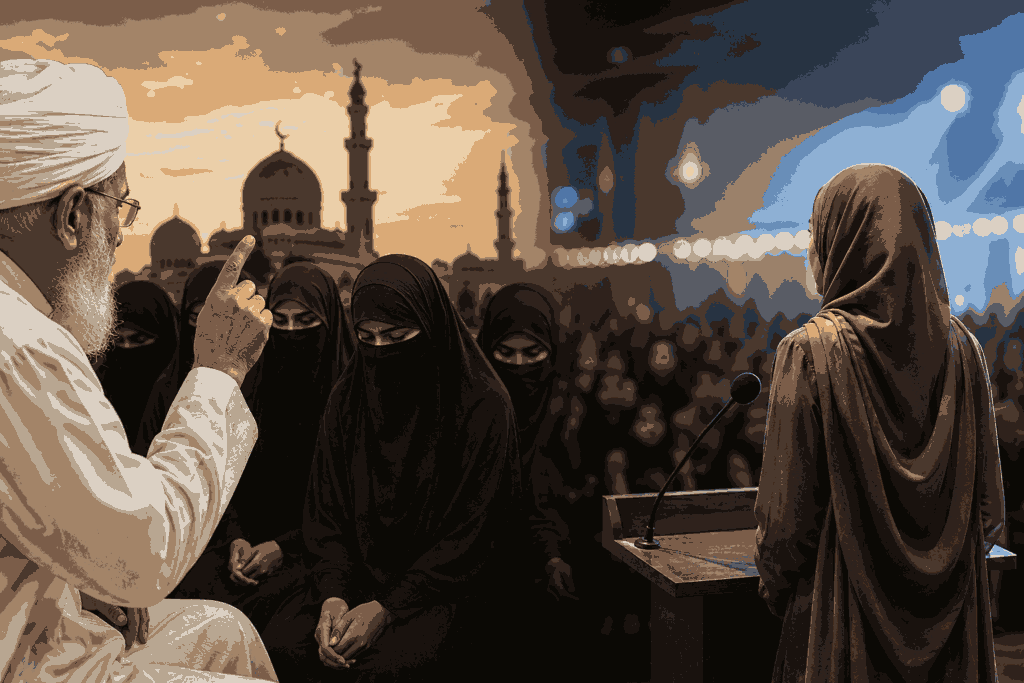
A Kerala Sunni Body has issued a directive asking mahals, mosques, madrasas and other institutions to ensure that women do not appear among unrelated men in public programmes or on stages, bringing renewed attention to questions surrounding women’s participation in religious and cultural life. The directive, attributed to Samastha Kerala Jamiyyathul Ulama’s Kanthapuram faction, has generated criticism and discussion over the balance between religious guidance, community practices and women’s freedom to participate in public spaces.
According to reports, the statement was issued by Samastha president E. Sulaiman Musliyar and general secretary Kanthapuram A.P. Aboobacker Musliyar. It called on institutional authorities to ensure that programmes organised under their supervision remain within what the organisation considers Islamic norms. The statement reportedly objected to the presence of young women among unrelated men in public spaces and on stages.
The Kerala Sunni Body’s position has attracted attention because the instruction goes beyond the organisation’s internal religious gatherings and touches on participation in public programmes and celebrations. Reports said the directive also warned against incorporating customs considered incompatible with Islamic practices into religious festivals and ceremonies.
The controversy comes at a time when public celebrations in Kerala, particularly in parts of Malabar, have become increasingly visible. Reports cited by the media indicate that videos of Onam celebrations involving students, including Muslim girls, had circulated online. Muslim women and girls were also reportedly seen participating in Milad-e-Sharif programmes. The development appears to have prompted renewed discussion within conservative religious circles about how such events should be conducted.
A Kerala Sunni Body functionary defended the instruction as a reminder of existing religious norms rather than a new prohibition. Jamal Karulai, Kerala Muslim Jamaat district secretary, reportedly said Islamic scholars were carrying out their responsibility by reminding followers not to depart from their religious path. He also stressed that people have the freedom to follow and preach their faith. (
Criticism, however, has emerged from political and social quarters. CPI(M) central committee member P.K. Sreemathy reportedly condemned the circular and called for its withdrawal. She questioned the language used in the directive and argued that women should be treated with respect and consideration. Her response has added a political dimension to a debate that otherwise centres on religious interpretation and community practice.
The Kerala Sunni Body has placed responsibility on mahal committees, mosque authorities, madrasa managements and other institutional leaders to ensure that programmes follow the religious values and discipline it advocates. It has also called for moral guidance for younger Muslims. Supporters of the directive see this as an internal matter of religious observance, while critics regard the instruction as an attempt to restrict women’s visibility and participation in public life.
The debate highlights a question about how religious organisations interact with Kerala’s changing social landscape. Women have long participated in education, culture and public institutions across the state. When religious bodies issue guidance affecting such participation, disagreements are likely over where religious authority ends and individual choice begins.
For many observers, the most significant issue is not simply whether a particular religious interpretation permits women to appear on stages alongside men, but whether community members should be able to make their own decisions about participation in cultural and social events. A Kerala Sunni Body may frame its instruction as religious guidance, but its practical effect depends on how individual institutions and families choose to implement it.
At the same time, the issue should not be reduced to a blanket judgment about Kerala’s Muslim community. Religious communities contain diverse viewpoints, and the reported directive represents the position of a particular organisation and its leadership. The response from supporters and critics alike shows that there is active debate within Kerala over religious practice, gender roles and participation in public life.
The Kerala Sunni Body controversy is therefore likely to remain part of a wider conversation about women, faith and modern public life. Whether the directive remains limited to institutions associated with the organisation or influences broader community practices will depend on how local bodies respond. For now, the episode has placed a familiar question back in the spotlight: how should religious traditions adapt when social participation increasingly crosses traditional boundaries?
The Kerala Sunni Body directive has also prompted renewed scrutiny of the role of religious leadership in shaping everyday community behaviour. While religious organisations have the right to articulate their beliefs to followers, public discussion will continue over the implications of such guidance for women and girls who wish to participate in education, culture, celebrations and other social activities.