
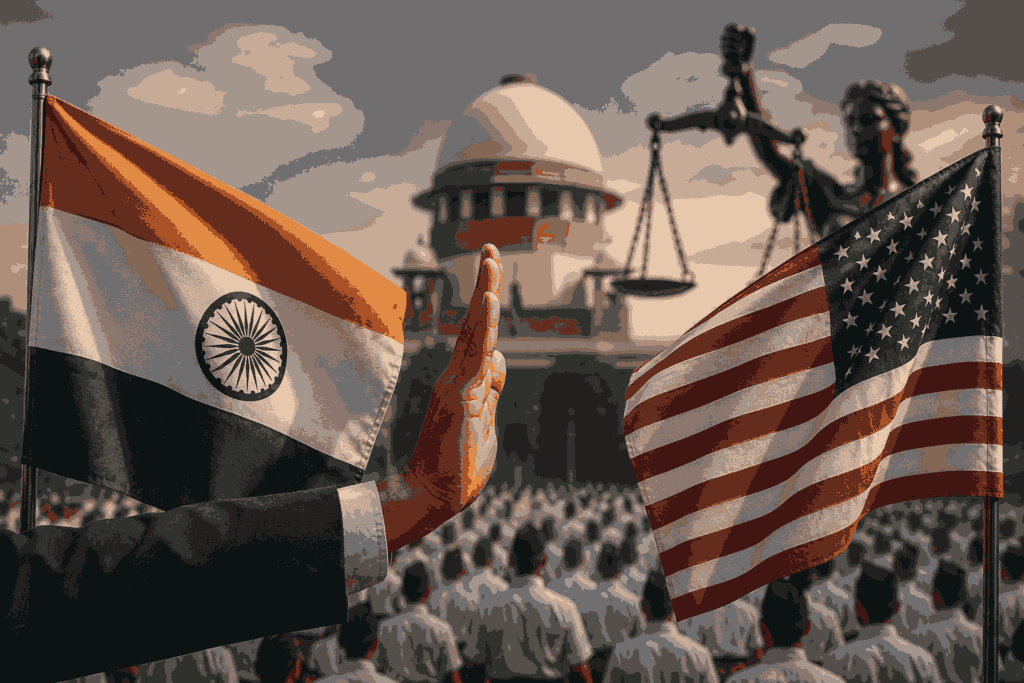
India has strongly rejected a recent call by the United States Commission on International Religious Freedom (USCIRF) for sanctions against the RSS, describing the American body as biased and lacking credibility. The controversy erupted after USCIRF urged Washington to impose targeted sanctions on members of the organisation instead of extending high-level diplomatic courtesies to its leaders. The remarks came shortly before RSS chief Mohan Bhagwat’s planned visit to the United States.
The Ministry of External Affairs responded sharply to the development on August 21. MEA spokesperson Randhir Jaiswal said USCIRF had repeatedly made what New Delhi considers misleading and provocative statements about India. He argued that organisations pursuing their own agendas while making such claims should not be given undue credibility. The government’s latest response reflects a broader disagreement that has persisted between New Delhi and the commission over its assessments of religious freedom in India.
The immediate controversy followed a public statement by USCIRF officials calling on the US administration to consider sanctions against the RSS. The commission also argued that American authorities should reconsider extending diplomatic courtesies or high-level meetings to its leaders. The timing was notable because Mohan Bhagwat is scheduled to undertake a visit covering the United States, Canada and the United Kingdom beginning August 25.
USCIRF’s position is rooted in its wider criticism of India’s religious-freedom record. In its 2026 annual report, the commission recommended that Washington designate India a “Country of Particular Concern” and impose targeted sanctions on entities and individuals it alleges are responsible for or tolerate serious religious-freedom violations. The report specifically names the RSS, along with India’s external intelligence agency, in its sanctions recommendations.
New Delhi, however, has consistently rejected the commission’s assessment. In March, following the publication of the 2026 annual report, Jaiswal said India categorically rejected what he called USCIRF’s “motivated and biased” characterisation of the country. He accused the commission of presenting a distorted and selective picture based on questionable sources and ideological narratives rather than objective facts.
The government has also turned the criticism back towards the United States, pointing to incidents involving vandalism and attacks on Hindu temples as matters that deserve attention. In its March response, the MEA additionally raised concerns about what it described as growing intolerance and intimidation faced by members of the Indian diaspora in the United States. The argument illustrates the widening gap between Washington-based assessments and New Delhi’s interpretation of religious-freedom conditions.
The latest exchange is therefore more than a disagreement over one organisation. It has become part of a larger diplomatic argument over who has the legitimacy to assess religious freedom within India and how such assessments should influence bilateral relations. For New Delhi, external pressure directed at the RSS is particularly sensitive because the organisation has a significant social and political presence in India, while its critics maintain that its activities deserve greater international scrutiny.
The controversy also comes at a politically sensitive moment for India-US relations. Both countries have developed extensive cooperation in areas ranging from defence and technology to trade and strategic affairs. Against that backdrop, recommendations for sanctions by a US federal commission can create diplomatic friction even when they do not automatically translate into binding policy by the American administration.
For the RSS, the dispute places renewed international attention on an organisation that has remained a major subject of debate over its ideology, social activities and relationship with Indian politics. Supporters regard it as a large voluntary social and cultural organisation, while critics have accused it of contributing to majoritarian politics. The competing narratives have repeatedly shaped international coverage of India.
The Indian government’s latest response suggests that it has no intention of accepting USCIRF’s recommendations without challenge. By questioning the commission’s credibility and accusing it of pursuing a selective agenda, New Delhi is seeking to draw a clear distinction between legitimate international engagement and what it considers politically motivated intervention in India’s internal affairs.
As Mohan Bhagwat’s overseas visit approaches, the dispute is likely to remain under scrutiny. Whether the USCIRF recommendations influence the US administration remains uncertain, but the episode has already highlighted the sharp disagreement between the two sides. For India, the central message is that assessments of its domestic institutions and organisations must be based on what New Delhi considers objective evidence rather than politically charged narratives.
The confrontation ultimately underscores a broader challenge in India’s engagement with international rights-monitoring bodies: criticism of domestic policies can quickly acquire diplomatic consequences when it involves prominent organisations such as the RSS. With New Delhi rejecting the allegations and USCIRF maintaining its position, the disagreement is unlikely to disappear quickly. Instead, it is set to remain another contentious issue in the evolving conversation between India and the United States over democracy, religious freedom and sovereignty.