
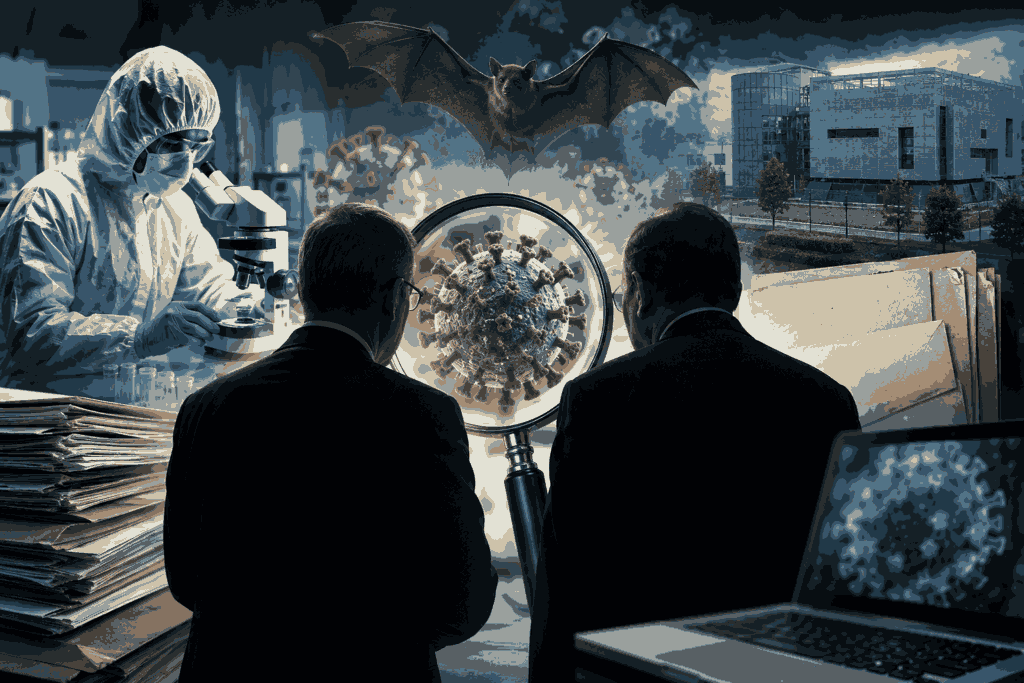
The origins of COVID-19 have returned to the centre of an intense international controversy after newly revealed court documents allegedly showed that former US health official David Morens used private communications with scientist Peter Daszak while efforts were being made to counter claims that the virus may have escaped from a laboratory in Wuhan. The revelations have renewed questions about transparency, government record-keeping and whether officials presented the public with the full picture during the earliest and most consequential months of the pandemic.
According to documents cited in the latest report, Morens pleaded guilty to conspiring to evade federal public-records requirements. Prosecutors allege that he used a personal Gmail account to communicate about government business, thereby attempting to keep those exchanges outside the reach of Freedom of Information Act requests. The case has acquired particular significance because Daszak, a prominent figure in coronavirus research and former president of EcoHealth Alliance, was identified as a co-conspirator in the criminal proceedings involving Morens. No criminal charges have been filed against Daszak.
The central issue is not simply whether the laboratory-leak hypothesis is correct. Rather, the new material raises questions about how competing explanations for the origin of the virus were handled by people who occupied influential positions in the US public-health establishment. Court documents reportedly say that Morens and others worked to counter the narrative that the virus had leaked from a laboratory and that communications were concealed while scientific papers and public commentary were being produced.
Peter Daszak’s involvement is particularly significant because of his longstanding professional relationship with researchers in China. Through EcoHealth Alliance, he had collaborated with scientists studying bat coronaviruses, including researchers associated with the Wuhan Institute of Virology. His position therefore became a point of contention when he participated in discussions about the origins of the outbreak. Critics have argued that his connections represented a potential conflict of interest, while Daszak and his supporters have rejected accusations that he concealed the truth.
The controversy also revisits the origins debate surrounding a scientific paper that became highly influential in 2020. The publication, “The Proximal Origin of SARS-CoV-2,” was widely cited in arguments against the laboratory-leak hypothesis. More recent US congressional investigations have alleged that officials sought to shape the scientific and public narrative surrounding the origins question. The White House has likewise published material arguing that the paper was used to discredit the lab-leak theory, although those claims remain politically contested.
For years, the question of whether the outbreak began through natural transmission or through a laboratory-associated incident has remained unresolved in the public arena. A WHO-led investigation examined possible origins, while subsequent congressional investigations in the United States reached sharply different conclusions from some earlier scientific assessments. A House committee later said that available evidence pointed toward a laboratory incident, while other scientists have continued to argue that the available evidence does not establish such a conclusion.
The latest revelations involving Morens give the debate a new dimension because they concern not only scientific interpretation but also the handling of official records. If government officials deliberately shifted sensitive discussions to private accounts to avoid disclosure, the issue becomes one of institutional accountability regardless of which origin theory ultimately proves correct. Public confidence depends on officials preserving records and allowing competing evidence to be examined openly.
The role of Anthony Fauci has also returned to scrutiny. Morens previously served as a senior adviser associated with Fauci, and recent reports have highlighted diary entries and other communications concerning their interactions. Fauci has denied knowledge of Morens’ alleged efforts to evade records requirements, while newly released material has prompted renewed political demands for answers.
The debate over COVID-19 origins has therefore moved beyond a scientific disagreement into a broader examination of institutional trust. The public deserves to know whether scientific conclusions were reached independently, whether potential conflicts of interest were disclosed and whether government officials preserved communications as required by law.
For many families who experienced lockdowns, economic disruption, illness and bereavement, the origins question is not an abstract historical argument. Understanding what happened in the earliest days of the outbreak could help governments identify weaknesses in laboratory safety, international reporting systems and pandemic preparedness.
The controversy surrounding COVID-19 also demonstrates the danger of prematurely treating a disputed hypothesis as either established fact or outright conspiracy. Scientific questions should remain open to evidence, while allegations of misconduct must be judged through documents, testimony and due process.
Ultimately, the renewed scrutiny of Morens and Daszak does not by itself establish that the virus originated in a laboratory. It does, however, make demands for transparency harder to dismiss. The history of COVID-19 will be judged not only by where the virus began, but also by how institutions handled uncertainty, dissenting evidence and uncomfortable questions when the world most needed honest answers.