
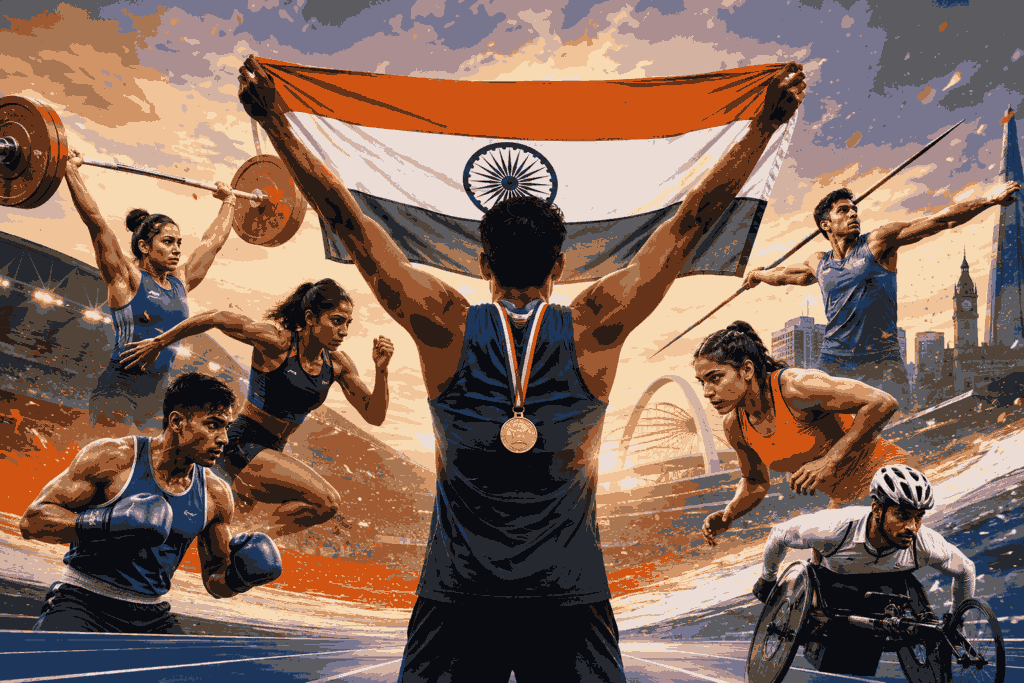
India’s performance at the Commonwealth Games 2026 reflected determination, resilience, and the emergence of a new generation of athletes who proved that success is not measured by medals alone. While the country finished with a lower medal tally than in previous editions, the unique structure of the Games, featuring fewer sports and medal events, made direct comparisons difficult. Despite these challenges, Indian athletes delivered several memorable performances, showcasing the steady growth of the nation’s sporting ecosystem and reinforcing optimism for the future.
Unlike previous editions, the Glasgow Games were organised with a significantly reduced programme. Several sports in which India has traditionally excelled were either excluded or had fewer medal events. Wrestling, badminton, cricket, and other disciplines that have historically contributed substantially to India’s medal count were absent or scaled down. As a result, the Indian contingent entered the competition knowing that every medal opportunity would carry greater significance than before.
Despite these limitations, Indian athletes displayed remarkable consistency in the events that remained on the schedule. Experienced campaigners once again demonstrated why they continue to rank among the country’s finest sporting ambassadors. Weightlifting, athletics, boxing, and para sports produced encouraging performances, with several competitors either winning medals or registering personal bests against world-class opposition. The performances reflected years of investment in coaching, sports science, and athlete development that have gradually strengthened India’s international competitiveness.
One of the biggest positives of the Commonwealth Games 2026 was the emergence of young talent. Several first-time participants competed with confidence despite facing seasoned international athletes. While not every promising performance resulted in a podium finish, many competitors gained valuable experience that is expected to benefit them in future international tournaments. Coaches believe exposure at this level plays a vital role in building athletes capable of succeeding at the Asian Games, World Championships, and eventually the Olympic Games.
The reduced medal tally has naturally invited discussion, but sporting experts have cautioned against making simple comparisons with Birmingham 2022 or earlier editions. The considerably smaller number of medal events meant that countries with strength across the omitted disciplines inevitably had fewer opportunities to climb the medal table. In India’s case, the absence of several traditional medal-winning sports significantly affected the overall standings without necessarily reflecting a decline in athletic standards.
Another encouraging aspect of India’s campaign was the consistency displayed by established champions. Senior athletes continued to perform under pressure while simultaneously mentoring younger teammates. Their experience, discipline, and professionalism provided stability to the contingent throughout the competition. Such leadership remains essential as India transitions toward a new generation of elite athletes capable of competing regularly at the highest international level.
The Commonwealth Games 2026 also highlighted the increasing importance of long-term planning in Indian sport. Over the past decade, greater investment in training facilities, scientific coaching methods, nutrition programmes, injury management, and international exposure has steadily transformed athlete preparation. While these improvements may not always produce immediate medal gains, they contribute to sustainable development and higher standards across multiple sporting disciplines.
Beyond medals, several Indian competitors achieved personal milestones by breaking national records, producing season-best performances, or reaching finals against highly competitive fields. These achievements often receive less public attention than podium finishes, yet they remain important indicators of progress. Every improved performance strengthens India’s position in global rankings while providing athletes with confidence heading into future championships.
Sports administrators are expected to conduct detailed assessments following the Games to identify both strengths and areas requiring further improvement. Continued emphasis on grassroots development, talent identification, and international competition will remain central to India’s long-term sporting ambitions. Lessons learned from Glasgow are likely to shape preparation strategies for upcoming continental and global events.
The campaign also demonstrated the value of adaptability. International sporting calendars continue to evolve, and major competitions increasingly feature changing event formats. Nations capable of responding quickly to such changes are better positioned to maintain consistent success. India’s athletes showed encouraging adaptability despite competing in an environment with fewer opportunities to secure medals.
Ultimately, the Commonwealth Games 2026 should be viewed as an important step in India’s continuing sporting journey rather than simply through the lens of medal totals. The combination of experienced champions, promising newcomers, and improved preparation methods offers confidence that Indian sport continues to move in the right direction.
As attention now shifts toward future international competitions, India’s performances in Glasgow provide reasons for optimism. The country may not have achieved its highest medal tally, but it demonstrated resilience, depth, and an expanding pool of talented athletes ready to compete on the world stage. The experience gained during the Commonwealth Games 2026 will help shape the next phase of India’s sporting progress, while the achievements recorded at the Commonwealth Games 2026 reaffirm that the nation’s long-term ambitions remain firmly on course.