
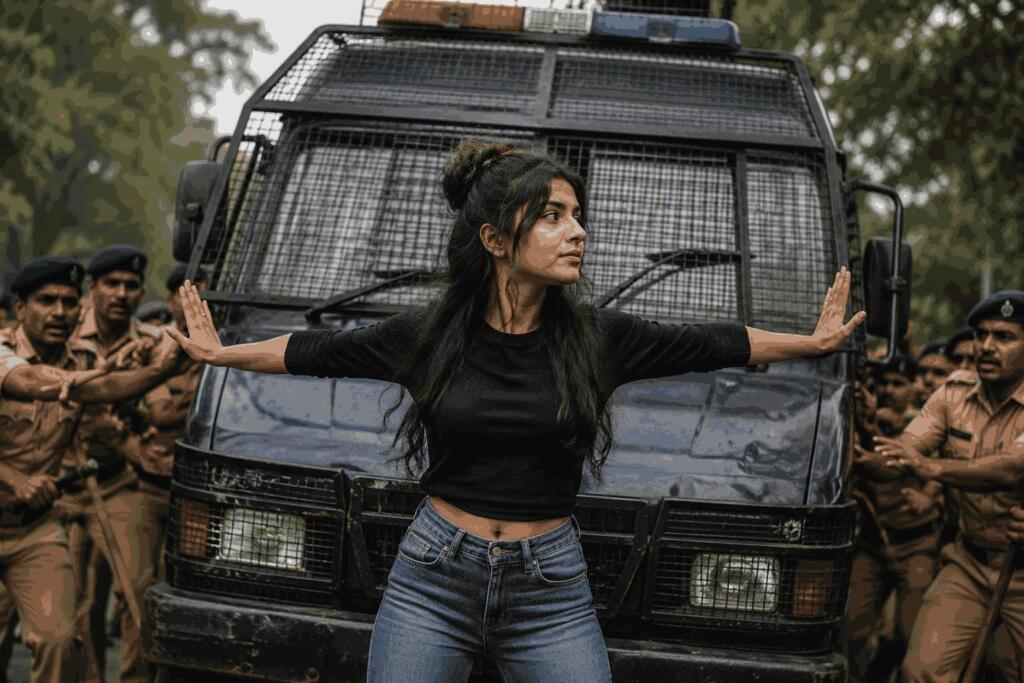
Social media personality Rhiya Ahir has found herself at the center of a nationwide discussion after a photograph of her standing in front of a police vehicle during a protest went viral across multiple platforms. While many users initially viewed the image as a symbol of defiance, renewed attention has shifted toward her online presence and subscription-based digital content, triggering a fresh debate over activism, public perception, and the influence of social media.
The viral image quickly spread beyond the original protest, generating millions of views and countless reactions online. For many internet users, the photograph became an emblem of courage during a tense confrontation with law enforcement. However, as her identity became widely known, discussions expanded beyond the protest itself, with several online communities examining her social media profiles and digital activities.
According to publicly available information, Rhiya Ahir maintains an active presence across various social media platforms, where she shares lifestyle content alongside material offered through an exclusive subscription service. Reports indicate that the subscription platform contains premium content available only to paying members, a fact that rapidly became a subject of discussion after the protest image gained widespread attention.
The developments have reignited broader conversations about the intersection of online influence and political activism. Supporters argue that an individual’s profession or method of earning income should not diminish the significance of their participation in public demonstrations. Others contend that viral personalities inevitably face heightened public scrutiny once they become prominent figures in news cycles.
As debates intensified, Rhiya Ahir reportedly addressed the attention surrounding the viral photograph, describing the moment as emotionally overwhelming. In media interactions, she said she was frightened during the confrontation but reacted instinctively while witnessing police action against protesters. Those remarks resonated with many social media users who viewed the incident through the lens of spontaneous human emotion rather than calculated publicity.
Digital culture experts note that the episode illustrates how rapidly internet narratives can evolve. A single photograph can transform an unknown individual into a nationally recognized figure within hours, while online audiences often begin investigating every aspect of that person’s public life. This phenomenon has become increasingly common in the age of viral content, where personal histories and professional choices are frequently examined alongside the events that first brought someone into the spotlight.
The discussion surrounding Rhiya Ahir has also highlighted the growing role of subscription-based creator platforms. Such services have become a mainstream source of income for many digital creators, enabling them to monetize exclusive content directly through their audiences. While these platforms continue to expand globally, public reactions often differ depending on the nature of the content and the circumstances under which a creator attracts widespread attention.
Meanwhile, commentators have emphasized that the broader protest should not be overshadowed by debates focused solely on one individual. The demonstrations themselves were driven by larger political and social concerns, and many participants insist that public attention should remain focused on the issues that prompted people to gather in the first place rather than on the personal backgrounds of individual protesters.
For Rhiya Ahir, the unexpected spotlight has dramatically altered her public profile. What began as a fleeting moment captured on camera has evolved into an ongoing national conversation about activism, internet fame, and digital identity. The episode also reflects the increasingly blurred boundaries between online personalities and real-world events, where viral visibility can rapidly reshape both reputation and public discourse.
Media analysts believe such incidents demonstrate how modern news cycles operate in tandem with social media algorithms. Once a video or photograph gains traction, secondary narratives often emerge, drawing attention to aspects of an individual’s life that were previously unknown. Whether this level of scrutiny is justified remains a matter of public debate, but there is little doubt that digital platforms have fundamentally changed the relationship between personal identity and public attention.
As conversations continue online, Rhiya Ahir remains one of the most talked-about personalities associated with the viral protest image. While opinions remain divided, the incident has once again underscored how a single moment can reshape an individual’s public image almost overnight. It has also prompted wider reflection on the responsibilities of social media users, news organizations, and audiences when discussing people who unexpectedly become the focus of national attention.