
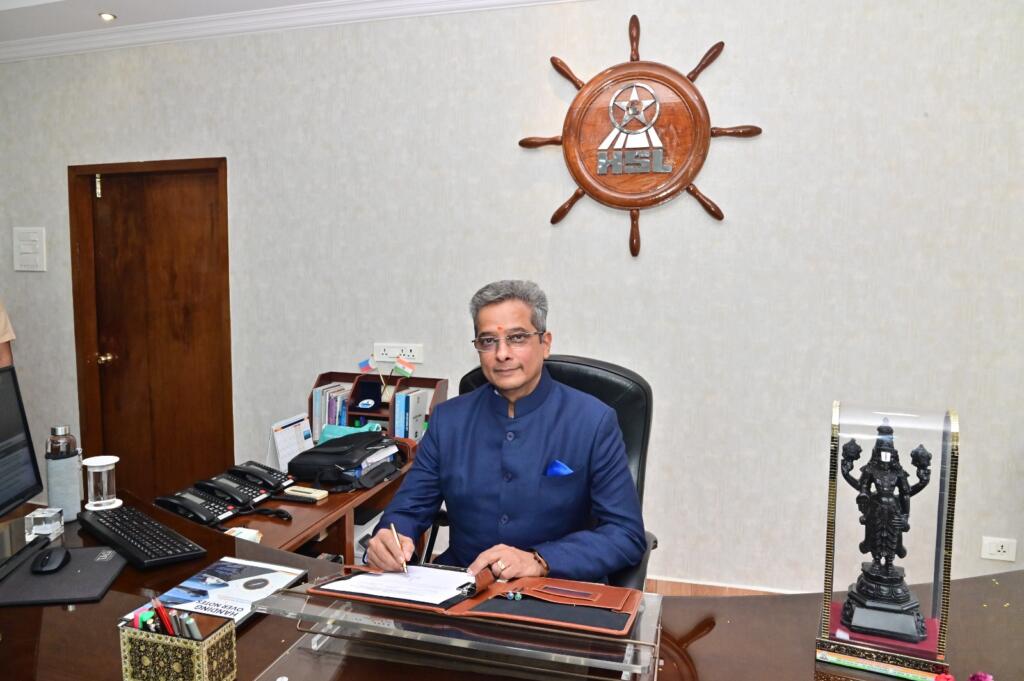
Rear Admiral Chandrasekharan Raghuram, VSM (Retd.), took charge as Chairman and Managing Director of Hindustan Shipyard Limited (HSL) on July 2, stepping into an organisation that has spent recent years rebuilding its finances and expanding its strategic footprint in Indian defence manufacturing.
The appointment places at HSL’s helm an officer whose entire career has centred on sustaining and modernising naval hardware. Commissioned in November 1989, Rear Admiral Raghuram spent more than three and a half decades in uniform, working across naval engineering, ship maintenance, and strategic planning before rising through operational and command postings, a career recognised with the Vishisht Seva Medal in 2017.
His academic training spans the Naval College of Engineering, Lonavala, Cranfield University in the United Kingdom, the Naval War College, and the National Defence College. This grounding translated into practical experience in equipment life-cycle support, warship design, combat system integration, and research and development.
He served afloat on INS Gomati and INS Trishul — joining the latter’s commissioning crew — and subsequently held postings at the Naval Dockyard, the Afloat Support Team for Talwar-class ships, and the Weapons and Electronics System Engineering Establishment (WESEE), all closely tied to keeping frontline warships combat-ready through their service lives.
Command and senior leadership roles followed, including Commanding Officer of INS Valsura, Principal Director Electrical Engineering at Integrated Headquarters (Navy), Command Electrical Officer at Eastern Naval Command, and Chief Staff Officer (Technical) at Western Naval Command, in addition to senior charges at Naval Dockyard, Mumbai, and Naval Headquarters. He comes to HSL directly from the post of Assistant Chief of Materiel, where he was responsible for the maintenance of key naval platforms.
At HSL, his brief is to consolidate the shipyard’s standing as a strategic defence enterprise and advance India’s self-reliance goals in maritime defence manufacturing. He takes over from Captain Ganti Venkateswarlu, Director (Shipbuilding) at HSL, who had been holding additional charge of the CMD post following the Public Enterprises Selection Board’s recommendation of Rear Admiral Raghuram’s name earlier this year and subsequent clearance from the Appointments Committee of the Cabinet.
Inside the shipyard he inherits
Raghuram is not walking into a blank slate. Founded in 1941 as the Scindia Shipyard and brought under government control in 1952, HSL carries the distinction of being India’s oldest shipyard, second only to Cochin Shipyard in scale, and equipped with a covered building dock rated for vessels up to 80,000 deadweight tonnage. It functions as a Mini Ratna Category-I Central Public Sector Enterprise, a tier reserved for state-run firms that have earned wider financial and operational freedom through demonstrated performance.
The yard’s reputation, however, rests less on scale than on a narrower, harder-to-replicate skill: submarines. HSL has spent years accumulating that expertise through prolonged refits of the Navy’s Kilo-class boats — INS Sindhukirti, INS Vela, and INS Vagli among them — plus the retrofit of INS Sindhuvir before it was handed over to Myanmar. Work on Sindhukirti’s medium refit and modernisation is still underway.
Beyond the current programme, HSL has been exploring submarine-refit and export tie-ups with Vietnam, Myanmar, and the Philippines, part of an evident push to turn the yard into a regional service hub for undersea platforms, and it is separately gearing up for a bigger share of submarine construction work alongside Mazagon Dock Shipbuilders Limited to build out India’s domestic submarine base.
There is more on the order book than submarines alone. A near-₹19,000-crore Fleet Support Ship contract for the Navy ranks among the largest shipbuilding deals awarded domestically, and HSL has already delivered Diving Support Vessels built with a high proportion of local content, along with INS Dhruv, India’s first Ocean Surveillance Ship.
A February agreement with Garden Reach Shipbuilders & Engineers (GRSE) commits the two yards to a joint national shipbuilding programme, while infrastructure work — a slipway extension and a 300-tonne Goliath crane due by May 2026 – is meant to lift the yard’s heavy-lift capacity. A separate conversation with the Andhra Pradesh government, over land for a proposed greenfield facility to build large commercial tankers and gas carriers, points to ambitions that go beyond naval work altogether.
None of this changes the fact that HSL was, until fairly recently, a loss-making enterprise. That it now records a profit — ₹118.82 crore after tax in FY 2023-24, its highest production value to date — is the backdrop against which Raghuram’s tenure begins: a shipyard with genuine financial headroom for the first time in years, and a full pipeline of strategically sensitive work to show for it.