
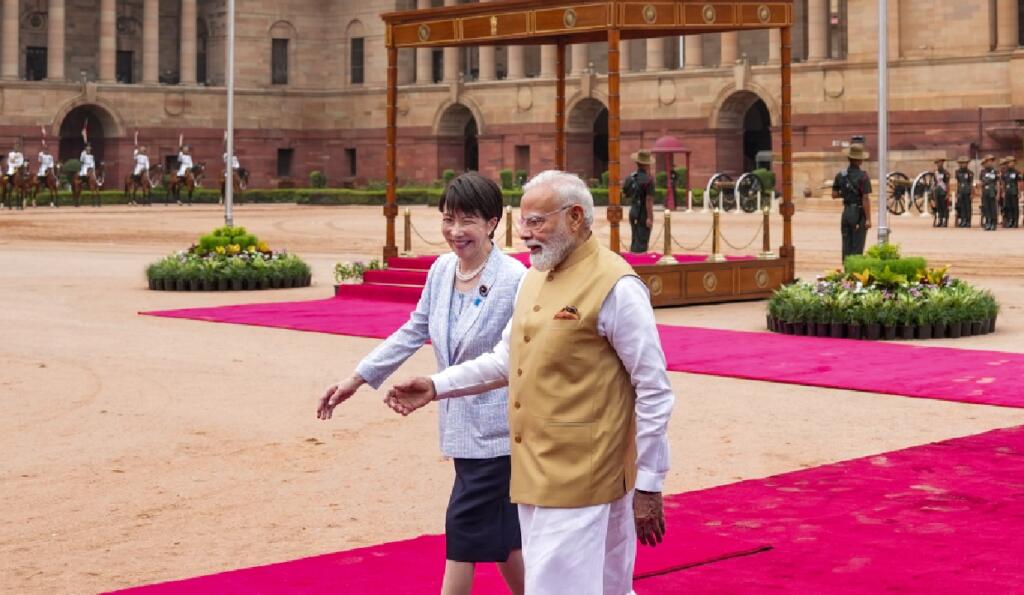
Prime Minister Narendra Modi and Japanese Prime Minister Sanae Takaichi on Thursday unveiled the next phase of the India-Japan partnership, with the 16th India-Japan Annual Summit in New Delhi firmly centred on economic security, advanced technology, defence cooperation and a shared commitment to preserving a free, open and stable Indo-Pacific.
Welcoming Takaichi on her first official visit to India, Modi said he was “delighted” to host the Japanese Prime Minister and expressed confidence that the summit would further deepen the India-Japan Special Strategic and Global Partnership. He affirmed that the two democracies would continue working together to advance peace, stability and prosperity across the Indo-Pacific and beyond.
The summit reflected a broader strategic reality. As geopolitical competition intensifies and global supply chains undergo significant realignment, New Delhi and Tokyo are steadily transforming their relationship from a robust economic partnership into one anchored in strategic convergence, trusted technology partnerships and long-term security cooperation.
Economic security emerges as the defining agenda
Economic security dominated the discussions as both leaders explored ways to strengthen cooperation in sectors that have become central to national resilience and future growth.
The two sides focused on expanding collaboration in semiconductors, artificial intelligence, critical minerals, pharmaceuticals and other emerging technologies. Following the summit, India and Japan were expected to unveil a joint declaration on economic security cooperation alongside a separate joint statement dedicated to cooperation in artificial intelligence.
External Affairs Ministry spokesperson Randhir Jaiswal described the summit as taking forward “a partnership anchored in trust, shared values and strategic convergence”, underscoring the strategic direction both countries intend to pursue.
The agenda also reflected growing concerns over disruptions to global supply chains and increasing economic vulnerabilities, prompting both governments to prioritise trusted partnerships in critical sectors.
Japanese investment receives a major push
Alongside the strategic dialogue, economic cooperation gathered fresh momentum through the Japan-India Economic Forum, which brought together representatives from more than 150 Japanese companies and business organisations seeking to expand their presence in India’s rapidly growing economy.
Japanese Deputy Chief Cabinet Secretary Masanao Ozaki said around 120 cooperation agreements are expected to facilitate investments worth nearly 2 trillion yen, equivalent to approximately 12.5 billion US dollars. The proposed collaborations span semiconductor materials manufacturing, artificial intelligence, renewable energy, biogas production and digital innovation.
These investments form part of the broader commitment announced last year to mobilise 10 trillion yen in private Japanese investment into India over the next decade, reinforcing Tokyo’s long-term confidence in India’s economic trajectory.
Before departing Tokyo, Takaichi had underlined the importance of combining government initiatives with private sector participation to broaden bilateral cooperation and build a stronger economic partnership.
Speaking at NDTV’s Indo-Japan Strategic Dialogue, Union Commerce and Industry Minister Piyush Goyal said Japan’s engagement with India has increasingly focused on investment-led growth. Referring to one of the partnership’s flagship infrastructure projects, he remarked that the Mumbai-Ahmedabad bullet train project was “back on track”, signalling renewed momentum in bilateral infrastructure cooperation.
Goyal also said the proposed India-United States bilateral trade agreement was “99 per cent done”, describing it as a fair and equitable arrangement while noting that only the final issues remained to be resolved. On reports surrounding the United States renaming its Indo-Pacific Command, he said excessive interpretations were unnecessary, stressing that India, Japan and the United States remained committed to a free and open Indo-Pacific.
Defence and the Indo-Pacific take centre stage
Strategic and security cooperation featured prominently throughout the summit as both countries reaffirmed their commitment to maintaining a Free and Open Indo-Pacific and strengthening coordination under the Quad framework.
According to details emerging from the proposed joint statement, India and Japan intend to deepen maritime security cooperation, enhance energy security, strengthen collaboration on critical minerals and support greater participation of small and medium-sized enterprises in the Indian market.
The two governments also plan to encourage cooperation on bringing JR East’s next-generation E10 Shinkansen technology to India while promoting innovation in artificial intelligence and advanced technologies. The draft framework further envisages convening the next India-Japan Foreign and Defence Ministerial, or 2+2, meeting before the end of the year.
The proposed declaration also reflects concerns over non-market policies, economic coercion and recent restrictions on rare earth exports, highlighting the importance of resilient and diversified supply chains.
A partnership with growing strategic weight
Takaichi, who arrived in New Delhi on Wednesday evening and received a ceremonial welcome at Rashtrapati Bhavan before holding summit talks with Modi, described the visit as an opportunity to deepen strategic cooperation in response to a rapidly evolving international environment. She said India and Japan share the responsibility of maintaining peace and stability across the Indo-Pacific and reiterated her commitment to strengthening the Special Strategic and Global Partnership through closer cooperation in economic security, investment, innovation and regional stability.
India and Japan elevated their relationship to a Special Strategic and Global Partnership in 2014 and have since expanded cooperation across defence, infrastructure, trade, digital technologies, clean energy, mobility, healthcare and people-to-people exchanges. As the two nations prepare to mark 75 years of diplomatic relations in 2027, the bilateral framework now encompasses more than 70 dialogue mechanisms, making it one of the most comprehensive strategic relationships in the Indo-Pacific.
Far more than a ceremonial summit, the Modi-Takaichi meeting underscored a decisive shift in India-Japan ties. At a time when technology, supply chains and economic resilience have become integral to national security, New Delhi and Tokyo are positioning themselves as indispensable strategic partners committed to shaping a stable, rules-based and prosperous Indo-Pacific.