
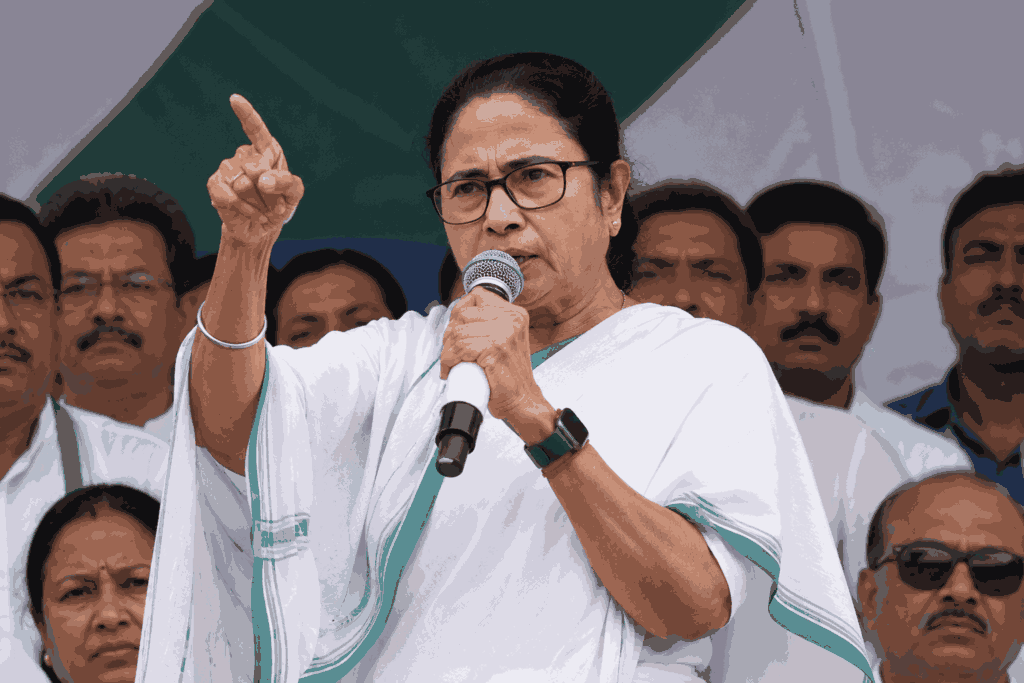
Mamata Banerjee has delivered one of her strongest political messages in recent months, making it clear that leaders who deserted the Trinamool Congress (TMC) should not expect an easy return. Addressing party workers during the annual Martyrs’ Day program in Kolkata, she declared that she would rather associate with the satirical “Cockroach Janta Party” protests than welcome back those she described as political turncoats. The remarks immediately sparked debate across West Bengal’s political landscape and underscored her determination to tighten discipline within the party.
The statement comes at a time when political realignments continue to dominate discussions following the Assembly election. Several former TMC leaders who had distanced themselves from the party have been the subject of speculation over a possible return. However, the latest comments leave little room for ambiguity. By publicly shutting the door on defectors, the TMC chief sought to reassure loyal party workers that commitment and consistency would be valued above political convenience.
In her address, Mamata Banerjee also called upon members of the INDIA bloc to remain united against the BJP. Stressing that opposition parties should focus on their common political objectives rather than internal disagreements, she argued that cooperation would be crucial in future electoral battles. Her appeal reflected an effort to balance regional political priorities with broader opposition coordination at the national level.
The sharp rejection of rebels carries significant political symbolism. Party defections have often shaped electoral fortunes in West Bengal, with leaders crossing political lines before major elections. By refusing to entertain the possibility of reconciliation, Mamata Banerjee appears to be signaling that rebuilding the organization will depend on strengthening committed grassroots workers instead of relying on returning defectors. Political observers believe the message is intended to reinforce discipline and prevent uncertainty within the party ranks.
Her remarks also highlighted the emotional dimension of political loyalty. Speaking before thousands of supporters, Mamata Banerjee suggested that those who had left during challenging periods had forfeited the trust of the organization. Such statements resonate strongly with party cadres who remained with the TMC through electoral setbacks and organizational challenges. The emphasis on loyalty over expediency is likely to become an important theme in the party’s future political strategy.
Predictably, opposition parties dismissed the speech as political posturing, arguing that the TMC leadership was attempting to project organizational confidence despite recent challenges. Supporters of the Trinamool Congress, on the other hand, viewed the declaration as evidence of decisive leadership. For them, Mamata Banerjee was sending a clear message that ideological commitment and dedication to the party would outweigh short-term political calculations.
The comments regarding the “Cockroach Janta Party” protests also attracted widespread attention because of their unusual political imagery. While the reference generated headlines and social media discussion, the larger political takeaway remained her categorical refusal to rehabilitate dissidents. Analysts noted that such emphatic messaging is often designed to energize the party base while discouraging speculation over negotiations with former leaders. (
As West Bengal’s political environment continues to evolve, Mamata Banerjee has chosen to adopt an uncompromising stance on party discipline. Whether this approach strengthens internal cohesion or limits future political flexibility will become clearer over time. For now, the speech has reaffirmed her willingness to prioritize organizational loyalty over political reconciliation, ensuring that her remarks remain at the center of political discussion well beyond the Martyrs’ Day event.