
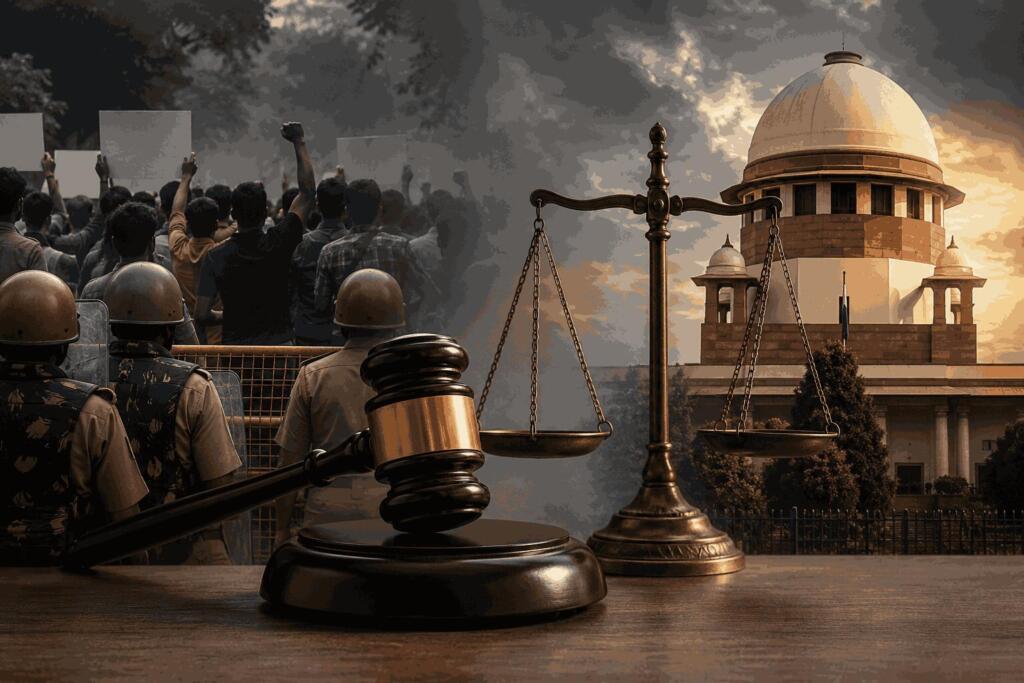
The debate surrounding the withdrawal of FIRs registered during the recent Cockroach Janta Party (CJP) protests has intensified after questions emerged over whether the Central Government can legally halt criminal proceedings involving allegations of violence. While political negotiations may lead to assurances for peaceful demonstrators, India’s criminal justice framework makes it clear that cases involving cognizable offences cannot simply be wiped away through executive promises. Legal experts argue that once an investigation is set in motion, the law—not politics—takes precedence.
The controversy follows claims by sections of the CJP that the Centre had promised to withdraw criminal cases against protesters. Government sources, however, have maintained that any assurance was intended only for peaceful participants and never extended to those accused of violence, vandalism, or attacks on law enforcement personnel. Officials insist that criminal acts affecting public order cannot be overlooked merely because they occurred during a political agitation.
Legal scholars point out that under the Code of Criminal Procedure and established judicial principles, criminal offences are treated as wrongs committed against society rather than against an individual complainant alone. Consequently, once police register a case involving serious offences, the executive branch has limited authority to terminate the investigation unilaterally. Courts ultimately retain the power to supervise the process and determine whether proceedings should continue.
This distinction has become central to the ongoing public debate. While governments may exercise discretion in recommending withdrawal of certain prosecutions under specific legal provisions, such decisions are subject to judicial scrutiny. They cannot automatically extinguish FIRs involving allegations of assault on public servants, destruction of public property, or other grave offences merely because political negotiations have taken place.
The Supreme Court has also drawn a careful balance between safeguarding constitutional freedoms and ensuring accountability. During recent hearings, the apex court reiterated that the right to peaceful protest is constitutionally protected. At the same time, it observed that allegations of violence require proper investigation. Interim relief from coercive action was extended to protesters without criminal antecedents, while individuals accused of violent conduct were not granted blanket immunity.
The Court’s observations indicate that democratic dissent and criminal conduct must be assessed separately. Peaceful assemblies deserve constitutional protection, but allegations of arson, attacks on police personnel, or organised violence cannot be dismissed solely because they arose in the context of a protest movement. As a result, FIRs connected with such allegations remain subject to the normal course of criminal investigation unless a competent court directs otherwise.
Government sources have similarly clarified that no commitment was ever made to shield persons accused of violent offences. According to officials, any decision regarding withdrawal would apply only to genuine peaceful protesters and not to those facing allegations involving public violence or criminal misconduct. This clarification has become a focal point in the continuing political dispute over the scope of the government’s assurances.
Legal commentators further note that police authorities are obligated to investigate cognizable offences once FIRs have been registered. Investigating agencies cannot simply abandon such cases because of political agreements unless the law specifically permits it and the judiciary approves. This principle is designed to preserve the independence of the criminal justice system and prevent arbitrary interference in investigations.
The broader constitutional issue extends beyond the present controversy. If governments could routinely erase FIRs involving allegations of violence through executive decisions, critics argue it could weaken the rule of law and create unequal standards in criminal enforcement. Judicial oversight therefore acts as a safeguard, ensuring that decisions affecting prosecutions are based on legal merit rather than political expediency.
At the same time, civil liberties advocates continue to emphasise that peaceful protesters should not face unnecessary harassment or excessive police action. The Supreme Court’s recent directions reflect this balance by protecting those without criminal backgrounds while permitting investigations into allegations of violence to proceed independently.
As the legal battle unfolds, the fate of the disputed FIRs is likely to depend less on political statements and more on judicial interpretation of statutory powers. The controversy serves as a reminder that while governments may negotiate with protesters and announce policy decisions, criminal investigations into serious offences remain governed by constitutional safeguards, statutory procedures, and ultimately, the authority of the courts.