
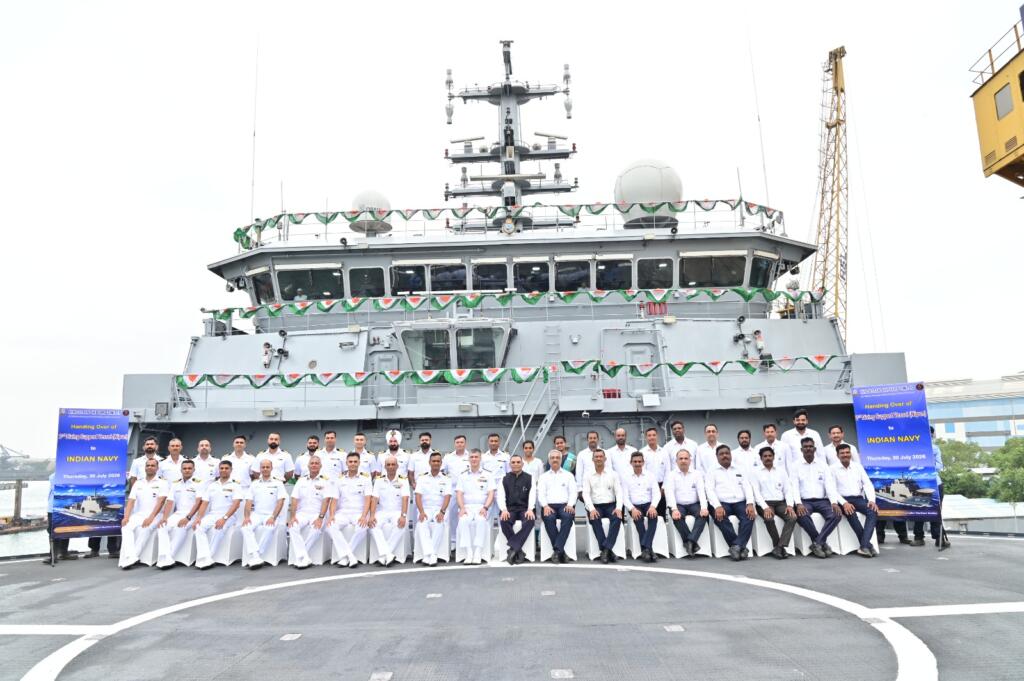
On July 30, the Indian Navy took delivery of Nipun, the second Diving Support Vessel (DSV) built by Hindustan Shipyard Limited (HSL), a Miniratna Category-I Defence Public Sector Undertaking (DPSU). The induction may not have generated the kind of headlines reserved for fighter jets or missile announcements, but overlooking it would be a mistake. It represents one of the most significant milestones in India’s recent defence-indigenisation journey. Its importance lies not only in the capability it brings but also in the fact that, despite receiving little public attention, the project was delivered on schedule. The vessel has been designed and built in accordance with the Classification Rules of the Indian Register of Shipping (IRS).
A Name Worth Noting
‘Nipun’ derives from Sanskrit, meaning one who is adept, capable, and well versed in a particular discipline. The ship lives up to that name, having been built as a highly specialised platform for Deep Sea Dive Operations and Rescue Operations at Sea.
A Second Ship Changes the Story
A single indigenous platform can always be dismissed as a demonstration project — a one-off proof of concept that may or may not be repeatable. Nipun’s delivery, arriving just a year after INS Nistar’s handover, changes that calculus. Two complex, technologically dense vessels delivered roughly a year apart suggests HSL has internalised the process rather than simply completed a single difficult build. That distinction between a capability and a curiosity is the real headline here.
The Substance Behind the Buzzwords
Nipun’s stated capabilities – Dynamic Positioning, Saturation Diving, Submarine Rescue, and Deep-sea Intervention — read like a checklist, but each represents a genuine engineering achievement that only a small number of navies worldwide have integrated onto a single, indigenously built hull. The ship is equipped with state-of-the-art Dive Equipment capable of Deep Sea Saturation Diving, complete with a Side Diving Stage for diving operations, while its Remotely Operated Vehicles support Diver Monitoring and Deep Sea Salvage Operations. It also stands ready to serve as the ‘Mother Ship’ for the Deep Submergence Rescue Vessel (DSRV), enabling personnel evacuation during a submarine emergency. Before INS Nistar, India’s ability to conduct submarine rescue independently was limited. That gap is now closing with a second ship, not merely a symbolic first one.
The Quieter Economics
Public conversation around Aatmanirbhar Bharat in defence tends to fixate on marquee platforms and their import-substitution value. The DSV programme’s more durable contribution may lie in its stated 80-plus percent indigenous content and the roughly 120 Micro, Small and Medium Enterprises reportedly involved across its supply chain. Getting dozens of smaller manufacturers to meet naval-grade certification standards is arguably harder and more economically consequential than assembling a single ship at a single yard. Whether that vendor ecosystem persists and finds work beyond this one programme is the real test of whether Aatmanirbhar Bharat is building lasting capacity or a one-time contract windfall.
HSL’s Bet on Complexity
There is also a case to be made about HSL itself. As a Miniratna DPSU with a shipbuilding history stretching back more than eight decades, HSL has historically been associated with less complex repair and construction work. The DSV programme — delivered twice, on a near-annual cadence — represents a deliberate move up the complexity curve into safety-critical, technologically dense platforms once the preserve of specialised foreign yards. Consistency, not just capability, is what should reassure defence planners considering HSL for future high-value contracts.
A Caveat Worth Keeping in Mind
The framing of Nipun as a step toward India becoming a “Preferred Submarine Rescue Partner” deserves scrutiny, not just repetition. Submarine rescue diplomacy depends on sustained readiness, trained crews, and interoperability exercises — not ship deliveries alone. Today’s handover is a necessary step toward that ambition, not its fulfilment. But it is, notably, a step delivered on time.
None of this makes for a dramatic news cycle. Quiet, repeatable capability-building of this kind may be the better indicator of where India’s defence-industrial base is actually headed.