
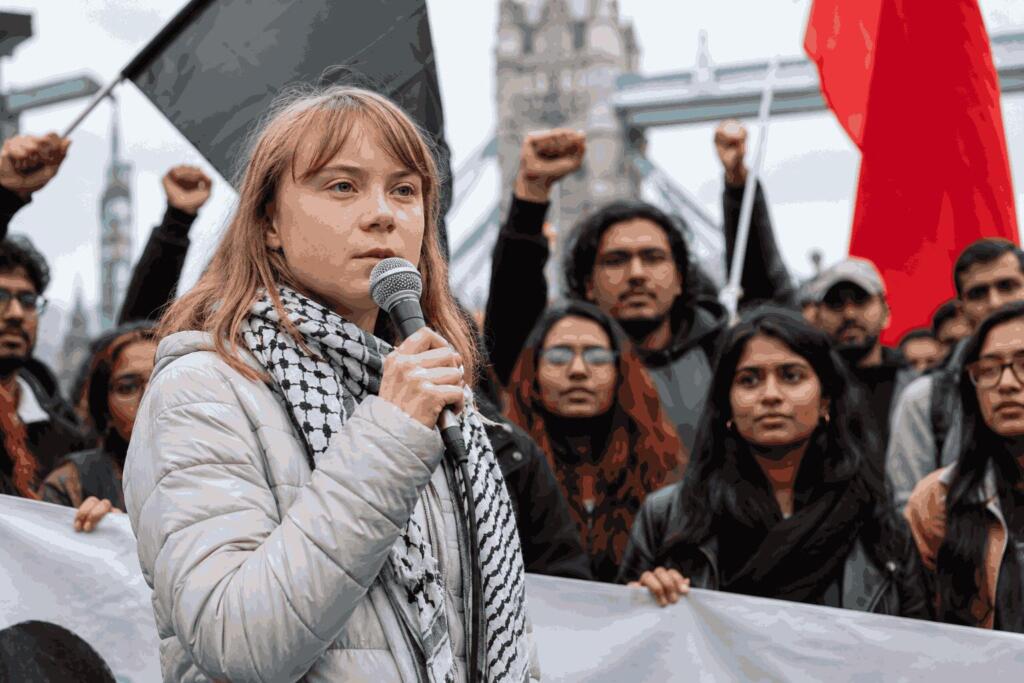
The participation of Greta Thunberg at an SFI-UK programme that expressed solidarity with the ongoing CJP protest has triggered sharp political reactions, drawing attention to the growing international dimension of the demonstrations. The event, held in London, featured speeches and slogans supporting the protest movement, with Thunberg’s appearance adding global visibility to a controversy that has already generated intense debate in India.
The programme was organised by the United Kingdom unit of the Students’ Federation of India (SFI-UK) during a public gathering commemorating “Victory Day.” According to videos and statements released by the organisers, several activists addressed the audience on issues they described as social justice, democracy, and international solidarity. Footage from the event showed the Swedish climate campaigner participating alongside organisers and attendees.
Greta Thunberg has increasingly broadened her activism beyond environmental issues in recent years, often taking positions on international political and humanitarian causes. While she first gained worldwide recognition for launching the Fridays for Future climate movement, her public engagements have gradually expanded to include demonstrations concerning conflicts, human rights, and civil liberties. Supporters argue that this reflects a broader understanding of global justice, while critics contend that such interventions risk drawing environmental activism into contentious political disputes.
The London gathering quickly became a talking point on Indian social media, where clips from the event were widely circulated. Political commentators questioned the implications of international personalities lending support to protests connected with domestic political controversies. Others argued that global activists frequently participate in causes they believe have international significance and that such appearances are not unusual in today’s interconnected activist networks.
For many observers, Greta Thunberg‘s appearance illustrates how domestic political movements can rapidly acquire international attention through digital platforms and activist collaborations. Within hours of the event, hashtags related to both the protest and the Swedish activist began trending across multiple social media platforms, with users expressing sharply divided opinions. While supporters welcomed what they viewed as international solidarity, opponents accused foreign activists of intervening in India’s internal affairs.
The controversy has also reignited discussions about the evolving role of global campaigners. Greta Thunberg has previously participated in demonstrations concerning climate policy, fossil fuel financing, and humanitarian issues, making her one of the world’s most recognisable activist figures. Her supporters believe such involvement reflects consistency in standing with causes she considers important, whereas critics argue that high-profile endorsements inevitably influence political narratives beyond environmental advocacy.
Political analysts note that international endorsements often amplify public attention rather than fundamentally alter the course of domestic movements. Nevertheless, the presence of globally recognised personalities can reshape media coverage and broaden international awareness of ongoing protests. The London event has therefore become significant not merely because of its organisers but because of the worldwide attention generated after Greta Thunberg‘s participation became public.
The incident also underscores how activism today increasingly transcends national boundaries. Social media enables events held in one country to become subjects of debate across continents within minutes. As a result, organisations seeking to highlight particular causes often invite internationally recognised campaigners whose presence can attract extensive media coverage. In this case, Greta Thunberg‘s participation ensured that the London programme received attention far beyond its immediate audience.
Meanwhile, reactions in India continue to remain divided. Supporters of the protest have described the event as evidence of growing international awareness, while critics maintain that foreign endorsements neither determine the legitimacy of domestic political movements nor influence democratic processes. With the debate continuing online and across political circles, Greta Thunberg‘s appearance at the SFI-UK event has once again demonstrated how globally recognised activists can become focal points in discussions extending well beyond their original areas of advocacy.