
India has entered a decisive phase in its military modernisation with Chief of the Army Staff General Dhiraj Seth unveiling the ‘VIJAY’ doctrine, a comprehensive roadmap that seeks to transform the Indian Army into a technologically superior, future-ready force equipped to confront the complex security challenges of the coming decades. Introduced a day after he assumed office as the 31st Chief of the Army Staff, the doctrine reflects a strategic shift towards integrated warfare, indigenous capability and institutional transformation at a time when the global battlefield is being reshaped by emerging technologies and multidomain threats.
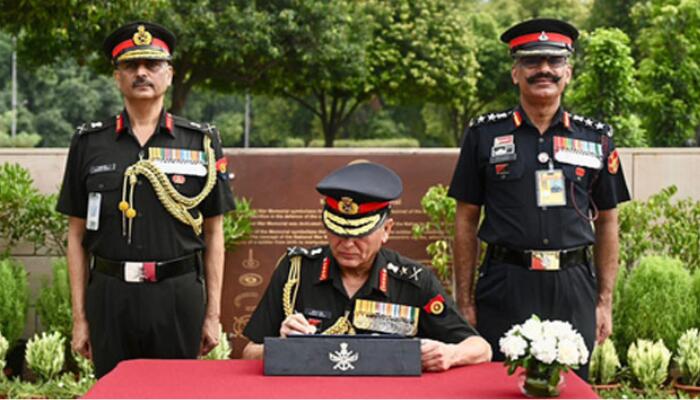
General Seth commenced his first official engagements by laying a wreath at the National War Memorial, paying tribute to soldiers who made the supreme sacrifice in service of the nation. He later reviewed a ceremonial Guard of Honour at the South Block Lawns before outlining his vision for the Army’s future. Calling the appointment a moment of “great pride and humility”, he reaffirmed his unwavering commitment to the ideals of Duty, Honour and Nation First, while thanking the Prime Minister and the Defence Minister for the confidence they had placed in him.
A Strategic Framework for the Battlefields of Tomorrow
Describing the Indian Army as a battle-hardened and combat-ready force, General Seth stressed that the changing nature of warfare demands a faster pace of modernisation. Conventional military superiority alone, he indicated, will no longer suffice in an era increasingly defined by technological disruption, hybrid conflict and multidomain operations.
It is against this backdrop that the ‘VIJAY’ framework has been introduced.
The first pillar, Vigilance, commits the Army to maintaining the highest standards of operational preparedness and constant alertness along India’s frontiers. General Seth emphasised that safeguarding national security requires the ability to respond swiftly and decisively to any emerging threat.
The second pillar, Innovation and Transformation, seeks to institutionalise technological advancement within the Army’s doctrine, capability development and operational planning. Modernisation, he said, must become a continuous process to ensure that the force remains ahead of the rapidly evolving character of warfare.
Jointness, Self-Reliance and National Security
The doctrine’s third pillar, Jointness and Integration, advocates deeper operational synergy among the Army, Navy and Air Force while extending collaboration beyond the armed forces through a Whole-of-Nation approach. General Seth argued that stronger military-civil integration will strengthen national security and contribute meaningfully to the larger national aspiration of Viksit Bharat 2047.
Equally significant is the emphasis on Atmanirbharta, which places indigenous defence capability at the centre of military preparedness. Reiterating the objective of “Winning Our Wars with Indigenous Solutions,” the Army Chief underscored the importance of expanding the use of homegrown technologies and strengthening India’s domestic defence manufacturing ecosystem.
Putting the Soldier at the Heart of Reform
The final pillar, Yodha First, recognises the soldier as the Army’s greatest strategic asset. General Seth affirmed that every member of the force, from Agniveers to veterans, would remain central to the institution’s priorities. Enhancing professional training, technological competence, welfare measures and the empowerment of veterans and Veer Naris, he said, would remain integral to the Army’s future.
General Seth also acknowledged the contributions of his predecessor, General Upendra Dwivedi, and former Chiefs of the Army Staff for shaping the Indian Army into one of the nation’s most trusted institutions.
His appointment also carries historical significance. He becomes the first officer from the Armoured Corps to assume the Army’s highest office since General Shankar Roy Chowdhary retired in 1997. Commissioned into the Armoured Corps in December 1986 after graduating from the National Defence Academy, General Seth has served across operational, strategic and institutional appointments, including commanding both the South Western and Southern Commands during a distinguished military career spanning nearly four decades.
Concluding his address, General Seth affirmed that the principles of jointness, innovation and Atmanirbharta would guide the Indian Army’s transformation in the years ahead. Through the ‘VIJAY’ doctrine, he projected a vision of an Army that is not only prepared for the wars of tomorrow but is also positioned to safeguard India’s sovereignty and strategic interests in an increasingly uncertain global security environment.