
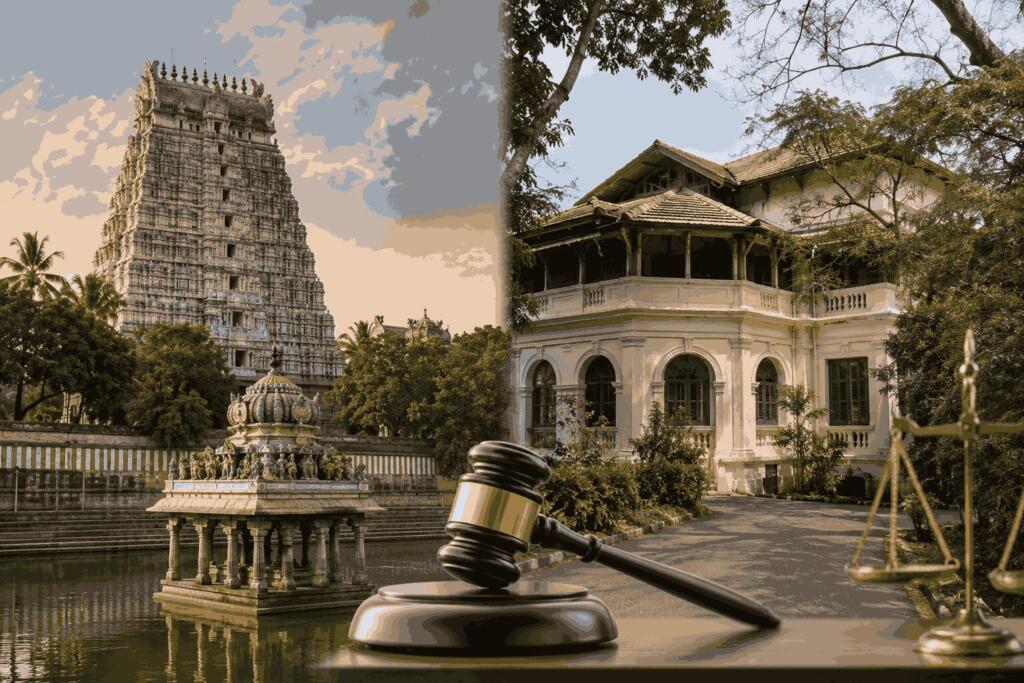
The transfer of the Arunachaleswarar Temple Property in Chennai’s Adyar for the restoration of Dr. Muthulakshmi Reddy’s former residence has sparked a fresh public debate over the management of temple assets in Tamil Nadu. The move, carried out following a Madras High Court order, has drawn both appreciation for preserving the legacy of a pioneering social reformer and criticism from those who argue that temple-owned lands should remain exclusively dedicated to religious purposes.
According to reports, the property belongs to the historic Sri Arunachaleswarar Temple at Tiruvannamalai but had long been leased to institutions associated with Dr. Muthulakshmi Reddy. The bungalow, where the renowned physician, legislator, and founder of the Cancer Institute (WIA) resided for several decades, has reportedly fallen into disrepair. The renovation project aims to restore the building and convert it into a memorial highlighting her life and contributions to healthcare and women’s welfare.
The decision has nevertheless ignited controversy because the Arunachaleswarar Temple Property is regarded by many devotees as part of the religious endowment of one of Tamil Nadu’s most revered Shiva temples. Critics contend that temple lands should primarily serve religious and charitable objectives connected to the institution that owns them. They have questioned whether sufficient safeguards exist to ensure that the ownership and long-term interests of the temple remain protected throughout the restoration project.
Supporters of the initiative present a different perspective. They point out that the Madras High Court permitted the restoration and that the renovation is expected to be financed through a private trust rather than from temple funds. According to those involved, the restored premises will function as a memorial dedicated to Dr. Muthulakshmi Reddy while being maintained by the Cancer Institute. They argue that preserving an important piece of social and medical history can coexist with respecting the property’s legal ownership.
The controversy surrounding the Arunachaleswarar Temple Property has also revived broader discussions about the administration of temple assets under the Hindu Religious and Charitable Endowments (HR&CE) Department. Over the years, temple land management has frequently been the subject of litigation, with courts hearing disputes involving leases, rent revisions, alleged encroachments, and recovery of temple-owned properties. Devotee groups have consistently sought stronger mechanisms to safeguard these assets from misuse or unauthorized occupation. (DT Next)
The Arunachaleswarar Temple at Tiruvannamalai occupies a unique place in India’s spiritual landscape. Dedicated to Lord Shiva and revered as one of the Pancha Bhuta Sthalams representing the element of fire, the temple attracts millions of pilgrims annually during festivals such as Karthigai Deepam. Because of its religious significance and extensive historical endowments, any development involving Arunachaleswarar Temple Property naturally attracts widespread public attention.
Meanwhile, historians have emphasized the extraordinary legacy of Dr. Muthulakshmi Reddy, who became India’s first woman legislator and played a pioneering role in cancer care, women’s education, and social reform. Supporters of the memorial argue that preserving the residence where she lived and worked for decades will help future generations understand her contributions to public life. They maintain that the project represents heritage conservation rather than a transfer of ownership away from the temple. (
Even so, the Arunachaleswarar Temple Property issue has intensified demands for greater transparency in decisions involving temple assets. Legal experts note that clear documentation, public disclosure of lease conditions, and judicial oversight are essential whenever historically significant religious properties are utilized for public purposes. Such measures, they argue, can reduce future disputes while protecting both cultural heritage and public confidence.
Political observers believe the debate is unlikely to subside soon. Temple administration has long remained a sensitive issue in Tamil Nadu, where questions surrounding ownership, heritage preservation, and government oversight frequently generate intense public discussion. The latest development has once again brought these competing priorities into focus, with different sections of society offering sharply contrasting interpretations of the decision.
As restoration work prepares to move forward, the Arunachaleswarar Temple Property controversy is expected to remain under close public scrutiny. For supporters, the project offers an opportunity to preserve the memory of one of India’s foremost medical pioneers. For critics, it highlights the continuing need to ensure that temple assets are managed with transparency, accountability, and due regard for their religious significance. The manner in which authorities balance these concerns may ultimately determine how this debate is remembered in the years ahead.