
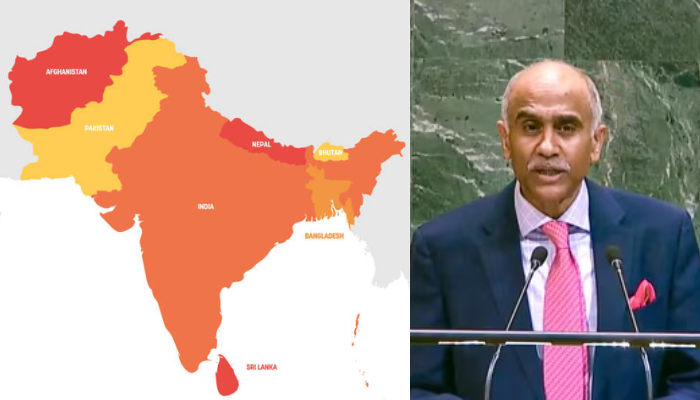
Diplomatic confrontation sharpens over civilian casualties in Afghanistan
India told the Security Council that Pakistan’s actions inside Afghanistan amounted to violations of international humanitarian law, alleging that airstrikes and military operations had directly caused civilian casualties. The Indian envoy stressed that rebranding such operations as legitimate security responses did not erase responsibility for the deaths, particularly when non-combatants were among the victims.
Citing United Nations Assistance Mission in Afghanistan data, India pointed to 372 civilian deaths in the first three months of 2026 alone, noting that a significant proportion of casualties occurred during Ramadan. The statement placed the human cost of continuing cross-border violence at the centre of the debate, underscoring the worsening security environment along the Afghanistan–Pakistan frontier.
India also referenced wider instability in the region, including earlier escalations that led to dozens of deaths and large-scale displacement. According to figures cited in the Council, more than 100,000 people were forced from their homes amid sustained hostilities, reflecting the depth of the humanitarian crisis unfolding on the ground.
‘Massacre cannot be repackaged’: India rejects Pakistan’s framing
In one of its strongest formulations at the UN in recent years, India rejected Pakistan’s description of militant-related operations as “Fitna al Hindustan”, calling it a structured attempt to recast internal security issues as external conspiracies. The Indian envoy said such terminology was part of an “officially sponsored misinformation and disinformation architecture” designed to influence both domestic opinion and international perception.
India further argued that this narrative strategy served a political purpose within Pakistan, enabling its establishment to deflect attention from internal governance and economic challenges. The envoy described it as a “systematic factory of hate”, alleging that externalisation of blame had become a recurring feature of Pakistan’s diplomatic posture.
The Indian statement also pointed to what it called a pattern of accusing neighbouring countries without presenting verifiable evidence, framing it as a long-standing diplomatic tactic rather than an isolated claim.
India contrasts criticism with large-scale humanitarian support to Afghanistan
While sharply criticising Pakistan, India simultaneously outlined its humanitarian engagement in Afghanistan, presenting itself as a consistent development partner despite the security environment. Since 2021, India has supplied 50,000 tonnes of wheat, along with 420 tonnes of medicines and vaccines and 40,000 litres of pesticides to support agricultural recovery.
New Delhi also highlighted emergency assistance, including flood relief supplies and medical consignments delivered to Kabul in April 2026. Beyond immediate aid, India pointed to its broader reconstruction footprint across Afghanistan’s 34 provinces, with more than 500 development projects underway.
These include maternity clinics in Paktika, Paktia and Khost, alongside major medical infrastructure such as upgrades to the Indira Gandhi Institute of Child Health and the establishment of trauma care and oncology facilities. A 30-bed hospital has also been constructed under Indian assistance programmes.
India additionally referenced its people-to-people engagement, including hosting Afghanistan’s cricket team for bilateral series, framing it as part of continued civil society ties despite political uncertainty.
A widening strategic rift at the UN stage
The exchange at the Security Council reflects deepening friction between India and Pakistan over the Afghanistan dossier, with New Delhi positioning itself as a development-focused stakeholder while accusing Islamabad of militarised interference and narrative manipulation. The debate highlights how Afghanistan remains not only a humanitarian concern but also a contested diplomatic battleground where competing regional narratives are being aggressively projected at the global level.