
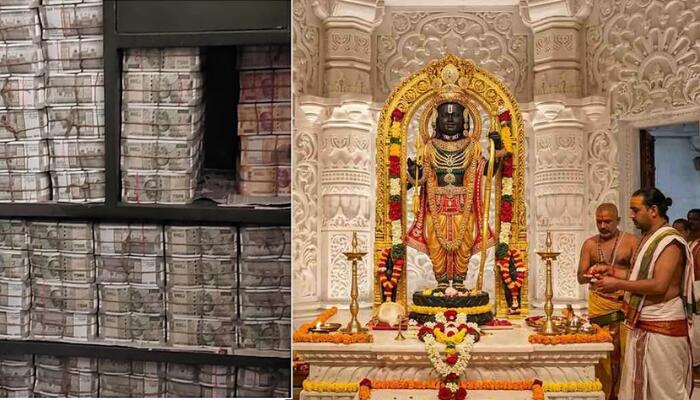
So far, investigators have recovered around ₹2 crore in cash, along with a car and three iPhones from five individuals under suspicion. Authorities are also examining property records, financial transactions, and lifestyle changes of those associated with the temple’s donation handling system.
A tightly controlled donation system under scrutiny
The Ram Mandir receives offerings through 14 designated collection points across the temple complex. These donations are transported to a highly secure internal “confidential room” for counting, the location of which is kept undisclosed due to security protocols. Access remains strictly limited to authorised personnel.
The temple witnesses an estimated 1 to 1.5 lakh devotees every day, with offerings forming a steady and significant inflow of cash and valuables. The counting process operates through multiple layers of verification involving staff, Trust officials, and external auditors.
In total, around 50 individuals were involved in handling and verifying donations. This includes 24 staff members hired through a private agency responsible for counting currency notes, 12 employees of the Shri Ram Janmabhoomi Teerth Kshetra Trust assigned supervisory responsibilities, and 14 officials and auditors from the State Bank of India and TCS tasked with audit and verification duties.
Despite this structured framework, investigators are now examining how alleged lapses occurred within such a tightly regulated system.
Sudden wealth patterns trigger first alarms
According to sources, suspicion first emerged when multiple individuals linked to the donation system were found to have accumulated significant assets over the past five years despite modest declared incomes.
Reports of land acquisitions, expensive vehicles, and visible lifestyle upgrades reportedly triggered internal concern. These discrepancies were initially flagged but did not lead to immediate corrective action within the system.
The matter escalated after a local employee from Ramkot in Ayodhya brought the issue into the public domain. It later gained political traction after reaching Samajwadi Party chief Akhilesh Yadav, turning an internal administrative concern into a high-profile controversy.
Senior intervention and fast-moving SIT probe
Sources indicate that a senior IPS officer was flown from Delhi to Ayodhya on a special aircraft four days ago to assist with the investigation. The officer has since held meetings with officials of the Shri Ram Janmabhoomi Teerth Kshetra Trust and is preparing a detailed report for higher authorities.
Following this, the Uttar Pradesh government constituted a Special Investigation Team (SIT) and directed it to submit its findings within 15 days.
The SIT is headed by Lucknow Divisional Commissioner Vijay Vishwas Pant, with IPS officer Kiran S., a former CBI official, overseeing the investigative component. Special Secretary (Finance) Neelratan is handling financial scrutiny, audit records, and donation-related documentation.
Individuals under scrutiny and alleged asset build-up
Several individuals linked to the donation handling system are now under investigation.
Ramshankar Yadav, also known as Tinnu Yadav, is among the most prominent names under scrutiny. His assets are estimated at around ₹50 crore, including a hostel near Ayodhya airport, stakes in restaurants, residential properties in Ayodhya and Lucknow, and a Toyota Fortuner. Investigators are also examining his earlier modest financial background.
His nephew, Manish Yadav, is also under investigation, with officials reportedly recovering ₹36 lakh in cash during questioning.
K D Tiwari, responsible for handling donated jewellery, is being probed over alleged land purchases worth around ₹1.5 crore. He has denied wrongdoing, stating his role was limited to recording and transferring ornaments to Trust authorities, and attributing his financial position to professional careers in the armed forces, education, and law enforcement.
Other individuals, including Rajesh Pathak and Anukalp Mishra, are being examined for property transactions and changes in financial behaviour. In Mishra’s case, a house purchase worth ₹64–65 lakh and a farmhouse in his ancestral village have come under review.
Lavkush, a former mechanic who later joined the donation handling system, is also under investigation after authorities reportedly recovered around ₹10 lakh from his residence along with evidence of recent construction activity.
Questions over oversight and institutional accountability
As the SIT continues its time-bound probe, the case has raised wider questions over the robustness of internal controls governing temple donations. The scale of alleged discrepancies has intensified scrutiny of how high-value cash flows are monitored within one of India’s most sensitive religious institutions.
Sections of saints in Ayodhya have also raised concerns over the composition of the probe panel, particularly after earlier suggestions to include retired judges were not implemented.
Temple Construction Committee Chairman Nripendra Mishra has distanced himself from the controversy, stating that his responsibilities are limited to construction-related work and not internal financial management of the Trust.
With the investigation moving forward at pace, the SIT’s findings are expected to determine whether the alleged irregularities point to isolated misconduct or a deeper systemic breakdown in the management of temple donations.