
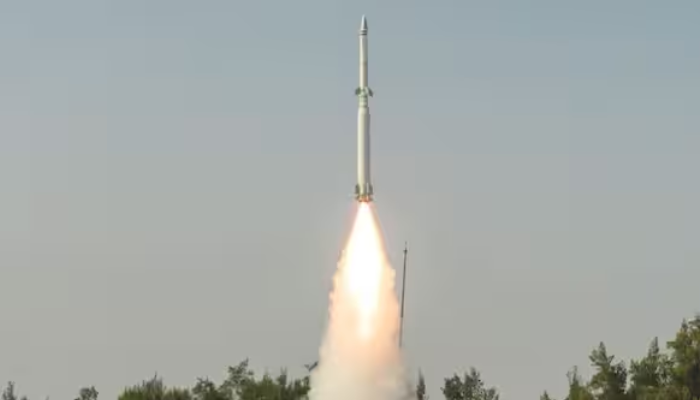
India’s ballistic missile defence programme has reached a defining point. The Defence Research and Development Organisation (DRDO) has developed interceptor systems that can neutralise ballistic missile threats simulating ranges of up to 5,000 kilometres. As a result, India now joins a select group of countries with validated high-end interception capability.
Importantly, the achievement reflects steady progress rather than a single breakthrough. Over time, engineers have built a layered interception architecture. This system combines radar networks, command-and-control systems, and interceptor missiles into one integrated framework.
A layered shield built for complex threats
At its core, the system uses a multi-tier ballistic missile defence design. It engages incoming threats across different phases of flight. In addition, it combines exo-atmospheric and endo-atmospheric interception layers.
This structure increases flexibility. It allows the system to respond at different altitudes depending on the missile trajectory. Therefore, interception does not depend on one defensive point alone.
Instead, multiple engagement windows work together. This improves the chances of neutralisation, even in complex and high-speed attack scenarios. Officials describe it as a networked defensive grid rather than a single system.
Faster response through integration
The system depends heavily on network-centric integration. Radar systems detect and track incoming threats. Then, command nodes process this data and trigger interception decisions.
As a result, the time between detection and response reduces significantly. This matters because ballistic missiles travel at extreme speeds. In such situations, even seconds become critical.
Moreover, the system does not work in isolated parts. Instead, all components operate as a single coordinated loop. This improves precision and reduces delay in engagement.
India joins a restricted global group
With this capability, India now stands among a small group of nations that can intercept long-range ballistic missile threats. The 5,000-kilometre benchmark places this system in the category of intercontinental-level strategic deterrence.
However, the significance goes beyond range alone. It also lies in system reliability. The architecture functions as a complete integrated system under realistic conditions. In such environments, timing and coordination must align precisely.
Consequently, this capability strengthens India’s position in advanced missile defence operations.
A shift in deterrence structure
This development also signals a change in strategic thinking. India is no longer focused only on offensive missile capability. Instead, it is also building a credible defensive shield.
In this way, both layers now work together. This dual structure strengthens overall deterrence. It also adds resilience to national security planning.
As the programme evolves, engineers will refine integration further. They will also aim to improve response speed and expand interception range. Still, this milestone already marks a clear shift. India’s missile defence system has moved into a more advanced and operational phase.