
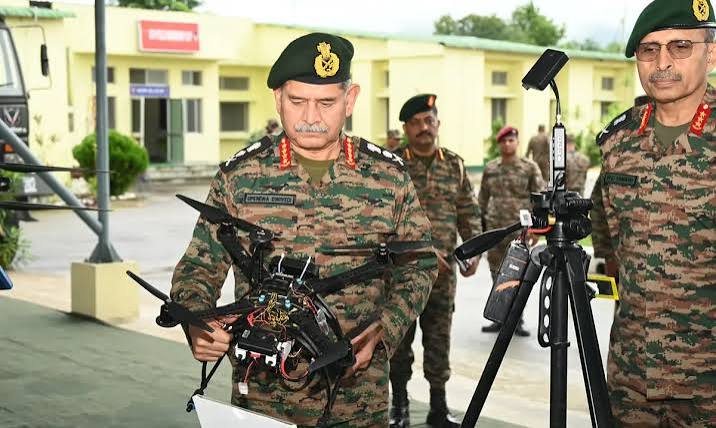
When India’s senior military fraternity began calling General Upendra Dwivedi the “Drone General,” it was not a casual observation. It was an institutional verdict — a recognition that one man had, in the span of a single tenure, fundamentally reoriented how the Indian Army thinks about war.
That verdict deserves to be examined seriously, because what it describes is not merely a procurement story. General Dwivedi did not simply preside over the purchase of drones. He changed the Army’s relationship with technology itself — its comfort with it, its dependence on it, and its willingness to restructure around it.
Consider what existed before. A few hundred drones, scattered across a force of over a million soldiers, used selectively and without the infrastructure to scale. By the time General Dwivedi retires on June 30, 2026, that number has crossed 50,000. More than 25 Drone and Counter-Drone Hubs dot military stations across the country. Precision engagement systems reach distances approaching 500 kilometres. The change is not incremental. It is generational.
What makes this more than a logistics achievement is the doctrine that accompanied it. Nearly 25 policy documents, guidelines, and standard operating procedures were issued during his tenure, covering everything from land warfare to space and red teaming. New formations — Bhairav Battalions, Ashni Platoons, Divyastra Batteries — were created not to absorb new equipment but to fight differently. The Drone General did not add drones to the old army. He began building a new one.
Operation Sindoor gave that new army its first serious test. The integrated use of drones, loitering munitions, electronic warfare and intelligence fusion in a live operational context answered the question that doctrine alone cannot: does it actually work? The answer, by most credible assessments, was yes.
Critics may argue that 50,000 drones mean little if strategic decision-making, joint integration and defence manufacturing ecosystems do not keep pace. That is a fair challenge, and one that General Dwivedi himself appeared aware of — which is why self-reliance, civil-military logistics fusion and military diplomacy all featured as explicit pillars of his agenda rather than afterthoughts.
The “Drone General” title will follow him into retirement. But its real significance lies not in what it says about the man, but in what it demands of those who come after him. A nickname like this sets a standard. The Indian Army has now been publicly defined, at the highest level, as a force in transformation. The question his successors must answer is whether transformation was a chapter in his tenure, or the permanent condition of the institution he left behind.
That answer will determine whether “Drone General” becomes a fond historical footnote or the first entry in a longer list.