
For four years, Pakistan’s political establishment dismissed Imran Khan’s “foreign conspiracy” allegations as political theatre. Washington rejected the claims outright. Pakistan’s military establishment portrayed them as dangerous populists. Opposition parties insisted Khan’s removal followed constitutional procedure.
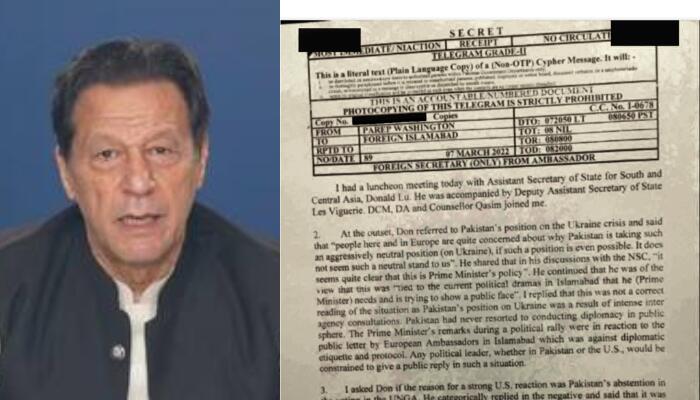
Now, the full text of Pakistan’s classified diplomatic cable I-0678 has resurfaced. The leak is once again shaking Pakistan’s political landscape.
The classified cypher, released by US-based investigative outlet Drop Site, documents a March 7, 2022, meeting between Pakistan’s then ambassador to Washington, Asad Majeed Khan, and senior US State Department official Donald Lu. Weeks later, Imran Khan lost a no-confidence vote and became the first Pakistani prime minister removed through that parliamentary process.
At the centre of the controversy lies one explosive sentence. “If the no-confidence vote against the Prime Minister succeeds, all will be forgiven in Washington.” That remark has now become political dynamite inside Pakistan.
The Cable That Refuses To Disappear
The leaked document suggests the Biden administration strongly opposed Pakistan’s foreign policy direction under Imran Khan. Washington reportedly disliked Khan’s refusal to align fully with Western priorities against Russia and China.
Donald Lu criticised Pakistan’s “aggressively neutral” stance on Ukraine. He also linked Khan’s Moscow visit in February 2022 with worsening ties between Washington and Islamabad.
According to the cable, Lu warned that if Khan survived politically, “It will be tough going ahead”. He also claimed Khan’s “Isolation will become very strong from Europe and the United States”.
Khan’s Moscow visit became a major flashpoint. He travelled to Russia on the very day Moscow launched its invasion of Ukraine. Reports later suggested Washington had urged Islamabad to cancel the trip beforehand.
Pakistan also abstained during key UN votes condemning Russia. That decision further strained ties with the United States.
The cable records Pakistani diplomats defending the visit. They argued officials planned the trip before the invasion and never intended it as support for Russian military action. Asad Majeed Khan reportedly stressed that institutional consultation shaped the decision, not Khan alone.
The document also claims Khan regretted the timing of the Moscow visit once the invasion began.
Afghanistan Deepened The Divide
The leaked cypher reveals broader tensions between Washington and Khan’s government.
After the US withdrawal from Afghanistan, Khan publicly rejected requests for American military bases inside Pakistan. The US reportedly wanted those bases for “over-the-horizon” counterterrorism operations targeting Afghanistan.
Reports suggest that the decision deeply frustrated Washington.
Khan repeatedly criticised America’s war on terror. He argued Pakistan paid a high strategic and human cost for becoming involved in US military campaigns after 9/11.
For years, American officials have accused Pakistan of sheltering the Taliban while receiving billions in US aid. Relations worsened further after US Navy SEALs killed Osama bin Laden in Abbottabad in 2011 without informing Islamabad beforehand.
During his presidency, Donald Trump also suspended military aid to Pakistan. He accused Islamabad of failing to act decisively against terrorism.
The cable further reveals Pakistani concerns over Afghanistan’s instability after the Taliban takeover. Pakistani diplomats reportedly feared the Ukraine war would divert global attention away from the Afghan crisis.
The Military Question Returns
The leak has once again placed Pakistan’s military establishment under scrutiny.
Reports reviewed by Drop Site claim Pakistan’s generals had already started distancing themselves from Khan before the no-confidence vote. One explosive allegation states that the military retained a former CIA Islamabad station chief as a lobbyist in Washington without Khan’s knowledge.
If true, the allegation suggests the military establishment operated through parallel strategic channels while Khan remained prime minister.
The cable also records Pakistan raising concerns over double standards in Washington’s treatment of India and Pakistan regarding Ukraine’s neutrality. Donald Lu reportedly replied that the US viewed India mainly through the strategic lens of China.
The cypher’s concluding assessment may prove the most politically damaging section. The Pakistani envoy reportedly wrote that Donald Lu “could not have conveyed such a strong demarche without the express approval of the White House”.
The cable also recommended that Pakistan consider lodging a formal diplomatic protest with the United States.
‘All Will Be Forgiven’
For PTI supporters, the phrase “all will be forgiven” now symbolises what they see as geopolitical pressure aimed at removing Khan from office.
Khan repeatedly accused the United States, Pakistan Muslim League-N, Pakistan Peoples Party, and sections of Pakistan’s military establishment of coordinating efforts to remove him because of his independent foreign policy.
Washington consistently denied those allegations. Then State Department spokesperson Ned Price insisted there was “no truth” to claims of American involvement in regime change.
Pakistan’s National Security Committee also stated that it found no evidence of a formal conspiracy. However, the committee acknowledged that American officials used language amounting to “blatant interference”.
Pakistan’s Political Battlefield Reopens
The leak arrives during another period of deep instability in Pakistan.
Imran Khan remains imprisoned alongside his wife, Bushra Bibi, after convictions linked to corruption, contempt, and national security cases. PTI lost its electoral symbol before the 2024 elections. Many PTI-backed independents also allegedly faced institutional restrictions despite electoral victories.
The cypher leak has now given Khan’s party fresh political ammunition. PTI leaders and supporters have aggressively amplified the document through social media campaigns, leaked cables, and Khan’s earlier speeches.
Further reports linked to the leak allege that Pakistan’s post-Khan government moved closer to US strategic priorities. Those reports claim Pakistan later facilitated artillery ammunition supplies linked to the Ukraine conflict through contractors and intermediaries.
The reports also allege that IMF bailout negotiations became indirectly tied to military cooperation. Pakistan later accepted a Saudi defence arrangement resisted during Khan’s tenure.
The leaked cypher does not conclusively prove a coordinated foreign conspiracy. No released document directly establishes operational US involvement in Khan’s removal.
But the cable reveals something politically explosive. Powerful international actors viewed Imran Khan as a growing strategic problem and openly discussed the consequences of his political survival.
In Pakistan’s opaque power structure, that revelation alone may prove politically devastating.