
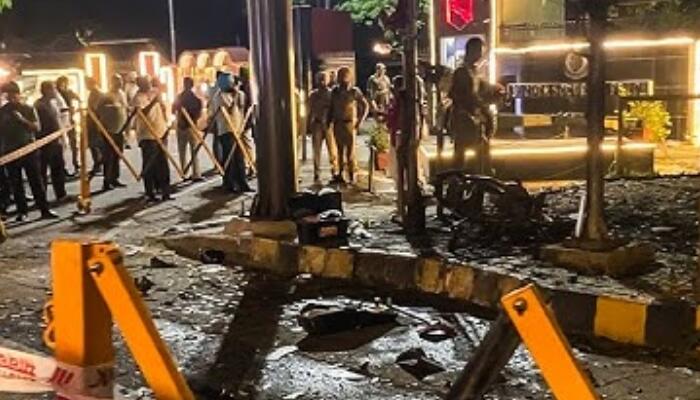
The investigation into the improvised explosive device (IED) blast outside the Border Security Force (BSF) Punjab Frontier headquarters in Jalandhar has intensified with the arrest of two key accused, Umar Deen and Anil Kumar, exposing what officials describe as a wider, structured conspiracy involving interstate operatives and suspected cross-border handlers.
Punjab Police, in coordination with central agencies and the Delhi Police Special Cell, confirmed that the arrests are part of an expanding investigation that has now led to 17 detentions. The breakthrough follows weeks of surveillance, digital tracking, and movement analysis across Punjab, Uttar Pradesh, and Delhi, with investigators tracing communication and travel patterns linked to the accused.
Coordinated roles in execution and documentation
According to senior officials, the module functioned through a division of roles. Umar Deen, a taxi driver from Zirakpur, was tasked with planting the IED outside the BSF headquarters. The device was reportedly placed inside a dustbin near the high-security perimeter and later triggered remotely using a SIM-based mechanism. Officials also suspect he received around ₹1 lakh for executing the operation.
Anil Kumar, originally from Uttar Pradesh and residing in Amritsar, was assigned to record the explosion. Investigators said he travelled from Amritsar to Jalandhar specifically for this purpose. A video recovered from his mobile phone, believed to have been shot from a position opposite the blast site, is now part of the forensic examination.
Twin explosions across sensitive military zones
The primary explosion took place on May 5 around 8 pm outside the BSF Punjab Frontier headquarters, destroying a delivery scooter and damaging nearby infrastructure, including shattered windowpanes. Panic spread quickly in the high-security zone following the blast.
Hours later, a second explosion occurred at around 11.15 pm near the boundary wall of the Khasa Army cantonment in Amritsar, where a tin sheet was dislodged due to the impact. Although no casualties were reported in either incident, the proximity of both blasts to sensitive installations has heightened security concerns.
Cross-border links under investigation
Preliminary findings suggest the use of an improvised explosive device triggered through a SIM-based mechanism, pointing to a level of technical planning. Officials are also probing alleged links to Pakistan’s Inter-Services Intelligence-backed networks, reportedly operating through gangster Shahzad Bhatti and associated modules.
Punjab Director General of Police Gaurav Yadav has described the incident as part of a “proxy war” aimed at disturbing peace in the border state. Security agencies are further examining whether the banned Khalistan Liberation Army, which claimed responsibility through an unverified social media post, had any operational role. The claim remains under verification.
Multi-state trail and expanding investigation
Investigators traced the accused through technical surveillance and physical movement mapping, leading teams into Uttar Pradesh, Amritsar and Delhi. Anil Kumar was first arrested by the Delhi Police Special Cell, after which Umar Deen’s involvement surfaced during interrogation.
Officials said explosives may have been sourced from an individual operating near the India-Pakistan border, though this angle is still under examination. CCTV footage from hundreds of cameras across Jalandhar and adjoining areas is being analysed to reconstruct the movements of those involved before and after the blast.
The case has also triggered a political exchange in Punjab, with Chief Minister Bhagwant Mann alleging the incident is linked to BJP’s “election preparedness”, a claim the party has strongly rejected, instead blaming the state government for security lapses.
With investigations still underway, officials indicated that further arrests are likely as agencies work to map the complete network, including handlers believed to be operating from across the border.