
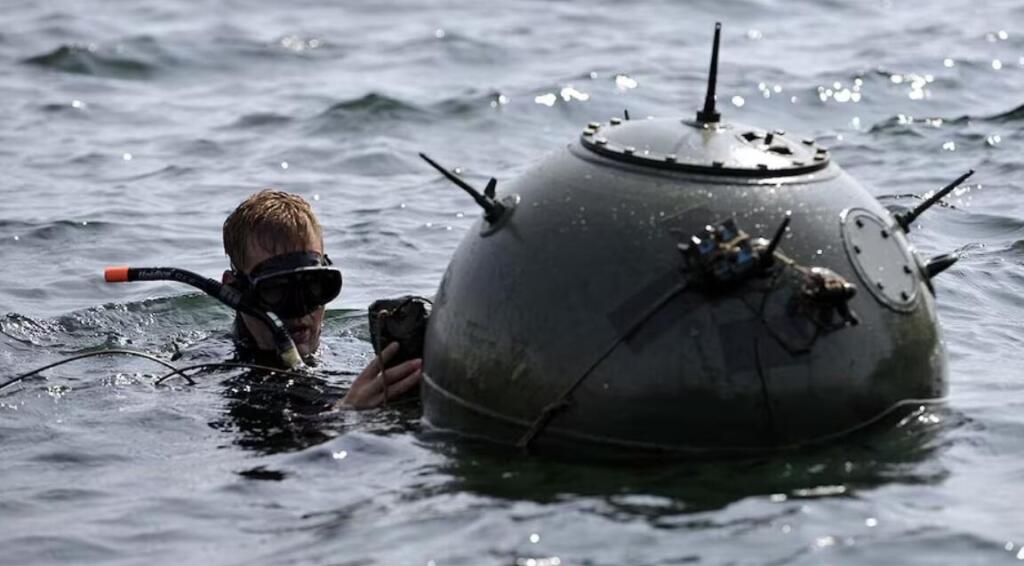
The Strait of Hormuz, a narrow yet vital waterway through which nearly 20% of the world’s crude oil flows, has been transformed into a literal maritime minefield.
Despite a recent pause in the month-long conflict between the United States and Iran, the strait remains a “no-go zone” for global commerce. Shipping lanes are paralyzed by the lingering threat of what lies beneath the surface.
In an effort to disrupt traffic and inflate the costs of the US-Israeli military campaign which both nations have characterized as a “pre-emptive and defensive move against Iran and its ambitions of developing a nuclear weapon” Tehran is believed to have extensively mined these waters. Although active hostilities reached a pause last week, the strait is far from open.
With initial peace talks stalling, the US has responded by announcing a blockade on all vessels traveling to or from Iranian ports. Simultaneously, the US Navy has assumed the daunting responsibility of clearing the strait to establish safe corridors for international shipping. However, neutralizing this invisible threat is a monumental challenge.
NAVAL MINES: CHEAP, CRUDE, DISRUPTIVE
Naval mines are among the oldest tools in maritime warfare, yet they remain devastatingly effective. Their power lies not just in their explosives, but in the psychological “minefield” they create, generating enough risk to make insurers spike rates and merchant fleets hesitate.
These devices generally fall into two categories, the Contact Mines, triggered by physical impact with a ship’s hull and Influence Mines, that have sophisticated sensors that detect a ship’s “signature,” such as acoustic engine noise, magnetic field distortions from steel hulls, or pressure changes in the water.
Placement also dictates their danger level. Moored mines are tethered to the seabed, floating at specific depths to target surface ships or submarines. Bottom mines sit directly on the seafloor, making them nearly impossible to detect in shallow waters.
The most unpredictable are drifting mines, which move with the currents, expanding the danger zone far beyond the initial drop site.
In this conflict, Iran has deployed its Maham (“Full Moon”) series. The Maham-1 and Maham-2 are conventional contact mines equipped with five “Hertz horns”, lethal primers that detonate a 120kg explosive charge when bent.
The larger Maham-3 is a moored heavyweight (380kg), while the Maham-7 is a 220kg limpet mine designed to attach magnetically to hulls in waters up to 35 meters deep.
HOW MINESWEEPERS DEAL WITH THEM
Countering these threats is an arduous, high-stakes game of cat and mouse. Historically, wooden-hulled minesweepers would drag serrated wires to cut a mine’s tether, allowing it to float to the surface where it could be destroyed by gunfire.
As mines became smarter, so did the countermeasures. Navies began using “influence sweeping,” towing devices that mimic a ship’s magnetic or acoustic profile to trick mines into detonating at a safe distance. To survive these missions, specialized ships were built with non-magnetic materials to avoid triggering the very weapons they sought to destroy.
Modern mine warfare has moved toward precision hunting. This involves a multi-layered approach.
Detection in which sonar and laser systems on ships and helicopters map the area. In inspection, Unmanned Underwater Vehicles (UUVs) and Unmanned Surface Vehicles (USVs) provide close-up visuals of suspicious objects and in Neutralization, once a mine is identified, it is destroyed in a controlled manner by naval gunfire, acoustic generators, or helicopter-launched destructors.
WHAT THE US IS LIKELY TO DO IN HORMUZ
The US Navy’s immediate objective is not to clear every square inch of the strait, but to establish a “secured corridor” that can be expanded over time.
On April 11, the US Central Command commander announced the start of these operations, stating, “Today, we began the process of establishing a new passage and we will share this safe pathway with the maritime industry soon to encourage the free flow of commerce.”
The spearhead of this effort will be the Littoral Combat Ships (LCS), designed for near-shore operations, supported by MH-60 Romeo helicopters. These helicopters use the Airborne Laser Mine Detection System to scan vast areas quickly, creating an initial map of the threat.
The LCS serves as a “mothership” for a fleet of drones. USVs tow specialized sonar to scan the water column, while torpedo-sized UUVs dive deep to inspect contacts. This process is made significantly more dangerous by the fact that it is occurring during a “live conflict” under the constant threat of fresh attacks.
The ultimate goal in Hormuz is more than technical, it is psychological. The US is not just fighting to remove physical explosives; it is fighting to restore the confidence of the global shipping industry. Success will be measured not by the number of mines destroyed, but by the return of the merchant vessels to the world’s most critical chokepoint.