
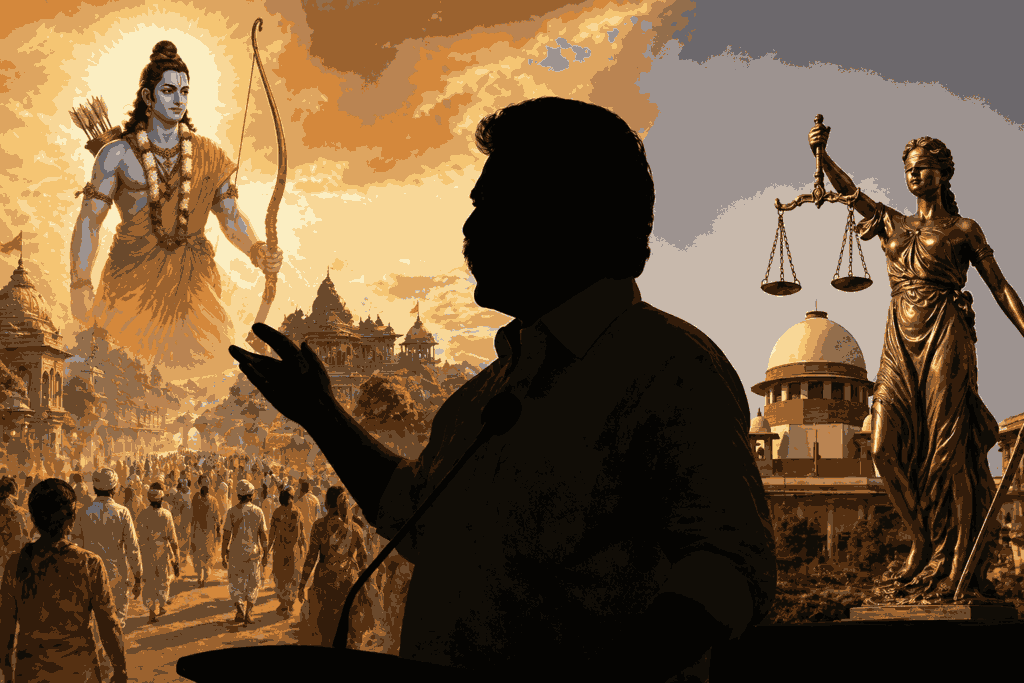
A recent statement by DMK spokesperson T. K. S. Elangovan regarding Ram Rajya has triggered political controversy and renewed debate over religion, governance, and cultural symbolism in India. The remark, in which he reportedly said he did not know what Ram Rajya was because he “was not there when Ram ruled,” has been widely discussed by supporters and critics alike. The episode reflects how references to faith-based ideals continue to shape modern political discourse.
The phrase Ram Rajya occupies a significant place in Indian public imagination. It is commonly understood as an ideal state marked by justice, moral governance, prosperity, and equality. Leaders across generations, including Mahatma Gandhi, used the term not as a literal historical model but as a symbol of ethical rule and people-centric administration.
The present controversy arises because critics argue that dismissing Ram Rajya ignores its cultural and philosophical meaning for millions. Supporters of the DMK, however, maintain that the comment was aimed at questioning political appropriation of mythology rather than insulting belief systems. This distinction has become central to the debate.
Tamil Nadu’s political landscape has long been shaped by the Dravidian movement and parties such as Dravida Munnetra Kazhagam, which historically emphasized rationalism, social justice, and opposition to caste hierarchy. In that context, sceptical remarks on religious symbolism are not new. Yet in an era of social media amplification, even brief comments on Ram Rajya quickly become national flashpoints.
For many Indians, Ram Rajya is less about theology and more about standards of governance—honesty in public life, protection of the weak, efficient institutions, and welfare for all sections. Because of this broader meaning, the phrase often resurfaces during elections and ideological battles.
The political impact of such remarks can be substantial. Opponents may use the controversy to portray rivals as disconnected from mainstream sentiment, while supporters may frame criticism as selective outrage. Either way, discussions around Ram Rajya often move beyond the original statement and become contests over identity and national values.
There is also a larger lesson here. India’s democracy includes both deep religious traditions and strong constitutional pluralism. Political parties routinely navigate the balance between respecting faith and defending secular governance. Debates around Ram Rajya reveal how symbols can unify some citizens while alienating others, depending on presentation and intent.
Ultimately, the issue is not only what one spokesperson said. It is about how political language interacts with heritage, memory, and public emotion. As India continues to evolve, references to Ram Rajya will likely remain powerful because they combine morality, governance, and cultural continuity in a single phrase.
Whether one embraces it literally, metaphorically, or critically, Ram Rajya remains one of the most resonant concepts in Indian politics. That is why even a short remark can generate nationwide discussion and intense reactions across ideological lines.