


















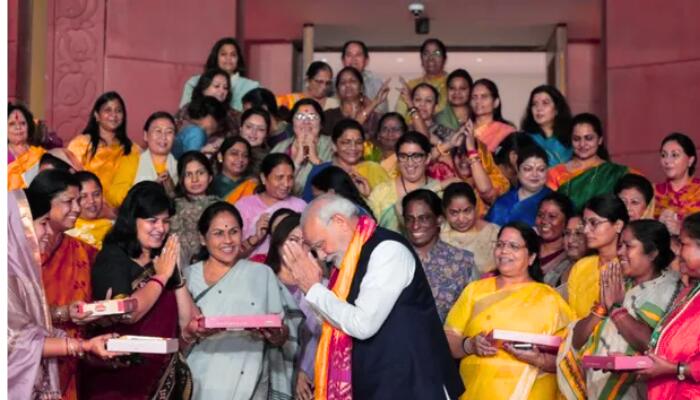
India is on the verge of taking what Prime Minister Narendra Modi described as one of the most consequential decisions of the 21st century, as Parliament prepares to deliberate on amendments related to the women’s reservation legislation. Speaking at the Nari Shakti Vandan Sammelan at Vigyan Bhawan in New Delhi on Monday, Modi said the proposed step represents a historic moment dedicated to Nari Shakti and the long-awaited expansion of women’s role in political decision-making.
Addressing the gathering, the Prime Minister said the country stands at a crucial juncture in its development journey and is approaching a decision that could redefine democratic participation. “Amidst these crucial milestones in the country’s journey of development, India is about to take one of the biggest decisions of the 21st century. I am saying with great responsibility that this is among the most important decisions of our time. This decision is dedicated to Nari Shakti and to the veneration of women’s power,” he said.
Parliament Set to Debate the Proposal
Modi said Parliament is close to creating a new chapter in India’s democratic history and that a comprehensive discussion on the proposal will begin on April 16. The deliberations are expected to continue for three days as lawmakers consider amendments linked to the women’s reservation framework.
“Our country’s Parliament is close to creating a new history. A history that will realise the visions of the past and fulfil the resolutions of the future,” he said.
The Prime Minister added that the initiative seeks to transform long-standing aspirations into reality and strengthen the role of women in governance. According to him, the move reflects a broader commitment to building an egalitarian India where social justice becomes an intrinsic part of the country’s work culture and decision-making processes.
He also noted that the debate around reservation for women in democratic institutions has continued for nearly four decades, involving successive governments, political parties, and several generations of leaders. “The need to provide reservations for women in democratic structures has been felt by everyone for decades. This discourse has been going on for nearly forty years and includes efforts by all parties,” he said.
Target of Implementation by 2029
The Prime Minister said there has been a widespread demand that the Women’s Empowerment Act be implemented by 2029. Keeping that timeline in mind, he said Parliament would hold an extensive discussion on the matter beginning April 16.
“It is our endeavour and our desire that this work be done with cooperation and participation. With everyone’s collective efforts, the dignity of the entire House will reach new heights,” he said, expressing hope that political parties would rise above partisan differences to advance the measure.
Modi also highlighted the growing role of women in governance across the country, noting that women have repeatedly demonstrated their leadership capabilities in key positions. He said India has already witnessed women occupying high offices, including that of the President and the Finance Minister.
According to the Prime Minister, more than 1.4 million women are currently serving in local government bodies across the country. In about 21 states, women’s participation in Panchayats has reached nearly 50 per cent, a level of representation that often surprises international observers.
“When I discuss this subject with foreign guests, they are left astonished. This active participation of millions of women in politics and social life brings immense pride to India,” he said.
The national-level Nari Shakti Vandan Sammelan was organised in support of the proposed amendment aimed at operationalising the Nari Shakti Vandan Adhiniyam, 2023. Delhi Chief Minister Rekha Gupta and Union Minister for Women and Child Development Annpurna Devi were among those present at the event.