
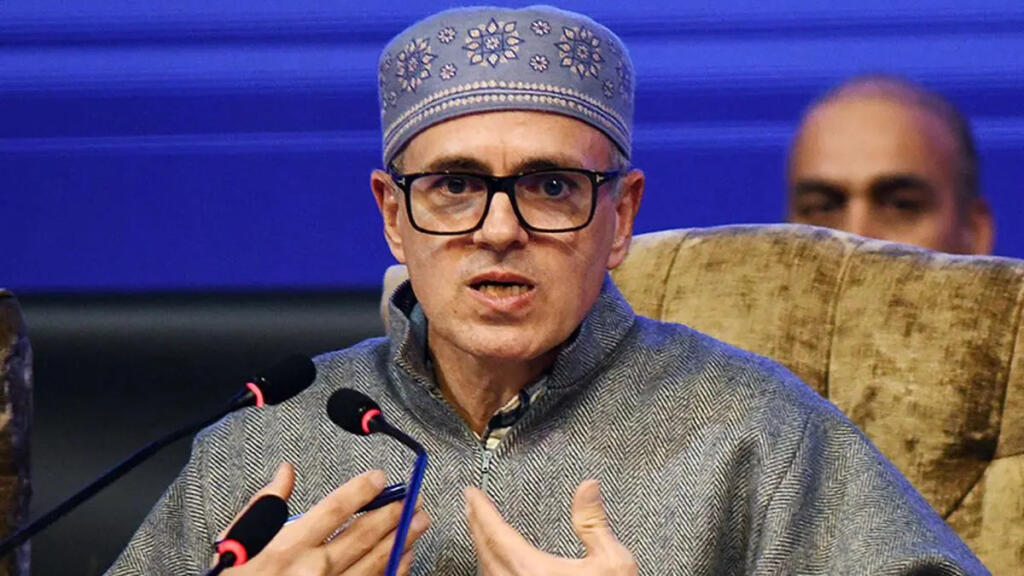
The political discourse around Jammu and Kashmir’s special status has once again intensified, with Chief Minister Omar Abdullah at the center of a growing debate. Questions are being raised about whether his recent political moves indicate a calibrated, step-by-step attempt to restore Article 370, which was abrogated by the Centre in August 2019.
To understand the controversy, one must revisit the significance of Article 370 itself. The provision granted Jammu and Kashmir a special autonomous status within the Indian Union, allowing it its own constitution and significant legislative independence. However, on August 5, 2019, the Government of India rendered the provision inoperative, reorganizing the state into two Union Territories—Jammu & Kashmir and Ladakh.
Since then, Omar Abdullah and his party, the Jammu & Kashmir National Conference, have consistently advocated for the restoration of the region’s special status. The party’s political positioning has remained rooted in constitutional methods—resolutions, legal avenues, and public mobilization—rather than direct confrontation.
Recent developments have fueled speculation that Omar Abdullah may be pursuing a gradualist approach. His government passed a resolution in the Jammu and Kashmir Assembly calling for the restoration of special status, which, notably, has not been formally rejected by the Centre. This has been cited by supporters as a strategic foothold in a longer political process.
At the same time, Omar Abdullah has maintained a nuanced public stance. While reiterating his commitment to restoring Article 370, he has also acknowledged the practical limitations of achieving this goal under the current central leadership. In one instance, he candidly remarked that restoration would not be possible during Prime Minister Narendra Modi’s tenure, reflecting a pragmatic assessment of political realities.
This dual messaging—firm on principle yet cautious in execution—has led to interpretations that Omar Abdullah is attempting a “step-by-step” pathway rather than an immediate confrontation. Such a strategy could involve incremental political gains, including the restoration of statehood, rebuilding institutional autonomy, and creating legal grounds for future constitutional reconsideration.
Critics, however, remain unconvinced. Opposition parties in Jammu and Kashmir, including the People’s Democratic Party (PDP), have accused Omar Abdullah of diluting the demand for full restoration. They argue that incrementalism risks normalizing the post-2019 status quo rather than challenging it. Political rivals have also questioned whether symbolic actions—such as resolutions and campaigns—translate into tangible outcomes.
The broader political context is equally important. The People’s Alliance for Gupkar Declaration, a coalition formed after the abrogation of Article 370, had explicitly aimed at restoring the region’s autonomy, though it has since lost momentum. This reflects the challenges of sustaining a unified political front on such a complex and sensitive issue.
Supporters of Omar Abdullah argue that his approach is grounded in constitutionalism and realism. They point out that any attempt to restore Article 370 must navigate legal, political, and institutional barriers, making a phased strategy more viable than immediate demands. From this perspective, each step—whether a legislative resolution or a political campaign—forms part of a longer-term roadmap.
At the same time, Omar Abdullah has also focused on governance and public welfare, balancing his political commitments with administrative responsibilities. This balancing act reflects the unique position of a leader operating within a Union Territory framework while advocating for greater autonomy.
The debate ultimately raises larger questions about the nature of political strategy in post-2019 Jammu and Kashmir. Is gradualism a pragmatic necessity, or does it risk weakening the core demand for restoration? Can constitutional methods alone achieve what was undone through a decisive political move?
As the discourse continues, Omar Abdullah remains a central figure navigating these competing pressures. Whether his approach represents a calculated pathway toward restoring Article 370 or merely a recalibration of political rhetoric is a question that will likely shape the region’s politics in the years to come.
For now, the issue remains unresolved—but firmly embedded in the political narrative of Jammu and Kashmir, with Omar Abdullah at its forefront.