
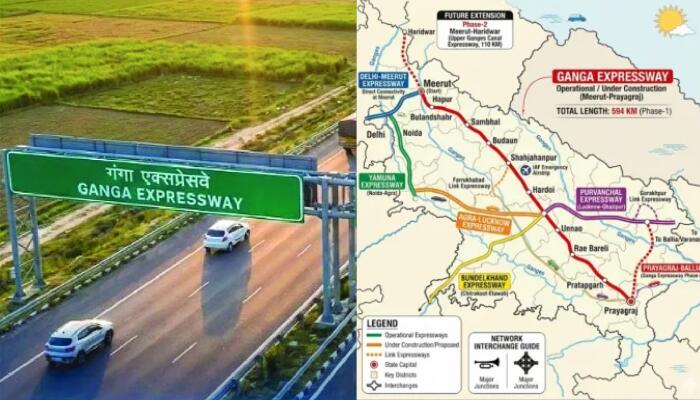
Prime Minister Narendra Modi inaugurated the 594-kilometre Ganga Expressway in Hardoi. The corridor connects western and eastern Uttar Pradesh through a greenfield, access-controlled highway. It spans 12 districts and 518 villages, making it one of the most extensive infrastructure projects in the state.
The project has been built at an estimated cost of ₹36,230–₹36,320 crore. It follows a public-private partnership model under DBFOT. At present, it has six lanes, though it can be expanded to eight lanes in the future. Moreover, engineers have designed it for speeds of up to 120 kmph to ensure faster mobility across long distances.
In terms of connectivity, the route passes through Meerut, Hapur, Bulandshahr, Amroha, Sambhal, Badaun, Shahjahanpur, Hardoi, Unnao, Rae Bareli, Pratapgarh, and Prayagraj. Consequently, officials expect travel time between Meerut and Prayagraj to drop from nearly 10–12 hours to around 6–7 hours.
At a broader level, Uttar Pradesh already accounts for nearly 60% of India’s expressway network. With this addition, the state’s transport backbone becomes even more interconnected.
A wider expressway web strengthens state connectivity
Importantly, the Ganga Expressway does not operate in isolation. It connects with the Purvanchal, Agra-Lucknow, Bundelkhand and Gorakhpur Link expressways. Together, these corridors form a unified high-speed road network across Uttar Pradesh.
Meanwhile, expansion plans are already in motion. The corridor is set to extend towards Haridwar, while the proposed Farrukhabad Link Expressway will further integrate regional connectivity.
Strategic features and advanced safety systems
Notably, the project includes a 3.2-km airstrip near Shahjahanpur, which can be used by the Indian Air Force for emergency landings. This adds a clear strategic and defence dimension to the expressway.
In addition, the corridor is equipped with an Intelligent Traffic Management System. CCTV surveillance covers major stretches, while emergency call boxes, ambulances, and patrol units operate continuously to ensure safety and quick response.
Industrial clusters aimed at investment and jobs
Alongside transport upgrades, the project includes Integrated Manufacturing and Logistics Clusters spread across nearly 7,000 acres. These zones will house warehouses, cold storage facilities, food processing units, and industrial centres.
As a result, officials expect stronger private investment inflows and large-scale job creation. At the same time, the corridor is designed to reduce logistics costs and improve access for farmers to larger markets.
Ultimately, policymakers view it as a key step towards Uttar Pradesh’s broader ambition of becoming a trillion-dollar economy.
Political messaging shapes the narrative
During the inauguration, Modi described the expressway as a “lifeline” for Uttar Pradesh. He linked its significance to the historical importance of the river Ganga in the region’s development.
Furthermore, he referred to expressways as the “palm lines of a developing India”, highlighting their role in shaping national growth. He also noted that the project was completed in about five years, reflecting what he described as a fast-paced development model.
Additionally, he announced future connectivity expansion, including the extension towards Haridwar and integration through the Farrukhabad Link Expressway.
Chief Minister Yogi Adityanath, meanwhile, called the project a lifeline for farmers, youth, and entrepreneurs. He credited the double-engine government for accelerating infrastructure development across the state. Similarly, Union Minister Pankaj Chaudhary termed it a major milestone for Uttar Pradesh.
Political criticism adds a sharp undertone
At the same time, Modi used the platform to criticise the Samajwadi Party. He accused it of opposing development and women’s empowerment initiatives.
Referring to the Nari Shakti Vandan Amendment, he alleged that the party resisted stronger representation for women. He also claimed that SP aligned with parties that “insult Uttar Pradesh” in Parliament.
According to him, such political positions would not support the state’s long-term progress.
Large-scale public participation across districts
To mark the inauguration, Modi visited an exhibition organised by the Uttar Pradesh Expressways Industrial Development Authority and planted saplings before addressing the gathering.
Meanwhile, parallel programmes were held across several districts, including Prayagraj and Sambhal, where large crowds witnessed the launch of the corridor.