
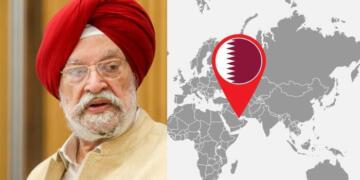







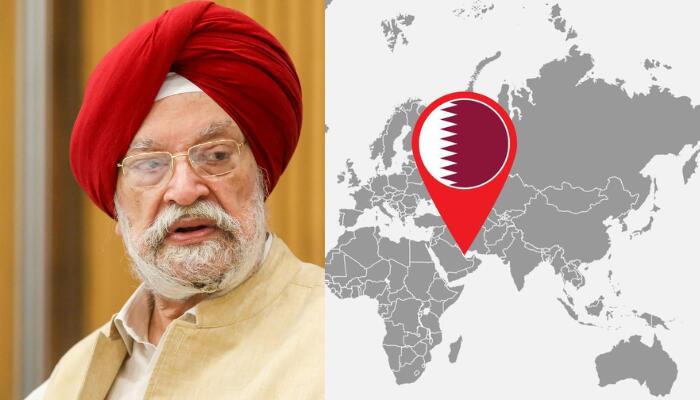
Union Petroleum and Natural Gas Minister Hardeep Singh Puri began a two-day visit to Qatar today as India moves to safeguard its energy supplies amid escalating disruptions caused by the ongoing conflict involving Iran in West Asia. The visit, scheduled for April 9 and 10, comes at a sensitive moment for global energy markets, with damage to Qatar’s gas infrastructure and continued restrictions in the Strait of Hormuz raising concerns for major energy-importing nations such as India.
India’s dependence on imported natural gas has made developments in the Gulf region particularly significant. According to oil economist Kirit Parikh, India imports around 50 per cent of its liquefied natural gas from international markets. Of these imports, roughly 40 per cent are sourced from Qatar, making the Gulf nation one of India’s most important energy partners.
However, the ongoing regional conflict has severely disrupted these supply chains. Major natural gas production plants in Qatar were closed after Iranian strikes damaged energy facilities, while maritime movement through the Strait of Hormuz has been significantly restricted.
Iranian Strikes Hit Key LNG Infrastructure
The crisis intensified after Iranian attacks on Qatar since the outbreak of the conflict in late February damaged critical energy infrastructure in the country. According to QatarEnergy Chief Executive Saad al Kaabi, the strikes hit two of Qatar’s fourteen LNG production trains and one of its two gas-to-liquids facilities.
The damage has taken an estimated 12.8 million tonnes of LNG per annum offline, accounting for nearly 17 per cent of Qatar’s total LNG export capacity. Officials estimate that repairing the damaged infrastructure could take between three and five years.
The disruption is expected to cost Qatar around 20 billion dollars in annual revenue losses. It has also triggered broader concerns about global energy security, particularly among key importers in Asia and Europe who depend heavily on Qatari gas supplies.
Against this backdrop, Puri’s meetings in Doha are expected to focus on ensuring continued LNG availability for India and exploring ways to stabilise energy flows despite the regional turmoil. According to reports, discussions during the visit are likely to centre on liquefied natural gas supplies.
India Expands Energy Procurement Strategy
As supply disruptions continue, India has already begun diversifying its natural gas sourcing strategy. The government has reportedly stepped up large-scale imports from alternative markets, including the United States, Australia, and Russia, to reduce dependence on a single supplier.
Government sources said, “India has so far managed to shield domestic consumers from the immediate effects of the conflict and rising global energy prices by actively engaging with energy partners and adjusting procurement routes”.
Concerns have nevertheless surfaced about the availability of liquefied petroleum gas in India after Iran blocked the Strait of Hormuz, a crucial maritime chokepoint through which nearly one-fifth of the world’s oil supply passes.
Despite these fears, the Ministry of Petroleum has said that LPG supply across the country remains stable. In a statement, the ministry said, “Distributors have not reported shortages even though the geopolitical situation has affected supply chains.”
Online LPG bookings have increased by approximately 95 per cent, while deliveries using the Delivery Authentication Code system have risen by about 91 per cent to prevent diversion of cylinders. The ministry also confirmed that domestic distribution continues normally, noting that more than 5.35 million LPG cylinders were delivered on April 7 alone.
Wider Diplomatic Outreach in the Gulf
India’s engagement in the region is also expanding diplomatically. External Affairs Minister S Jaishankar is scheduled to visit Mauritius and the United Arab Emirates between April 9 and April 12. He will first attend the Indian Ocean Conference in Mauritius before travelling to the UAE, where energy security is expected to be a key agenda item.
The diplomatic activity follows the announcement of a two-week ceasefire between the United States and Iran. US President Donald Trump described Tehran’s ten-point conditions for the agreement as workable. However, despite the ceasefire, strikes have continued across parts of the region, and maritime traffic through the Strait of Hormuz remains extremely limited.
For India, the developments underline the fragility of global energy supply chains. With damaged infrastructure, disrupted shipping routes, and continuing geopolitical tensions, New Delhi’s outreach to Gulf partners reflects a determined effort to protect one of the country’s most critical economic lifelines.