
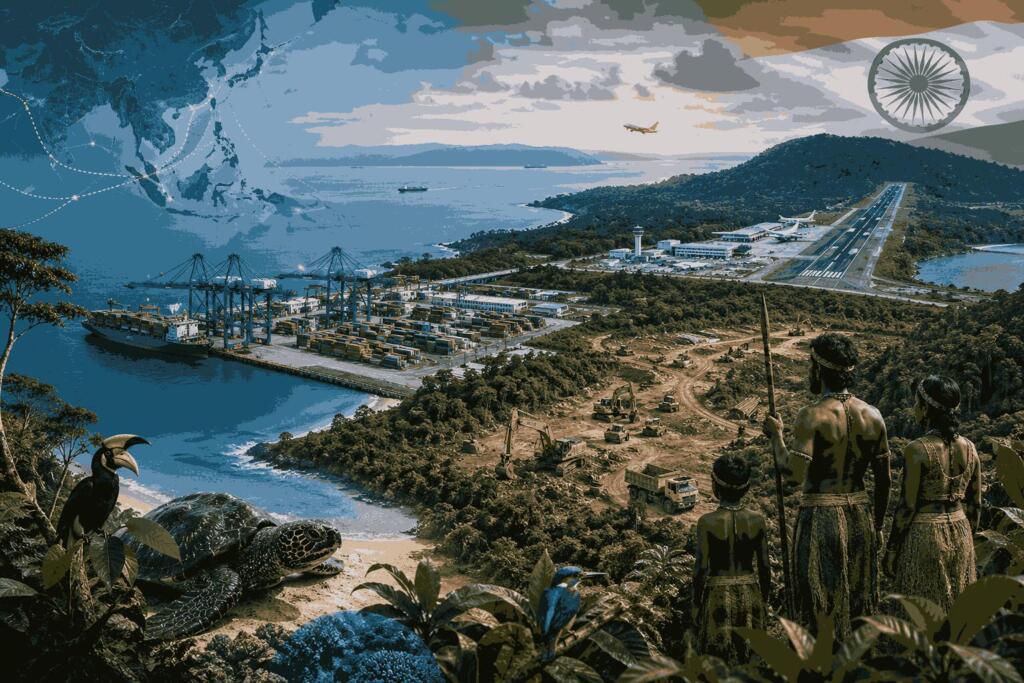
The Great Nicobar Project has emerged as one of India’s most ambitious infrastructure and strategic initiatives, but it has also become the focal point of intense global scrutiny, political contestation, and competing narratives. Positioned in the Andaman and Nicobar Islands near critical international shipping routes, the project seeks to transform Great Nicobar into a major economic, logistical, and military hub. At the same time, it is increasingly being portrayed—by critics and some international voices—as a controversial undertaking with ecological and humanitarian implications.
At its core, the Great Nicobar Project is a multi-billion-rupee development plan designed to establish an international container transshipment terminal, a dual-use airport, power infrastructure, and urban settlements. These components are intended to reduce India’s reliance on foreign ports such as Singapore and Colombo while enhancing its maritime competitiveness. The island’s proximity to the Strait of Malacca—one of the world’s busiest shipping lanes—makes it strategically invaluable, especially in the context of Indo-Pacific geopolitics.
Supporters argue that the Great Nicobar Project is crucial for strengthening India’s national security. The region already hosts a tri-services military command, and further development is expected to enhance surveillance and response capabilities across key sea lanes. In a broader strategic sense, the project is seen as a counterbalance to China’s expanding influence in the Indian Ocean, particularly given Beijing’s dependence on maritime energy routes passing through the Malacca Strait.
However, the Great Nicobar Project has also attracted strong opposition from political leaders and environmental groups. Critics have described it as a threat to the fragile ecosystem and indigenous communities of the island. Rahul Gandhi, for instance, termed it one of the “biggest scams” and a grave danger to tribal heritage, while Sonia Gandhi raised concerns about its potential impact on the Shompen tribe. These criticisms often focus on the scale of environmental disruption, including the diversion of forest land and the felling of hundreds of thousands of trees.
Environmental concerns surrounding the Great Nicobar Project are substantial. Estimates suggest that close to a million trees could be affected, alongside potential disruption to biodiversity, coral reefs, and endemic wildlife. The island is home to rare species such as the leatherback sea turtle and lies within an ecologically sensitive zone. Additionally, indigenous communities like the Shompen and Nicobarese, who have lived in relative isolation, face uncertainty regarding the long-term impact of increased human activity.
Despite these concerns, the Indian government maintains that the Great Nicobar Project incorporates safeguards and mitigation measures. The National Green Tribunal (NGT) has upheld environmental clearances, allowing the project to proceed under strict compliance conditions. Proponents argue that sustainable development and environmental protection can coexist, and that the project includes compensatory afforestation and conservation initiatives.
Beyond domestic debate, the Great Nicobar Project has also entered the realm of international discourse, where narratives often intersect with geopolitical interests. Some analysts suggest that global criticism may not be entirely detached from strategic competition in the Indo-Pacific. Given the project’s potential to enhance India’s maritime influence and reduce dependency on foreign transshipment hubs, it inevitably affects regional power dynamics.
From an economic perspective, the Great Nicobar Project promises significant benefits. It is expected to generate employment, boost trade efficiency, and contribute substantially to India’s blue economy. Estimates indicate that the transshipment port alone could handle millions of containers annually, positioning India as a key player in global maritime logistics. The development of infrastructure and urban centers could further transform the island into a hub for tourism and industry.
Yet, the central tension remains unresolved: can such large-scale development be pursued without irreversibly damaging a unique ecological and cultural landscape? Critics warn that the risks may outweigh the benefits, while supporters emphasize the strategic necessity of the project in an increasingly competitive global environment.
Ultimately, the Great Nicobar Project represents more than just an infrastructure initiative—it is a microcosm of the broader challenges facing modern India. Balancing economic growth, national security, environmental sustainability, and social responsibility is no easy task. As competing narratives continue to shape public perception, the project stands at the intersection of development and debate, reflecting the complexities of India’s rise on the global stage.