
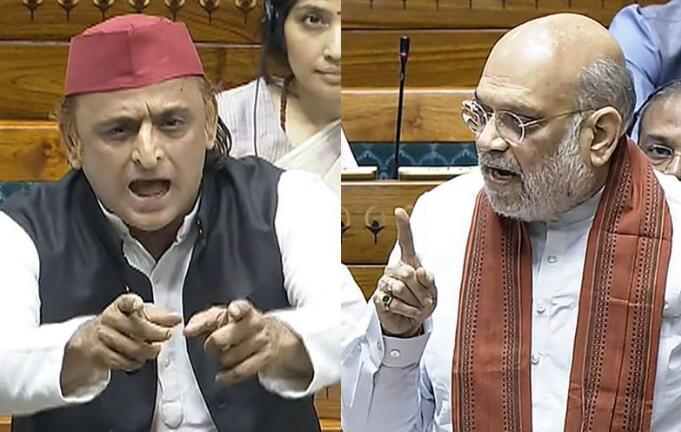
The Lok Sabha witnessed a high-decibel face-off on Thursday as the Central government and Opposition parties locked horns over the introduction of three pivotal bills aimed at reshaping India’s electoral landscape.
The legislative package, comprising the Constitution (131st Amendment) Bill, the Delimitation Bill, and the Union Territories Laws (Amendment) Bill seeks to streamline the implementation of women’s reservation in the legislative bodies of Delhi, Puducherry, and Jammu and Kashmir.
While the government framed the move as a historic step toward gender parity, the Opposition, led primarily by the Samajwadi Party (SP), accused the Centre of bypassing critical procedural milestones like the national census to gain a political edge.
The introduction of these bills has effectively turned the special three-day parliamentary session into a battleground over the intersection of gender, caste, and constitutional propriety.
The Core Contention: Census First or Quota Now?
The primary flashpoint of the debate was the sequencing of the reservation policy. Samajwadi Party chief Akhilesh Yadav spearheaded the Opposition’s attack, questioning the “tepid urgency” shown by the Centre.
While clarifying that his party supports the principle of women’s reservation, Yadav took a firm stand against the government’s approach, which ties the quota to a fresh delimitation exercise.
Addressing the House, Akhilesh Yadav asked why the government was “rushing” the process without first concluding the national census.
“Why are you in such a hurry? Why is the Centre rushing for women’s reservation? Start with the census first. Samajwadi Party is for women’s reservation, but is opposed to the approach via delimitation. As soon as the census is done, we will ask for the caste census, and then the reservation issue will come. Hence, you want to do dhokha with us [cheat us],” Yadav asserted.
Yadav’s argument suggested that without a transparent census and a subsequent caste-based enumeration, the reservation would not truly reflect the demographic reality of the country. He suggested that the current roadmap is a strategic maneuver to delay or dilute the actual impact of the quota.
Amit Shah’s Rebuttal: Census 2027 and the Caste Mandate
Home Minister Amit Shah provided a sharp and direct response to the SP chief’s allegations, making a landmark disclosure regarding the census and caste enumeration. Shah dismissed the notion that the government was stalling, instead revealing that the groundwork for the national headcount is already underway.
“Census 2027 is on; we have decided to go for caste enumeration,” Shah declared, informing the House that the government has formally integrated caste data collection into the upcoming census process.
The Home Minister also took the opportunity to address demands for religious-based sub-quotas within the women’s reservation, a point often raised by SP members.
He specifically critiqued Dharmendra Yadav’s earlier mentions of providing specific reservations for Muslim women, labeling such demands as a violation of the basic structure of the Constitution.
Speaking on behalf of the SP, Akhilesh Yadav said the party would not support the Women’s Reservation Bill unless it includes provisions for Other Backward Classes and Muslim women. He also urged the government to withdraw the proposed Bills and instead implement the law passed in 2023.
In response, Shah asserted that a reservation based on religion is not permissible under the Constitution and said, “Based on religion, reservation of any kind for Muslims is unconstitutional.”
In response, Akhilesh Yadav questioned whether the Muslim population falls outside the 50 per cent reservation cap, pressing the government on its position.
Replying to this, Shah said, “We are not stopping the Samajwadi Party from giving all their tickets to Muslim women.”
Lok Sabha Speaker Om Birla intervened, urging members not to engage in such direct back-and-forth debate and to maintain decorum during the proceedings.
Expanding the House: The 815-Seat Vision
As the debate raged, Union Law Minister Arjun Ram Meghwal provided the technical and statistical framework for the proposed changes. He reminded the House that the Nari Shakti Vandan Adhiniyam, passed in 2023, was always intended to be implemented following the post-2026 delimitation.
Meghwal outlined a transformative vision for the Lok Sabha, suggesting that the strength of the House would see a massive expansion to accommodate the new quota without shrinking the representation of any existing state.
“There will be an equal, 50 per cent increase in the strength of Lok Sabha members, and this will translate to 815 seats, of which 272 will be reserved for women, which comes to one-third of the strength of the House. There will be no loss to anyone (states), and they will retain their strength,” Meghwal explained.
By increasing the total seats to 815, the government aims to solve the mathematical puzzle of providing 33% reservation for women while ensuring that the current number of general and reserved seats for men does not drastically diminish, thereby mitigating anxiety among sitting MPs.
A High-Stakes Special Session
The special sitting, convened from April 16 to 18, 2026, marks a decisive moment for the current administration. By linking the women’s quota to the 2027 Census and a subsequent caste census, the government has attempted to take the wind out of the Opposition’s sails regarding the “caste census” demand. However, the Opposition remains skeptical of the “delimitation-first” approach, fearing it might delay the actual empowerment of women in the legislature for several more years.
As the bills move toward a vote, the floor of the Lok Sabha remains a theater of clashing ideologies—one side pushing for a swift legislative overhaul, and the other demanding a data-driven, caste-inclusive foundation before the ink dries on the new law.