
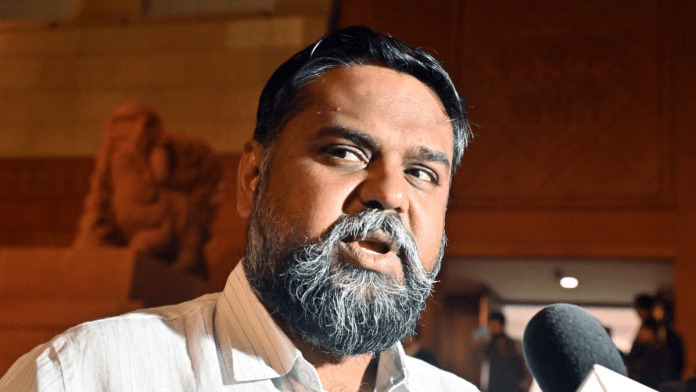
In a striking political turnaround, former DMK MP Senthil Kumar has found himself at the center of renewed attention as he transitions from a controversial past to an active electoral campaign. Once criticised for his stance on Hindu rituals, Senthil Kumar is now seeking temple blessings as he contests as an MLA candidate in the upcoming Tamil Nadu Assembly elections, reflecting a notable shift in political messaging and strategy.
Senthil Kumar, who previously represented Dharmapuri in the Lok Sabha, had courted controversy during his tenure with remarks and positions that were perceived as dismissive of certain Hindu traditions. His statements had drawn sharp reactions from political opponents and sections of the public, with critics accusing him of being insensitive to religious sentiments. Senthil Kumar later clarified some of his remarks, but the controversy continued to linger in public discourse. (Wikipedia)
Now, as the political landscape heats up ahead of the 2026 Tamil Nadu Legislative Assembly election, Senthil Kumar appears to be recalibrating his public image. Reports indicate that he has been actively visiting temples, offering prayers, and seeking blessings from priests and devotees alike. These visits are being viewed as a deliberate outreach to voters, especially in constituencies where religious identity and cultural sentiment play a significant role in electoral behaviour.
The transformation is being interpreted in multiple ways. Supporters argue that Senthil Kumar’s temple visits demonstrate respect for local traditions and reflect a leader willing to engage with diverse communities. Critics, however, see this as political opportunism, pointing out the contrast between his earlier positions and his current actions. The debate has added another layer to the already intense election season in Tamil Nadu.
The broader context of this shift cannot be ignored. Tamil Nadu politics has historically been shaped by Dravidian ideology, which often emphasised rationalism and social justice over religious symbolism. However, in recent years, there has been a perceptible change, with political leaders across party lines increasingly incorporating religious outreach into their campaigns. Senthil Kumar’s actions appear to align with this evolving trend.
The electoral stakes are high. With all 234 seats up for grabs in the assembly, parties are leaving no stone unturned to secure voter support. Dravida Munnetra Kazhagam, led by Chief Minister M. K. Stalin, is aiming to retain power, while opposition parties are working to capitalise on any perceived weaknesses. In this competitive environment, candidates like Senthil Kumar are adopting multifaceted strategies to appeal to a broad voter base.
Observers note that temple visits and religious symbolism often carry significant weight in Indian elections. For many voters, such gestures are seen as indicators of cultural alignment and personal belief. By participating in these rituals, Senthil Kumar may be attempting to bridge the gap between his earlier image and the expectations of his electorate.
At the same time, the shift raises questions about authenticity and consistency in political conduct. Critics argue that sudden changes in stance, especially on sensitive issues like religion, can undermine public trust. They contend that voters are increasingly discerning and may question whether such actions are driven by genuine belief or electoral necessity.
Nevertheless, the ground reality suggests that symbolic gestures continue to play an important role in shaping electoral narratives. In a state where identity, culture, and politics intersect in complex ways, leaders often find themselves balancing ideological commitments with pragmatic considerations.
Senthil Kumar’s journey from controversy to campaign trail highlights the dynamic nature of Indian politics. It underscores how leaders adapt to changing circumstances and voter expectations, sometimes revising their approach to remain relevant and competitive.
As the election approaches, all eyes will be on how voters respond to these shifts. Will Senthil Kumar’s outreach resonate with the electorate, or will his past controversies continue to influence public perception? The answer will likely emerge only after ballots are cast and counted.
For now, his temple visits have become a talking point, symbolising a broader trend in Indian politics where ideological lines blur in the face of electoral imperatives. Whether this strategy proves effective remains to be seen, but it has undoubtedly added a new dimension to the ongoing political discourse in Tamil Nadu.