
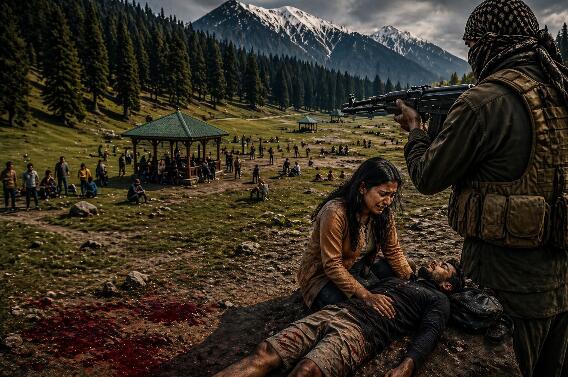
The Baisaran valley sits about seven kilometres from Pahalgam town, accessible only by foot or horseback. Locals call it “mini Switzerland.”
On a warm April afternoon, it was full of families, tourists who had come to Kashmir for its meadows, its cool air, and the simple relief of being somewhere beautiful.
At around 1 pm on April 22, 2025, armed men emerged from the surrounding forests. They moved through the crowd and, according to survivor accounts, asked people to identify their religion and those identified as Hindu were shot.
By the time it was over, 26 people were dead and 17 more were injured. Among the dead were primarily Hindu tourists, though a Christian visitor and a local Muslim pony ride operator were also killed. It was the deadliest attack on civilians in the region in a quarter century.
The choice of Baisaran was not random, in counter-terrorism terms, it was a near-perfect soft target, open ground, no fortifications, crowds of civilians with no means of defence, and the kind of scenic backdrop that guarantees images will travel far.
The tourists who come to Pahalgam represent something specific in the political landscape of Kashmir, they are living proof of the government’s claim that normalcy has returned to the region.
The attack signalled a calculated shift in terror strategy targeting the tourism sector to disrupt the narrative of stability that had been growing since the assembly elections of October 2024. By striking there, the attackers weren’t just killing people. They were killing an idea: that Kashmir was safe, open, and moving forward.
The weapons recovered told their own story. The attackers were armed with M4 carbines and AK-47s not improvised tools but military-grade firearms requiring training, supply chains, and planning. This was not desperation. It was organisation.
Proxy War in Plain Sight
The Resistance Front (TRF), a proxy of the Pakistan-based Lashkar-e-Taiba, initially claimed responsibility for the attack, twice, on the day of the attack and the day after. Four days later, on April 26, TRF withdrew the claim, saying its original message had been the result of a cyber intrusion. Whether that retraction was genuine or strategic, the fingerprints of LeT’s network were already being traced by investigators.
India’s response went beyond statements. New Delhi suspended participation in the Indus Waters Treaty, closed the main Attari-Wagah border crossing, and launched a diplomatic campaign briefing envoys of 45 nations on the attack. On May 7, India launched Operation Sindoor precision strikes on terrorist infrastructure across the border after which Pakistan responded with drone and missile strikes. A ceasefire was agreed on May 10.
Pakistan denied any involvement in the Pahalgam attack. But the denial carries a complicated backdrop. In an interview with Sky News days after the attack, Pakistan’s own defence minister acknowledged the country’s history of supporting, training and funding terrorist organisations.
Human Cost, Not the Headline
Behind every strategic analysis lies something simpler and harder to process, these were families on holiday. Children in open fields. Ordinary people who had saved money for a trip to one of the most beautiful places in India. They had no part in any conflict. They were chosen not for who they were, but for what they represented and for what their deaths would communicate.
The survivors carry injuries that won’t show up in any counter-terrorism report. The families of the dead will not forget where they were when they got the phone call. For them, Baisaran will never again be a meadow. It will be the place where everything changed.
What Comes After
The Pahalgam attack has forced a hard conversation about how to protect open, civilian spaces without turning them into fortresses which, paradoxically, is exactly what terrorists want. A Kashmir ringed with checkpoints and emptied of tourists is, in its own way, a victory for those who planned this attack.
Effective counter-terrorism here means more than military responses and border closures. Operation Mahadev, launched on the day of the attack, eventually tracked the terrorists through a monitored satellite phone and killed three of them in the Harwan jungles on July 28, 2025 over three months later. That timeline alone reflects the complexity of the challenge.
The meadow at Baisaran will eventually fill with tourists again. Kashmir’s resilience demands it. But the attack of April 22 has left a question that will not be easily answered–how many more ordinary people will have to pay for a conflict they never chose, and never understood?
Effective counter-terrorism in such contexts requires a blend of intelligence-driven operations, community vigilance, and technological surveillance. Equally important is the strategic communication that denies terrorists the narrative victory they seek.