
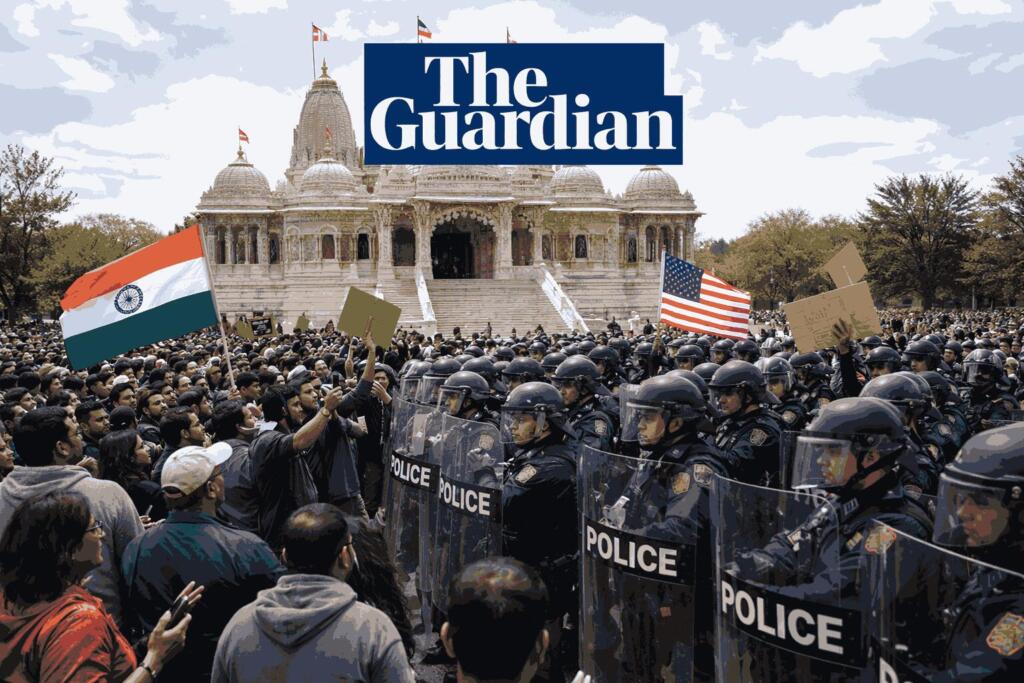
The controversy surrounding the BAPS Temple in New Jersey has once again resurfaced after a recent international media report revived allegations related to worker exploitation, despite earlier legal developments in the United States. The issue highlights the complex intersection of media narratives, legal findings, and public perception surrounding the BAPS Temple, one of the largest Hindu religious complexes outside India.
The BAPS Temple, formally known as the Swaminarayan Akshardham complex in Robbinsville, New Jersey, is a monumental structure built between 2015 and 2023. It stands as the largest Hindu mandir in the Western Hemisphere and a significant symbol of Indian cultural and spiritual presence abroad. However, since its construction, the temple has been entangled in controversy due to allegations made in a 2021 lawsuit filed by a group of workers.
The renewed debate stems from a recent report by The Guardian, which revisited earlier claims that workers involved in building the BAPS Temple faced issues such as labor exploitation, unsafe working conditions, and medical neglect. The report also referenced cases of serious illnesses, including silicosis, allegedly linked to prolonged exposure to construction materials. These claims have been widely circulated, reigniting scrutiny over the conditions under which the BAPS Temple was constructed.
However, a key aspect of the controversy lies in the legal outcome of investigations conducted in the United States. The U.S. Department of Justice (DOJ), which had initiated a probe into allegations of forced labor and discrimination, ultimately closed the case without filing any charges or establishing wrongdoing against the organization. This closure has been cited by supporters of the temple as a crucial fact that challenges the credibility of ongoing allegations surrounding the BAPS Temple.
The original lawsuit had claimed that over 200 workers, many reportedly from marginalized backgrounds in India, were brought to the U.S. under religious visas and subjected to poor working conditions. ( However, over time, several plaintiffs reportedly withdrew their allegations, and the legal process evolved alongside federal investigations. The absence of criminal findings in the DOJ probe has been interpreted by the temple authorities and their supporters as a form of vindication for the BAPS Temple project.
Critics, on the other hand, argue that the closure of a criminal investigation does not necessarily invalidate all concerns. Civil litigation related to labor practices has continued in various forms, and advocacy groups have called for further scrutiny and accountability. They contend that issues related to labor rights, especially involving migrant workers, require deeper examination beyond the scope of a single legal proceeding involving the BAPS Temple.
Another contentious dimension of the debate is the repeated framing of the issue through a caste-based lens, particularly focusing on Dalit workers. Some commentators argue that this framing oversimplifies a complex legal and social issue, while others maintain that caste dynamics are an important aspect of the allegations. The Guardian’s renewed focus on this angle has drawn criticism from those who believe it selectively highlights certain narratives about the BAPS Temple while overlooking the legal closure of the case.
The broader discourse also reflects tensions between global media reporting and diaspora community perspectives. For many devotees and members of the Hindu community, the BAPS Temple represents devotion, volunteerism, and cultural pride. Statements from the organization have consistently emphasized that the temple was built through the service of thousands of volunteers, reflecting a tradition of “seva” or selfless contribution.
At the same time, the case raises larger questions about how religious institutions operate in international contexts, particularly when they rely on cross-border labor and volunteer networks. It also underscores the challenges of interpreting religious service within the framework of modern labor laws, an issue that has surfaced in multiple legal and academic discussions related to the BAPS Temple.
In conclusion, the renewed attention on the BAPS Temple illustrates how controversies can persist even after formal investigations have concluded. While legal authorities in the United States have closed their probe without charges, debates continue in the public sphere, fueled by media reports, advocacy efforts, and differing interpretations of the facts. The case serves as a reminder of the complexities involved in balancing legal outcomes, ethical concerns, and the power of narrative in shaping public opinion.