
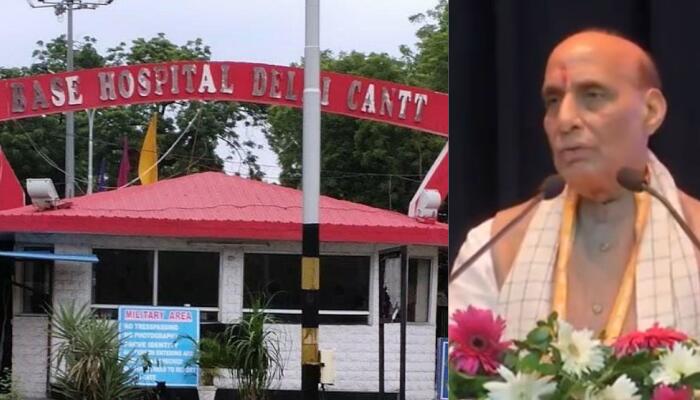
Defence Minister Rajnath Singh laid the foundation stones for three specialised medical centres at Army Hospital (Research & Referral) and new infrastructure at Base Hospital Delhi Cantonment, strengthening healthcare support for India’s armed forces.
The projects were announced during the 262nd Raising Day celebrations of the Army Medical Corps in New Delhi. The new facilities at the Army Hospital (Research & Referral) will include dedicated centres for ophthalmology, oncology, and joint replacement, aimed at expanding the tertiary care capabilities of the Armed Forces Medical Services.
Once operational, the centres are expected to enhance advanced eye care services, cancer treatment, and complex joint replacement surgeries for serving personnel, veterans and their dependents.
The infrastructure expansion at the Base Hospital in Delhi Cantonment will significantly increase medical capacity. The upgraded facility will have 998 beds along with an additional 100 crisis expansion beds, designed to meet both routine healthcare needs and emergency medical requirements of defence personnel.
Health Security Central to National Preparedness
Addressing the gathering, Singh stressed that health security has become an essential pillar of national strength in the modern era.
“In today’s world, security is not limited to protecting borders; health security is equally important,” he said. According to him, reliable and high-quality medical support enhances the confidence of soldiers and directly contributes to the success of military operations.
Referring to large-scale missions such as Operation Sindoor, Singh noted that soldiers perform their duties with greater assurance when they know advanced medical facilities are available in all circumstances.
He also praised the work of military medical teams deployed across remote regions and neighbouring countries. Medical outreach programmes conducted by the armed forces, including eye-care services and glaucoma surgeries in countries such as Nepal, have strengthened India’s humanitarian engagement and demonstrated the country’s soft power.
Push for Research and Clinical Trial Reforms
The defence minister also used the occasion to highlight the need for stronger research capacity within the medical system and called for reforms in the country’s clinical trial framework.
He suggested that the Armed Forces Medical Services should explore ways to play a meaningful role in clinical trials and medical innovation. In many advanced countries, clinical trials receive strong industry support and place equal emphasis on research, treatment and technological advancement.
Singh emphasised the importance of establishing standard operating procedures and structured protocols that allow doctors and hospitals to systematically share clinical experience related to specific diseases. Such mechanisms, he said, would lead to faster and more evidence-based treatments while improving overall healthcare efficiency.
He also proposed the creation of a national-level medical data pool that could provide stronger inputs for policymaking, validate new treatment methods and enable the large-scale adoption of successful medical practices. Such a system, he said, could gradually transform India’s healthcare approach from reactive to proactive.
Modernisation of Military Healthcare
During the visit, Singh toured a technology exhibition displaying innovations in combat medical care. The showcase included advancements in trauma management, battlefield evacuation systems, prosthetics, telemedicine and critical care technologies, highlighting the Armed Forces Medical Services’ focus on modernisation and self-reliance.
He also encouraged the services to explore upgrading existing command and base hospitals across different regions to match the standards of the Army Hospital (Research & Referral), rather than relying solely on entirely new institutions.
Senior defence officials, including Anil Chauhan, Dinesh K Tripathi and Upendra Dwivedi, attended the event.
On the occasion, Singh presented the Raksha Mantri Trophy for the Best Hospital of the Armed Forces Medical Services to Command Hospital (Southern Command) in Pune, while the second-best hospital award went to Indian Naval Hospital Ship Asvini in Mumbai. He also released a book titled Precision Protocols in Early Neurodevelopmental Intervention.