
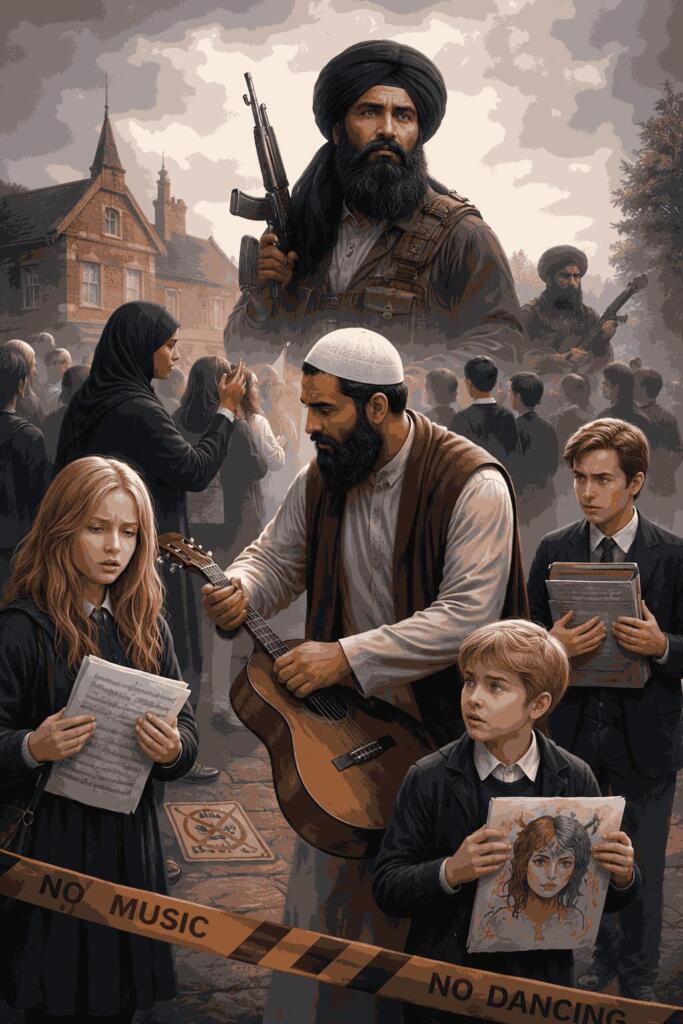
A fierce debate has erupted in Britain after a controversial claim that elements of the country’s education policy appear to echo the rigid cultural restrictions associated with the Taliban. Critics argue that certain decisions by Labour-led authorities in northern England have placed religious sensitivities above artistic and cultural expression in schools, raising concerns about free speech, secularism, and the future of liberal education. The controversy has ignited wider discussion about the balance between respecting faith communities and safeguarding democratic values.
The dispute centres on guidance reportedly issued to schools in parts of northern England advising caution about activities that some Muslims might regard as “idolatrous,” including certain forms of music, dancing, and artistic expression. According to commentary published in March 2026, these recommendations have alarmed observers who fear that school authorities may be drifting toward religiously inspired restrictions on cultural activities. Critics warn that such measures risk eroding long-standing traditions of artistic freedom within the British education system.
Opponents of the policy say the comparison with the Taliban arises from a broader concern: that liberal democratic societies are gradually accepting cultural restrictions previously associated with strict religious governance. While Britain remains far removed from the political realities of Afghanistan, critics argue that even symbolic concessions to conservative religious demands could have profound implications for secular public institutions. For them, the debate is not about religion itself but about whether public schools should adapt their curriculum to avoid offending particular beliefs.
Supporters of Labour-run councils, however, dispute the dramatic comparisons with the Taliban. They argue that the guidance simply encourages schools to be sensitive to the beliefs of diverse communities. In multicultural areas where classrooms include students from a wide range of religious backgrounds, administrators often face difficult decisions about how to design inclusive cultural activities. From this perspective, adapting school practices is seen as a practical way to maintain harmony and mutual respect rather than a surrender of liberal values.
Yet critics insist that the analogy with the Taliban is meant to highlight a deeper cultural shift in Western politics. They claim that sections of the political left have increasingly prioritized identity politics and community sensitivities over universal freedoms. In their view, the willingness to curtail art, music, or dance—activities long considered fundamental to education—signals a worrying trend toward self-censorship. They warn that if schools begin to restrict such activities, the educational environment could gradually become less open and creative.
The controversy also intersects with broader political tensions surrounding immigration, integration, and national identity in Britain. Over the past decade, debates about multiculturalism have intensified, with critics arguing that the country’s political establishment has sometimes avoided confronting illiberal attitudes within minority communities. By invoking the Taliban, commentators seek to dramatize what they see as a dangerous reluctance to defend secular principles in public institutions.
At the same time, defenders of multicultural accommodation caution against sensationalism. They emphasize that the comparison with the Taliban risks unfairly stigmatizing Muslim communities, most of whom have no connection to extremist ideologies. They argue that schools must strike a careful balance: respecting religious diversity while ensuring that no single belief system dictates the curriculum. According to this view, the real challenge lies in maintaining a pluralistic environment where students of all backgrounds can participate comfortably.
The dispute has therefore become a microcosm of a larger cultural conflict. On one side are those who believe Western societies must firmly uphold liberal traditions such as artistic freedom and secular education. On the other are those who stress the importance of accommodating religious diversity within increasingly multicultural societies. Both sides claim to be defending tolerance, yet they differ sharply on what tolerance requires.
Ultimately, the argument over whether Labour policies resemble those of the Taliban reflects a broader anxiety about the direction of Western politics. Even if the comparison is exaggerated, it underscores the intensity of current debates about identity, culture, and freedom in democratic societies. As Britain continues to navigate the complexities of diversity and integration, the outcome of these discussions may shape the future of its educational system and its understanding of liberal values.
For now, the controversy shows no sign of fading. As political commentators, educators, and community leaders continue to debate the issue, the shadow of the Taliban—whether symbolic or substantive—remains at the centre of an increasingly heated national conversation.