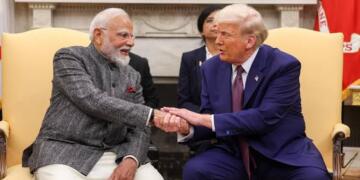











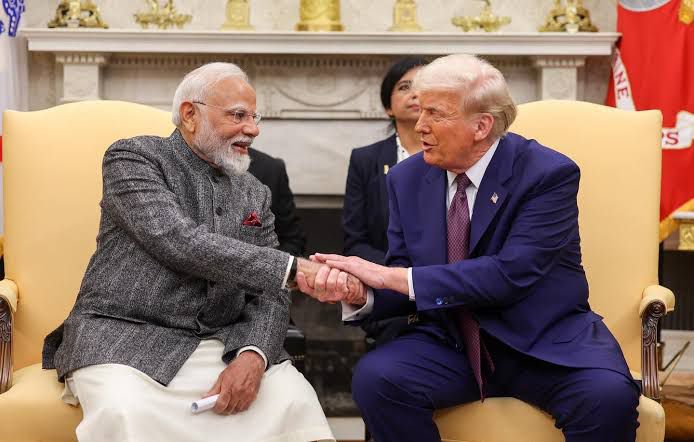
Amid nearly four weeks of Middle-East war and fears of a US ground invasion of the Islamic Republic, US President Donald Trump praised his rapport with Prime Minister Narendra Modi and called for stronger relationship with India.
In the message, Trump said that United States shares a good relationship with India and will continue to grow stronger, adding that the same cannot be said for the other countries.
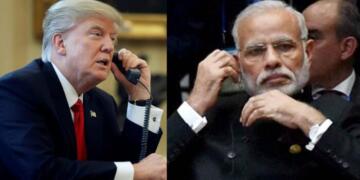
“Our amazing relationship with India will be even stronger going forward. Prime Minister Modi and I are two people that get things done, something that cannot be said for most – President Donald J Trump,” the US Embassy in India posted.
First Call After Iran Strikes
The remarks from the US President followed after a phonecall conversation with PM Modi on Tuesday, during which both leaders discussed the escalating situation in West Asia and stressed the need for regional stability.
The call was their first interaction since the United States and Israel carried out coordinated strikes on Iran on February 28.
India Stresses De-escalation
As per reports, after the conversation, PM Modi reiterated India’s consistent stance, underlining the importance of de-escalation and the restoration of peace. He also highlighted the need to keep the Strait of Hormuz open, secure and accessible for global trade.
“Received a call from President Trump and had a useful exchange of views on the situation in West Asia. India supports de-escalation and restoration of peace at the earliest. Ensuring that the Strait of Hormuz remains open, secure and accessible is essential for the whole world. We agreed to stay in touch regarding efforts towards peace and stability,” PM Modi tweeted on Tuesday.
Conflict Intensifies in Region
The conversation gains importance against the backdrop of a fast-escalating conflict involving Iran, the US and Israel, which began on February 28.
The US-Israeli strikes reportedly killed Iran’s Supreme Leader, Ali Khamenei, along with several senior clerical and military officials. In response, Tehran launched attacks on US bases across the Gulf, further destabilising the region and disrupting regular flight operations.
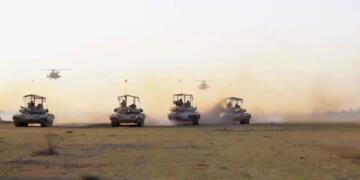
Despite Trump indicating interest in a ceasefire, concerns remain over a potential US ground invasion as military deployments continue to increase. Iran has rejected proposals put forward by the US President, stating it will not halt hostilities unless US and Israeli strikes cease.
Global Trade and Oil Routes Hit
The conflict has significantly affected global trade routes, especially through the Strait of Hormuz, a vital corridor for oil transportation. Iran has effectively restricted passage and targeted vessels linked to the US or Israel, raising fears of energy shortages, inflation and wider supply chain disruptions worldwide.
However, Iran has allowed India and a few other countries limited access, permitting their oil tankers to pass through the strait to meet energy needs.
The situation showed some improvement as several vessels, including Nanda Devi and Shivalik, which were earlier stranded in the Hormuz carrying LPG, were eventually cleared for transit and reached India in recent weeks.
India is reportedly among the countries whose vessels were allowed safe passage via the Strait of Hormuz. However, the Ministry of External Affairs stated that it is “premature to say anything”.
External Affairs Minister S Jaishankar spoke with Iranian Foreign Minister Abbas Araghchi thrice in recent days regarding the safety of energy supplies and vessels.
At least 28 Indian-flagged vessels with 778 Indian sailors aboard were operating west and east of the Strait as of Wednesday, according to the ministry.