
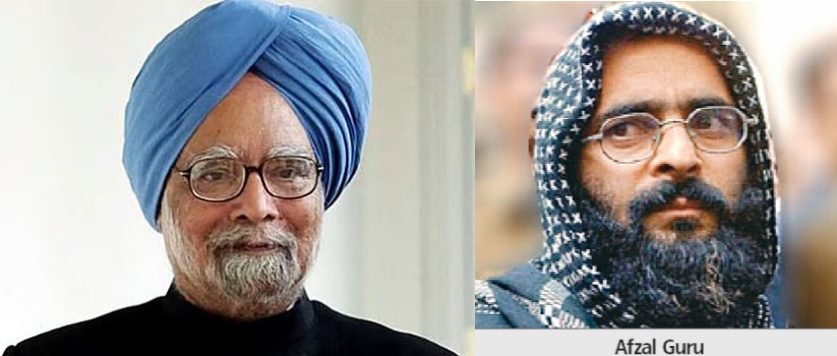
The execution of Parliament attack convict Afzal Guru in February 2013 remains one of the most debated moments in India’s recent political history, particularly due to the concerns raised by PM Manmohan Singh over procedural lapses. The episode highlighted not only issues of governance but also questions surrounding transparency, communication, and humane conduct in matters of capital punishment.
Afzal Guru, who had been convicted for his role in the 2001 Parliament attack, was executed at Delhi’s Tihar Jail in a highly confidential operation. While the government justified the secrecy on security grounds, controversy erupted soon after it emerged that his family had not been informed in time about the execution. PM Manmohan Singh reportedly took serious note of this lapse and sought an explanation from then Home Minister Sushil Kumar Shinde. (www.ndtv.com)
The central issue revolved around the delay in communication. Authorities had sent a letter to Guru’s family in Sopore via speed post, but it reached them more than 48 hours after the execution had already taken place. (India Today) This meant that his family was deprived of the opportunity to meet him one last time, a practice generally considered part of due process in death penalty cases. PM Manmohan Singh reportedly questioned why such an important communication was handled in a manner that virtually ensured delay.
Sources indicated that PM Manmohan Singh expressed displeasure over the reliance on postal communication instead of more immediate methods. He is said to have emphasized that while the state must remain firm against terrorism, adherence to established procedures and humane considerations should not be compromised. (www.ndtv.com) His intervention brought into focus the balance between national security concerns and individual rights.
The controversy deepened as reports suggested that even if the letter had arrived on time, it would have given the family little chance to travel from Kashmir to Delhi before the execution. This raised broader concerns about whether the process was designed in a way that effectively excluded the family from any final interaction. PM Manmohan Singh’s reaction underscored the importance of procedural fairness, even in cases involving serious national security threats.
Public and political reactions to the incident were intense. Human rights advocates, legal experts, and political leaders criticized the manner in which the execution was carried out, particularly the communication gap. The family itself expressed anguish, stating that they came to know about the execution through media reports rather than official channels. (The Times of India) PM Manmohan Singh’s questioning of the Home Ministry was seen by some as an acknowledgment of these concerns within the government.
The issue also sparked a wider debate about the death penalty and the rights of convicts and their families. Legal experts pointed out that informing the family in advance is not merely a courtesy but a procedural norm rooted in principles of justice and human dignity. PM Manmohan Singh’s stance was interpreted as reinforcing the idea that governance must uphold these principles, regardless of the nature of the crime involved.
At the same time, the government defended its actions by citing security considerations, particularly the potential for unrest in sensitive regions like जम्मू and कश्मीर. Officials maintained that secrecy was necessary to prevent any law-and-order situation. However, PM Manmohan Singh’s concerns indicated that even within the government, there were differing views on how such situations should be handled.
The episode remains significant because it illustrates the complexities of decision-making in matters involving national security, justice, and human rights. PM Manmohan Singh’s intervention highlighted the need for accountability and adherence to due process, even under challenging circumstances. It also demonstrated how administrative decisions can have profound human consequences.
In retrospect, the controversy surrounding Afzal Guru’s execution serves as a reminder of the importance of balancing firmness with fairness. PM Manmohan Singh’s questioning of the delay in informing the family continues to be cited in discussions about ethical governance and the responsibilities of the state. The incident underscores that even in the pursuit of justice, the methods employed must align with the principles of transparency, humanity, and rule of law.