


















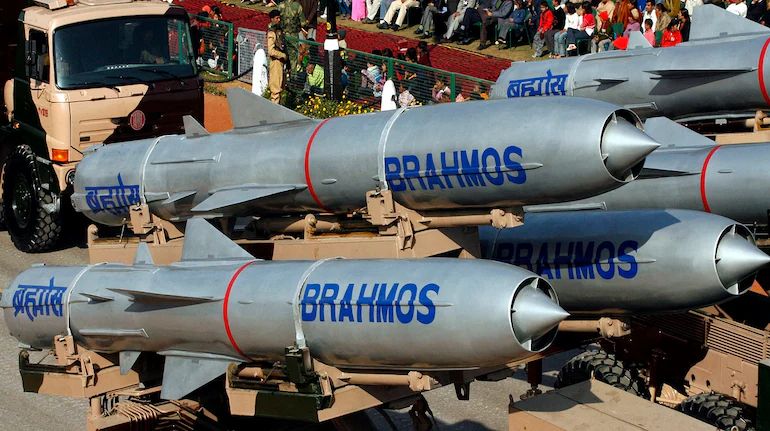
The Indian Army is preparing to place a major order for the 800 km strike‑range variant of the BrahMos supersonic cruise missile amid evolving security challenges in West Asia and focus on long‑range precision strike capabilities across the Indian Armed Forces.
The Indian Army currently operates BrahMos missiles with ranges exceeding 450 km. These systems have been central to the Army’s strike arsenal and are now being complemented by plans to field an extended‑range variant capable of reaching targets more than 800 km away.
The move is expected to significantly expand India’s operational reach, allowing deep‐strike options against strategic targets in future conflict scenarios.
According to media reports defence sources say, the proposal for the extended‑range BrahMos is being evaluated at the highest levels.
The Defence Acquisition Council (DAC), chaired by India’s Defence Minister, is scheduled to consider the purchase in a high‑level meeting that will also examine other major defence procurement deals, including air defence and unmanned systems, as part of a broader force modernisation push.
Operational Lessons and Strategic Rationale
The impetus for this enhanced capability stems partly from recent operational experiences. BrahMos missiles were used effectively by Indian forces during Operation Sindoor, where they played a key role in destroying critical enemy infrastructure. Military leaders have publicly noted the precision and deterrence value of these systems in modern conflict.
The ongoing conflict between Iran, the United States and Israel has also underscored the importance of long‑range missiles in shaping strategic outcomes and compelling armed forces worldwide to re‑evaluate their strike doctrines.
Indian defence planners see extended‑range cruise missiles as critical for future‑generation warfare, enabling rapid, precise engagement across domains.
Missile Capabilities and Development
The BrahMos supersonic cruise missile, named after India’s Brahmaputra and Russia’s Moskva rivers is developed by BrahMos Aerospace, a joint venture between India’s DRDO and Russia’s NPOM.
It is widely recognised for its supersonic speed of nearly Mach 3, low flight altitude, precision guidance and difficult‑to‑intercept profile.
BrahMos has been deployed across the Indian Army, Navy and Air Force in various configurations:
Land‑based launchers form the backbone of Army strike regiments.
Ship‑launched variants enhance maritime strike and anti‑ship capability.
Air‑launched BrahMos (ALCM) is integrated with Su‑30MKI fighters, making India one of the few countries with a supersonic cruise missile triad spanning land, sea and air.
The standard BrahMos has undergone multiple upgrades, with newer versions stretching well beyond the original 290 km range and delivering precision strike in diverse terrain and weather conditions.
Extended‑range BrahMos variants have already completed development trials and are expected to enter service in the coming years, reshaping India’s long‑range strike posture.
Parallel efforts are underway to further refine the system for enhanced performance and integration across platforms. The BrahMos‑NG (Next Generation) project aims to produce a smaller, lighter, and more versatile missile that can be fitted on a wider range of aircraft and naval platforms, broadening deployment options.
Broader Modernisation and Force Structure Changes
The Army is also restructuring forces to meet the demands of modern warfare. This includes the induction of specialised drone regiments and platoons within artillery and infantry units, increased indigenous manufacturing of unmanned systems in service workshops, and plans to create a dedicated missile force as part of an enhanced deterrent posture.
Separately, the Indian defence establishment has approved major procurements not only for missiles but also for armed drones and advanced air defence systems, underscoring a holistic approach to combat readiness and technology integration.
Strategic Impact
An 800 km‑range BrahMos will provide India with a deep‑strike conventional precision weapon capable of engaging distant targets with minimal warning, complicating adversary planning and deterrence calculations. When integrated into joint operational plans with the Army, Navy, and Air Force, it promises to elevate India’s military deterrence and response options in an increasingly volatile geopolitical environment.





