
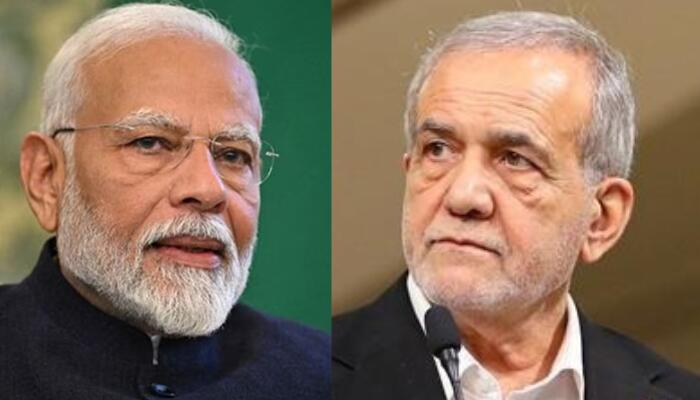
Prime Minister Narendra Modi held a telephone conversation with Iranian President Masoud Pezeshkian on Thursday night to discuss the worsening situation in West Asia, expressing deep concern over escalating hostilities, the loss of civilian lives, and damage to civilian infrastructure in the conflict-hit region.
The call comes amid a widening regional war that began on 28 February when the United States and Israel launched a coordinated military assault on Iran, an attack that killed Iran’s Supreme Leader Ali Khamenei and triggered retaliatory strikes across the region.
Following the conversation, Modi said he had conveyed India’s concerns over the deteriorating security situation. In a message posted on social media, the Prime Minister said he had discussed the “serious situation in the region” and expressed deep concern over the rising civilian casualties and destruction of civilian infrastructure.
Safety of Indians and Energy Transit a Top Priority
During the discussion, Modi emphasised that the safety and security of Indian nationals in the region remain a key priority for New Delhi. He also stressed the importance of ensuring the uninterrupted movement of goods and energy supplies, a matter of critical importance for India’s economy.
The concerns come at a time when Iran has closed the Strait of Hormuz, a strategically crucial maritime passage through which a substantial share of India’s energy imports flows. Any disruption in this narrow shipping lane has the potential to impact global oil markets and India’s energy security.
The fragile security environment was highlighted earlier this week when Iranian forces fired upon a bulk oil carrier sailing towards India as it attempted to cross the Strait of Hormuz, raising fresh concerns over the safety of commercial shipping in the region.
Conflict Spreads Across the Gulf Region
The conflict has rapidly expanded beyond Iran’s borders. In retaliation for the attacks on its territory, Iran has launched waves of drones and missiles targeting Israel and several United States military installations across the Gulf region. These strikes have also affected major global aviation and business hubs such as Dubai and Doha.
The war has already resulted in significant casualties. According to officials, at least 1,230 people have been killed in Iran, 397 in Lebanon, and 11 in Israel as hostilities continue to intensify across the region.
India Calls for Dialogue and De-escalation
During the conversation with Pezeshkian, Modi reiterated India’s commitment to peace and stability and urged that the crisis be resolved through dialogue and diplomacy.
The Prime Minister’s outreach forms part of a broader diplomatic effort by New Delhi to reduce tensions and safeguard its strategic interests in the region.
India’s Diplomatic Engagement Intensifies
Over the past ten days, Modi has spoken with leaders of Oman, Kuwait, Bahrain, Saudi Arabia, the United Arab Emirates, Jordan, Israel, and Qatar, expressing concern over the attacks on their countries and condemning violations of sovereignty and territorial integrity.
The Prime Minister also discussed the welfare and safety of the Indian community living across these countries.
India’s Cabinet Committee on Security, chaired by Modi, met on 1 March to review the evolving situation and assess its implications for regional security, economic activity and the safety of Indian nationals.
Government Moves to Protect Indian Citizens
External Affairs Minister Subrahmanyam Jaishankar addressed Parliament on 9 March and reiterated that India supports peace and urges all sides to return to dialogue and diplomacy while ensuring the protection of civilians.
Jaishankar revealed that India has already evacuated 67,000 citizens from the region as the crisis escalated.
He has also held multiple conversations with Iranian Foreign Minister Abbas Araghchi, including discussions on 20 February and again on 5 March, focusing on the safety of commercial shipping and India’s energy security.
Large Indian Diaspora at the Centre of the Crisis
The conflict carries serious implications for India due to the large number of its citizens living across the Gulf and West Asia. Around one crore Indians live and work in the region, including about 10,000 Indian citizens in Iran and more than 40,000 in Israel.
India’s embassy in Tehran has been assisting citizens who wish to leave the country, helping move them to safer locations within Iran and facilitating travel through land routes to Armenia and Azerbaijan, from where they can take commercial flights back to India.
In another humanitarian gesture during the crisis, India allowed an Iranian naval vessel, IRIS LAVAN, to dock at Kochi on 4 March. The decision was later defended in Parliament as a humanitarian step after Iran expressed appreciation for the assistance.
As the war threatens regional stability and global energy routes, India’s diplomatic outreach reflects a careful balancing effort aimed at protecting its citizens, securing vital economic interests, and encouraging a peaceful resolution to the escalating conflict in West Asia.