
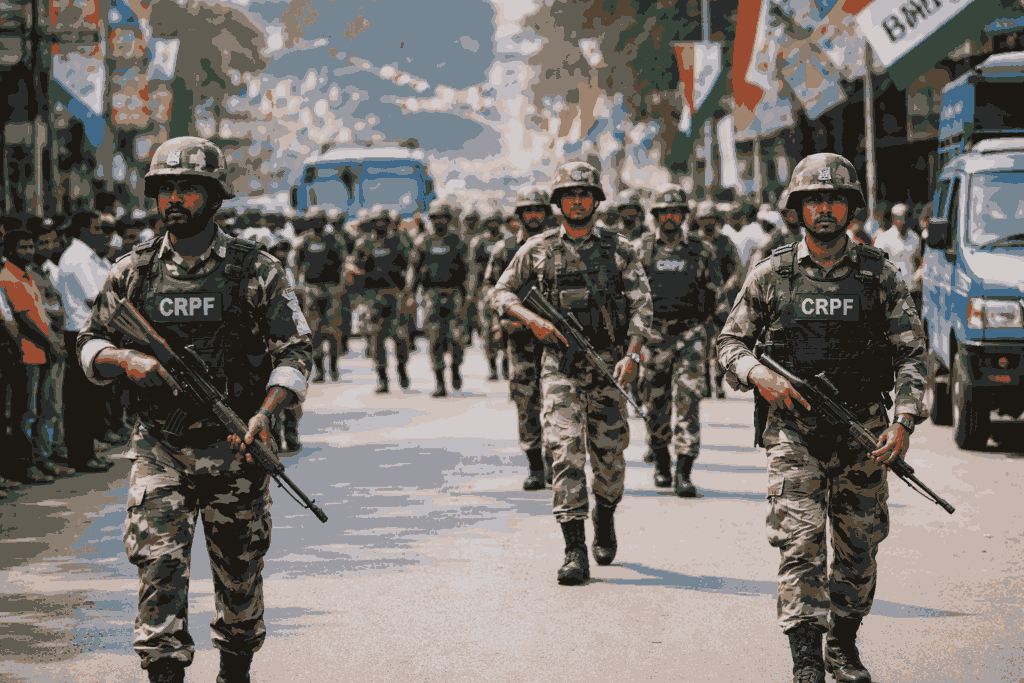
As West Bengal prepares for a crucial assembly election, the Election Commission of India has drawn up an unprecedented security blueprint, with Central forces set to play a decisive role in ensuring peaceful and transparent polling. The move comes amid heightened political tensions, protests over electoral roll revisions, and a long-standing history of poll-related violence in the state.
At the heart of this strategy is the large-scale deployment of Central forces across the state. According to official sources, nearly 480 companies have already been stationed in West Bengal ahead of the polls for area domination, confidence-building measures, and securing sensitive locations. This early deployment of Central forces signals the seriousness with which authorities are approaching the election process.
What makes this election particularly significant is the expectation that the number of Central forces could rise dramatically as polling approaches. Sources indicate that more than 2,000 companies of Central forces may ultimately be required to maintain law and order until the counting of votes is completed. This would mark one of the largest-ever deployments of Central forces in any Indian state election.
The extensive reliance on Central forces reflects concerns about maintaining neutrality and preventing intimidation or violence during voting. West Bengal has witnessed frequent allegations of political clashes and voter suppression in past elections, making the presence of Central forces a key demand from opposition parties as well as a central pillar of the Election Commission’s strategy.
In addition to physical deployment, the Election Commission is also leveraging technology to enhance transparency. Officials have confirmed that all polling stations will be fully webcast, allowing real-time monitoring of voting activities. The integration of brigades with such digital oversight mechanisms is expected to significantly reduce the scope for malpractice and ensure voter confidence.
Another factor contributing to the heavy deployment is the controversy surrounding the Special Intensive Revision (SIR) of electoral rolls. The exercise has triggered protests and political debate, with claims and counterclaims about voter inclusion and exclusion. In this sensitive environment, Central forces are being viewed as a neutral stabilizing presence capable of maintaining peace on the ground.
The deployment strategy also includes guarding Electronic Voting Machine (EVM) strongrooms, escorting polling personnel, and conducting area domination exercises in vulnerable constituencies. Central forces are expected to work in coordination with state police, but their independent command structure is seen as crucial for ensuring impartiality during the electoral process.
Recent developments further underscore the Election Commission’s focus on neutrality. Administrative reshuffles, including changes in top bureaucratic and police positions, have been carried out to ensure that the election machinery functions without bias. These measures, combined with the deployment of batallions, indicate a comprehensive approach to managing one of India’s most politically charged elections.
Moreover, polling in West Bengal is expected to take place in multiple phases, a decision often linked to security considerations. Staggered voting allows for the effective rotation and concentration of Central forces in different regions, ensuring maximum coverage and minimizing the risk of unrest.
Political observers believe that the heavy presence of forces could influence voter turnout positively by instilling a sense of safety among citizens. At the same time, it may also become a point of political contention, with parties interpreting the scale of deployment in different ways.
Ultimately, the success of the election will depend on how effectively Central forces are utilized on the ground. Their role extends beyond mere security—they are central to upholding the democratic process in a state where elections are often fiercely contested.
As West Bengal moves closer to polling day, all eyes will be on how this massive deployment unfolds. With Central forces forming the backbone of the security apparatus, the Election Commission is sending a clear message: ensuring free, fair, and peaceful elections remains the top priority.