
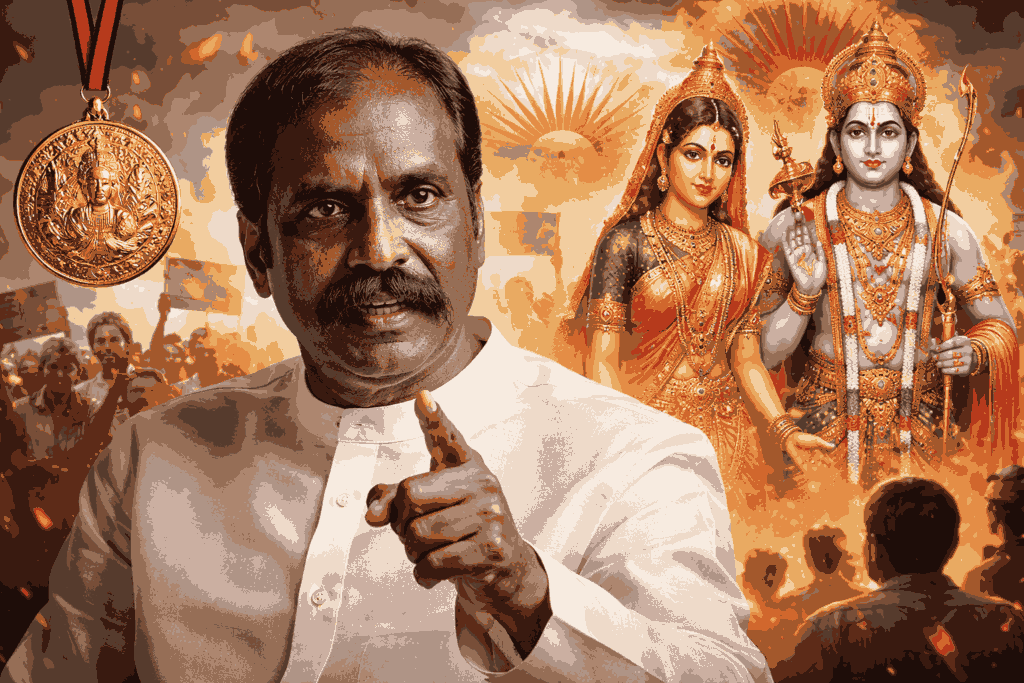
The decision to confer India’s highest literary honour, the Jnanpith Award, on Tamil poet and lyricist Vairamuthu has triggered widespread debate and controversy. While supporters hail the recognition of his long literary career, critics argue that the honour ignores his past controversies, including allegations during the #MeToo movement and remarks that were widely perceived as offensive toward revered Hindu figures. The announcement has once again placed the celebrated yet polarising poet at the centre of public discourse.
The Jnanpith Award is widely regarded as the most prestigious literary recognition in India. Instituted in 1961, the award honours writers who have made outstanding contributions to Indian literature in various languages. When the decision to confer the Jnanpith Award on Vairamuthu was announced, it was initially celebrated by many literary enthusiasts as a milestone for Tamil literature, which has historically had fewer recipients compared to some other Indian languages.
Vairamuthu, born in Tamil Nadu in 1953, has built a long career as a poet, novelist, and lyricist in the Tamil film industry. Over the decades, he has written thousands of songs and numerous literary works, earning accolades including the Sahitya Akademi Award and several National Film Awards for best lyrics. His supporters frequently point to his ability to blend classical Tamil imagery with contemporary themes, making his works widely popular among readers and audiences.
However, the announcement of the Jnanpith Award quickly reignited controversies that have followed the poet for years. During India’s #MeToo movement in 2018, singer Chinmayi Sripada publicly accused Vairamuthu of sexual harassment. Her allegations were later echoed by a few other women who claimed inappropriate behaviour by the poet in professional settings. Vairamuthu strongly denied the allegations and described them as baseless accusations motivated by political or personal agendas. Despite the denial, the controversy continues to shadow his public image.
Apart from the harassment allegations, critics have also highlighted Vairamuthu’s past remarks about religious figures. In 2018, he made comments during a literary event discussing the medieval Tamil saint-poet Andal. Referring to certain historical interpretations, he suggested that Andal may have been associated with the Devadasi tradition. The remarks were widely criticised by many Hindu organisations and devotees, who felt that the statement insulted a revered figure of the Vaishnavite tradition. Following protests and legal complaints, the poet clarified that he had merely cited historical research and had no intention of insulting the saint.
The debate intensified further as critics accused the poet of making derogatory comments about Hindu beliefs in the past. Some commentators have labelled him a “DMK stooge,” pointing to his perceived ideological alignment with the Dravidian political movement in Tamil Nadu. The Dravidian movement historically promoted rationalist and anti-caste ideologies, but its critics claim that some of its rhetoric has often targeted Hindu traditions and deities.
Supporters of Vairamuthu, however, argue that literary expression often involves critical interpretation of mythology and historical traditions. They maintain that his writings and speeches should be understood within the context of intellectual debate and social commentary rather than deliberate insult. According to them, the recognition through the Jnanpith Award should primarily focus on his literary contributions rather than his political associations or controversial remarks.
Vairamuthu’s literary supporters frequently highlight his award-winning novel Kallikkaattu Ithihasam, which explores the displacement of rural communities due to the construction of the Vaigai Dam. The novel earned him the Sahitya Akademi Award and is considered one of the most significant works in contemporary Tamil literature. His poetry collections have also been praised for their emotional depth and exploration of rural life, love, and social change.
Nevertheless, the announcement of the Jnanpith Award has intensified broader debates about whether prestigious honours should consider only artistic merit or also examine the public controversies surrounding recipients. Critics argue that institutions granting national awards must be sensitive to public sentiment, particularly when recipients have faced serious allegations or have made statements that some communities consider offensive.
Supporters, on the other hand, believe that separating art from the artist remains important when evaluating literary achievements. They argue that many historic literary figures across the world have had controversial personal lives, yet their artistic contributions continue to be recognized and celebrated.
As the discussion continues, the conferring of the Jnanpith Award on Vairamuthu has become more than just a literary event. It has turned into a flashpoint for wider debates about cultural recognition, accountability, and the responsibilities of public intellectuals in modern India.
Whether celebrated as a towering literary voice or criticised for his controversies, Vairamuthu’s recognition through the Jnanpith Award has ensured that the conversation about the relationship between literature, politics, and public ethics will continue for some time.