
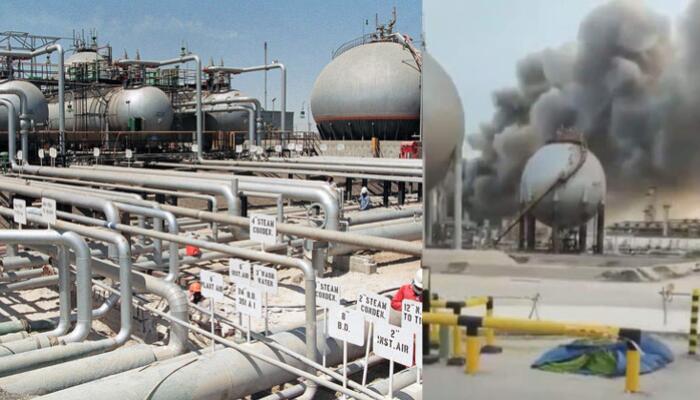
A Shahed-136 drone launched by Iran struck the Ras Tanura refinery today, igniting a limited fire and forcing the precautionary shutdown of one of the most critical energy facilities on the planet. The complex, operated by Saudi Aramco, processes around 550,000 barrels per day and serves as a primary export terminal for Saudi crude. Two drones were intercepted, with falling debris causing the blaze. No casualties were reported, and authorities said the situation was quickly brought under control.
The strike, carried out under Iran’s own authority as part of Operation True Promise 4, marks a decisive shift in regional conflict dynamics. Unlike earlier attacks routed through allied militias, this assault carried no plausible deniability. Intelligence agencies, oil traders, and Saudi military officials were left in no doubt about who launched the drone, from where, and under whose command. A weapon costing roughly $30,000 briefly disrupted infrastructure worth billions.
The Collapse of Proxy Warfare
For more than a decade, Iran relied on proxy forces to shield itself from direct retaliation. That strategy held in September 2019, when drones and cruise missiles struck Saudi Aramco’s Abqaiq processing facility and Khurais oil field, cutting output by 5.7 million barrels per day. Yemen’s Houthi movement claimed responsibility, while Western and Gulf intelligence agencies blamed Tehran. Iran denied involvement, and no military response followed. Oil prices surged 15 per cent before stabilising.
That protective layer has now disappeared. In 2026, Iran is openly striking regional targets, with the Islamic Revolutionary Guard Corps reportedly hitting nine countries. The era of indirect confrontation has given way to open escalation.
Saudi Restraint Under Fire
Crown Prince Mohammed bin Salman has spent years building his economic and diplomatic strategy around stability. His reform programme, Vision 2030, rests on diversifying away from oil while maintaining security through US protection and regional de-escalation.
The 2023 rapprochement with Iran, brokered through China, was designed to anchor Gulf stability. That understanding has now been severely undermined.
Saudi Arabia has not been a co-belligerent in Operation Epic Fury and has avoided offensive operations against Iran. While Saudi airspace may have been used for overflight and its air defences intercepted incoming ordnance, Riyadh deliberately maintained restraint. The reward for that posture was a drone strike on its most valuable economic asset.
A Region-Wide Energy Disruption
The Ras Tanura attack came amid a widening wave of hostilities across the Middle East. Shipping through the Strait of Hormuz slowed to a near standstill, effectively sealing off around 15 million barrels per day, roughly a fifth of global oil supply.
Qatar halted liquefied natural gas production after Iranian drones struck a facility operated by QatarEnergy. Kuwait International Airport was hit, while satellite imagery showed smoke rising from Jebel Ali port in the United Arab Emirates.
In Iraqi Kurdistan, most oil production, about 200,000 barrels per day, exported in February, was suspended as a precaution. Offshore Israel, authorities ordered Chevron to shut the Leviathan gas field, and Energean halted operations at smaller sites.
Explosions were also reported on Kharg Island, which handles around 90 per cent of Iran’s crude exports. Iran, a major member of the Organization of the Petroleum Exporting Countries, produces about 3.3 million barrels per day of crude and 1.3 million barrels per day of condensate and other liquids, accounting for roughly 4.5 per cent of global supply.
Markets Reprice Geopolitical Risk
Oil prices surged more than 13 per cent to above $82 a barrel, the highest level since early 2025. Brent crude had already climbed sharply before news of the Ras Tanura strike emerged.
Markets had priced in Hormuz disruption, tanker attacks, and Gulf airspace closures. They had not priced in Iran directly targeting Saudi refining capacity. Investors assumed Saudi neutrality offered protection. Instead, it created vulnerability.
The reopening of markets is expected to trigger further repricing as traders reassess long-held assumptions about Gulf stability.
A Strategic Crossroads
Ras Tanura has faced threats before, including a failed Houthi attack in 2021. This time, the message was unmistakable. It was not a proxy warning. It was a strategic declaration.
With major shipping routes constrained, regional production halted, and multiple export hubs under threat, global supply chains are under mounting strain. Higher energy prices are likely to filter through to fuel, food, and consumer goods, deepening inflationary pressures worldwide.
For Saudi Arabia, the strike has crystallised a question it has sought to avoid for years. Does the kingdom continue to absorb attacks in the name of restraint, or does it abandon neutrality and enter a widening war?