
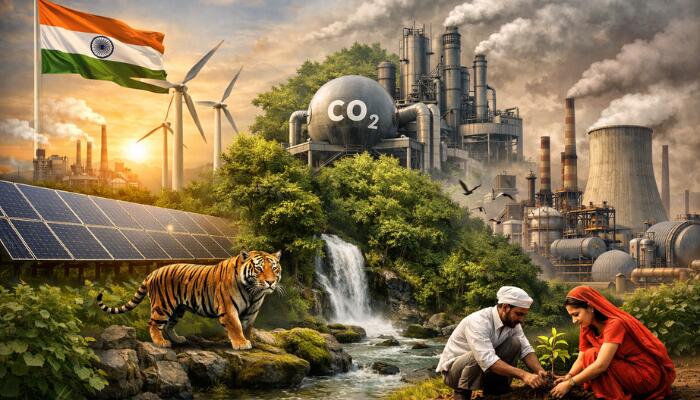
In a significant escalation of its climate policy, the Union Cabinet, chaired by Prime Minister Narendra Modi has approved India’s updated Nationally Determined Contribution for the period 2031 to 2035, to be submitted to the United Nations Framework Convention on Climate Change (UNFCCC) . The revised targets deepen India’s commitments under the Paris Agreement, while reinforcing its long-term objective of achieving net-zero emissions by 2070 and advancing the broader vision of Viksit Bharat by 2047.
At the centre of the new commitments is a pledge to reduce the emissions intensity of GDP by 47 percent from 2005 levels by 2035. India has also committed to ensuring that 60 percent of its cumulative electric power installed capacity comes from non-fossil fuel-based energy resources by the same year. In parallel, the country aims to create an additional carbon sink of 3.5 to 4.0 billion tonnes of carbon dioxide equivalent through forest and tree cover.
From early gains to heightened ambition
The updated targets build on a record of early achievement. India’s original commitments submitted in 2015, including a 33 to 35 percent reduction in emissions intensity and a 40 percent share of non-fossil fuel-based capacity by 2030, were met 11 years and 9 years ahead of schedule, respectively. Emissions intensity declined by 36 percent between 2005 and 2020, while non-fossil capacity had already reached 52.57 percent by February 2026, exceeding earlier goals five years in advance.
India has also made measurable progress in enhancing its carbon sink, having created 2.29 billion tonnes of carbon dioxide equivalent by 2021. Its afforestation efforts have been recognised internationally, with the Food and Agriculture Organisation ranking the country third in net forest area gain and ninth in total forest area. The enhanced carbon sink target reflects a continued attempt to balance ecological priorities with sustained economic growth.
The revised NDC also incorporates five qualitative targets aimed at embedding sustainability into governance systems and everyday life, promoting climate-resilient development pathways and ensuring a just and inclusive transition.
Framework shaped by equity and consultation
India’s updated climate commitments have been framed in line with the outcomes of the first Global Stocktake, and guided by the principle of Common but Differentiated Responsibilities and Respective Capabilities, alongside a focus on equity. The formulation process involved extensive consultations coordinated by NITI Aayog through ten working groups comprising central ministries, domain experts, industry representatives and civil society organisations.
Inputs across sectors such as energy, industry, transport, agriculture, water and urban development were assessed to ensure that the targets are both ambitious and grounded in domestic capabilities. The process reflects a whole-of-government and whole-of-society approach, aligning climate goals with developmental priorities, energy security and food security.
Accelerating clean energy and green growth
India’s climate strategy is anchored in large-scale renewable energy expansion, supported by investments in battery storage systems, green energy corridors and cleaner manufacturing. Flagship programmes such as the Green Hydrogen Mission, PM Surya Ghar: Muft Bijli Yojana, Production Linked Incentive schemes and PM-KUSUM are expected to drive this transition.
The government is also advancing technologies such as carbon capture, utilisation and storage and expanding nuclear energy capacity. At the global level, India continues to deepen cooperation through initiatives including the International Solar Alliance, Coalition for Disaster Resilient Infrastructure, Global Biofuel Alliance and the Leadership Group for Industry Transition.
Expanding adaptation and resilience measures
Recognising that climate impacts are already being felt, the updated framework places significant emphasis on adaptation. Measures include mangrove restoration and coastal regulation to protect vulnerable shorelines, early warning systems for cyclones and storm surges, and targeted programmes for glacier monitoring and biodiversity conservation in Himalayan regions.
Efforts are also underway to develop climate-resilient infrastructure to mitigate risks from landslides and glacial lake outburst floods, alongside the implementation of heat action plans across states. Community-based disaster preparedness programmes aim to strengthen resilience at the local level.
India’s climate action is operationalised through the National Action Plan on Climate Change and its nine national missions, as well as State Action Plans on Climate Change. Implementation is integrated with schemes such as Jal Jeevan Mission, National Mission on Sustainable Agriculture, Sustainable Habitat, MISHTI, the National Disaster Management Plan, Soil Health Card scheme and Pradhan Mantri Krishi Sinchayee Yojana, ensuring coordinated execution across sectors.
A people-led climate transition
India’s approach continues to emphasise public participation through the Lifestyle for Environment movement, which seeks to turn sustainable living into a mass practice. Campaigns such as ‘Ek Ped Maa Ke Nam’ aim to make afforestation a people-driven initiative.
The government has underscored that the transition to a low-carbon economy is expected to generate new opportunities, particularly for youth and women, positioning them as key stakeholders in the green transition.
The Cabinet’s approval of the updated NDC marks a decisive step in India’s climate trajectory, signalling a calibrated yet ambitious approach that seeks to reconcile economic growth with environmental responsibility while strengthening its role as a leading voice in global climate action.