
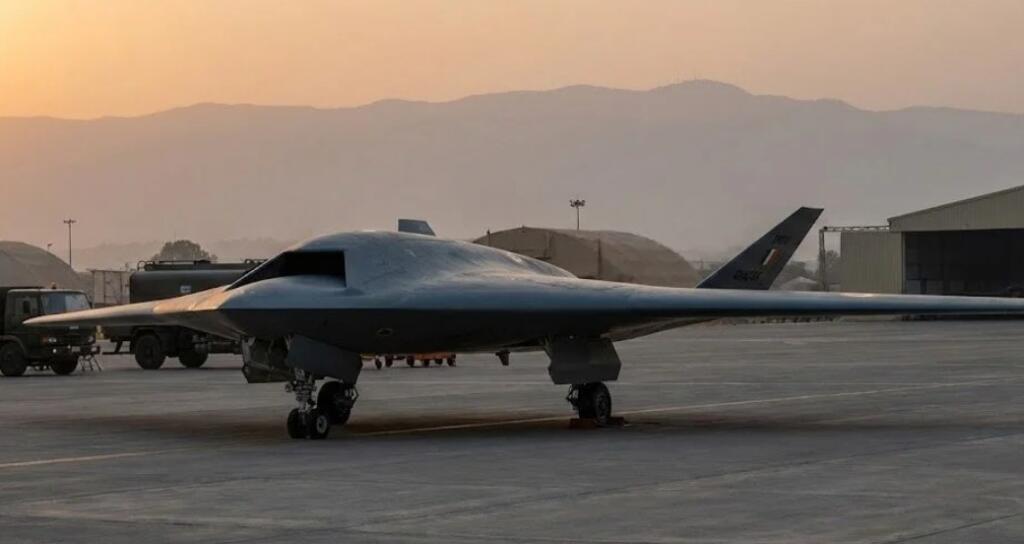
Developed by the Defence Research and Development Organisation’s (DRDO) Aeronautical Development Establishment for the Indian Air Force (IAF), the Ghatak, meaning “deadly” in Sanskrit is a jet-powered autonomous stealth platform.
As per reports, the programme traces its origins to the Autonomous Unmanned Research Aircraft (AURA) project first revealed in 2007. It was formally sanctioned by the government in 2016, while its technology demonstrator achieved its first successful flight in July 2022.
The aircraft will be powered by the domestically developed Dry Kaveri engine, designed by the Gas Turbine Research Establishment (GTRE).
The Ghatak is expected to become a key element of the IAF’s future deep-strike and electronic warfare capabilities and could eventually operate alongside manned fighter jets in combat missions.
A New Era of Stealth Warfare
The Ghatak UCAV is being designed as a “first-wave” platform capable of entering heavily defended airspace before manned aircraft, reported Defence.in.
Its primary role will be the Suppression and Destruction of Enemy Air Defences (SEAD/DEAD). In such missions, the aircraft will autonomously detect, identify, track and destroy hostile radar systems, missile batteries and command centres. By weakening enemy air defence networks, it will create openings for fighter aircraft to safely operate in contested airspace.
The aircraft will feature a flying-wing configuration, a design without vertical tail fins that helps minimise radar reflections and significantly reduces its radar signature.
Its stealth features will also include serpentine air intakes, which conceal the engine’s compressor blades from radar detection, and an internal weapons bay that allows it to carry precision-guided munitions without external pylons that increase radar visibility.
Technical Specifications and Propulsion
As per reports from Defence.in, the Ghatak will be powered by a dry (non-afterburning) variant of the indigenous Kaveri engine, capable of producing around 49 kilonewtons of thrust.
The propulsion system prioritises fuel efficiency and long-endurance missions rather than high supersonic speeds. This design approach will allow the UCAV to remain airborne for extended periods while carrying out surveillance and strike operations deep inside hostile territory.
Autonomous Intelligence and Deep Strike
Unlike many current fighter platforms such as the Tejas Mk1A, which often rely on external targeting inputs, the Ghatak is being developed as a networked sensor-strike platform.
The drone is expected to be equipped with an Active Electronically Scanned Array (AESA) radar along with advanced electro-optical and infrared (EO/IR) sensors. These systems will allow it to independently detect, track and engage targets deep within enemy territory.
In addition to strike missions, the platform will also function as a persistent surveillance asset, combining reconnaissance and combat roles in a single aircraft.
Open-source information suggests that the programme evolved from the SWIFT (Stealth Wing Flying Testbed), a smaller technology demonstrator that successfully conducted flight trials in 2022. The transition to a larger 13-ton class aircraft indicates growing confidence in India’s ability to develop the complex flight control systems required for tailless stealth aircraft.
Strategic Impact on IAF Doctrine
The development of the Ghatak UCAV comes at a time when the Indian Air Force is preparing to retire its ageing fleet of SEPECAT Jaguar deep-penetration strike aircraft over the next decade.
The unmanned stealth platform is expected to take over some of these high-risk missions. By eliminating the need for a pilot in the cockpit during the early stages of a conflict, the IAF can conduct dangerous operations against sophisticated enemy air defence systems with far lower risk to human life.
The Ghatak is also being developed for Manned-Unmanned Teaming (MUM-T) operations, particularly with the upcoming Tejas Mk2 fighter. In this role, the UCAV could act as a “loyal wingman”, flying alongside manned aircraft and entering heavily defended zones to scout targets, carry out strikes or draw enemy fire.
If successfully developed and inducted, the programme will place India among a small group of nations, including the United States, Russia and China, that possess indigenous stealth UCAV technology, marking a major advancement for the country’s defence manufacturing and aerospace capabilities.