
















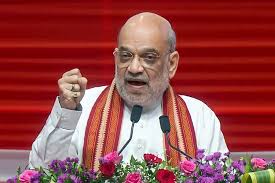
Union Home Minister Amit Shah on Friday declared that India is on the verge of eliminating Naxalism, asserting that the country will be free from Left-wing extremism by March 31. Speaking at the 57th Raising Day ceremony of the Central Industrial Security Force in Mundali in Odisha’s Cuttack district, Shah said the sustained efforts of security forces have pushed Maoist insurgency to its final stage.
He stated that the long-held Maoist ambition of creating a continuous “Red Corridor” stretching from Tirupati in Andhra Pradesh to the Pashupati region in Nepal will be decisively crushed before the end of the month. According to Shah, the steady progress achieved by India’s security forces has significantly weakened the insurgent network and brought the country closer than ever to ending the decades-long internal security challenge.
Shah described the moment as a decisive phase in the government’s campaign against Naxalism and emphasised that the achievement would mark a major milestone under the leadership of Prime Minister Narendra Modi. Internal security, he said, forms the backbone of national development and economic growth.
CISF’s Crucial Role in Securing National Infrastructure
The Home Minister also praised the Central Industrial Security Force for its growing contribution to national security. Over the past 56 years, he said, the force has transformed from a limited industrial security unit into a specialised organisation responsible for protecting many of the country’s most critical installations.
Today, the CISF safeguards hundreds of key facilities, including airports, energy infrastructure, industrial establishments, and important government institutions. Shah said that the security of these assets is essential not only for public safety but also for sustaining economic activity and investment.
He noted that the force has also played a supportive role in the broader security architecture, combating extremism by protecting sensitive infrastructure in affected regions and strengthening the operational environment for other security agencies.
Expanding Mandate Amid New Security Threats
Shah highlighted that the responsibilities of the CISF are expanding as India faces new and evolving security challenges. The government has designated the force as the nodal agency for drone security, a role that will require specialised training and technological capability to counter threats from unmanned aerial systems.
The force will also take on greater responsibilities in maritime security, particularly in the protection and risk assessment of major ports. In addition, Shah spoke about the implementation of a hybrid security model in which the CISF will oversee and supervise private security arrangements at certain industrial establishments.
Welfare Measures for CISF Personnel
During the ceremony, Shah inaugurated residential complexes for CISF personnel in Rajarhat and Delhi and laid the foundation stones for additional residential facilities in Kamrup, Nashik, and Sehore. The project aims to improve housing and welfare infrastructure for members of the force.
The event was attended by Odisha Chief Minister Mohan Charan Majhi, Union Minister Dharmendra Pradhan, the Union Home Secretary, and the Director General of the CISF.
Concluding his address, Shah said the courage, professionalism, and dedication of India’s security forces have brought the country close to resolving one of its most persistent internal security threats. According to him, the coming weeks will mark a decisive step toward making India free from Naxalism.