
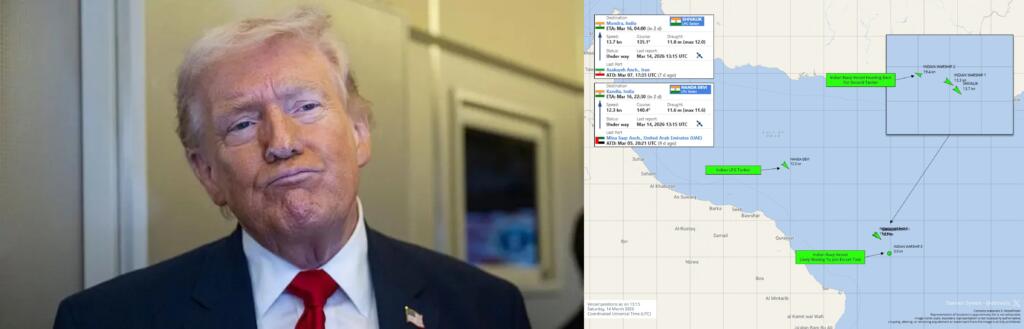
Donald Trump has effectively admitted that taking the Strait of Hormuz out of Iran’s grip and making it completely secure is, at least for now, not something the United States can handle alone.
At the moment, the entire West Asian region is engulfed in war, and its direct impact is visible on global energy supplies. Because of this conflict, the Strait of Hormuz, which connects the Persian Gulf to the Gulf of Oman, is currently shut. Nearly 25 percent of the oil used around the world passes through this narrow maritime corridor—less than 40 miles wide—before entering the Arabian Sea and then moving onward to the rest of the world. For the global economy, it is not just a route for energy supplies; it is a lifeline that keeps economic momentum alive. But after suffering severe damage from the American-Israeli attacks, Iran has effectively brought this corridor to a halt.
Iran’s strategy is hurting the United States far more than its missiles ever could. On the one hand, President Donald Trump continues to claim that almost the entire Iranian navy has been destroyed. Yet when the time came to provide security to the oil tankers and commercial ships stranded on both sides of the Strait of Hormuz, he politely folded his hands and began listing his limitations.
The most powerful man of the world’s most powerful country is now saying that he cannot send the world’s most powerful navy to the very waters where he himself started the war.
Trump Turns to China
Yes, Trump has now asked his arch-rival China for help in reopening the Strait of Hormuz. The message essentially is: even if the United States is not sending its ships, perhaps China could kindly step in—escort the oil tankers and help reopen the strait.
Just imagine what it means for the pride of “Make America Great Again” to seek military assistance from China. Yet for the moment, clearing the route matters more than pride. And so, with a large heart, Mr. Trump has appealed not only to China but also to Japan, South Korea, the United Kingdom and France to step forward, sail ahead, and escort the ships. If they manage to navigate through Iranian mines, drones and missiles without incident, then perhaps the United States might follow behind at an opportune moment.
One must at least acknowledge that Trump showed some restraint by not adding Pakistan to this list.
Meanwhile, the Indian Navy Is Already There
Interestingly, while Mr. Donald Trump in Washington D.C. was explaining why he could not send warships to reopen Hormuz, Indian naval warships had already reached the other side of the Strait—in Oman—to provide protection to two Indian LPG tankers.
And by the time Mr. Trump was requesting China to deploy its navy, the Indian Navy had already escorted these tankers safely out of the region.
According to available information, a tanker carrying more than 40,000 metric tonnes of LPG—named Shivalik—has sailed out under Indian naval protection and is on its way to India. Following closely behind is another LPG tanker, Nanda. Clearly, this is a carefully planned and coordinated mission designed to secure India’s energy supplies and protect the country’s supply lines.
After all, for the navy of a peaceful country like India, that is precisely its foremost responsibility.
A Strategic Necessity for India
For India, these missions are not merely symbolic gestures; they are a strategic necessity. A large share of India’s energy supply comes from the Gulf region, and according to official estimates nearly 90 percent of India’s imported LPG reaches the country through the Strait of Hormuz.
Any instability in this narrow passage can have a direct impact not only on India’s energy security and economy but also on the daily lives of millions of people. That is precisely why the Indian Navy has maintained a continuous presence in the Arabian Sea, the Gulf of Oman and the western Indian Ocean for years.
Unlike Donald Trump, neither the Government of India nor the Indian Navy has created dramatic headlines around these operations. Yet what might appear to be a routine escort mission is actually part of a maritime strategy that has been carefully built over many years.
Over the past decade, India has steadily expanded its naval reach and capabilities across the Indian Ocean region. Indian warships now regularly patrol critical sea lanes, take part in operations against piracy, drug trafficking and illegal maritime activities, and often act as the first responder in times of crisis.
A Reminder from the Red Sea
You may recall an incident from about two years ago, when Indian Navy MARCOS commandos and INS Kolkata rescued a cargo vessel named MV Ruen near the Red Sea from Somali pirates. The pirates had held the ship hostage for months, but the Indian Navy not only freed the vessel and its crew but also arrested 35 pirates during the operation.
India did not beat the drums about that success either. Yet it is worth remembering that at the time Chinese naval ships were stationed in Djibouti, and several Western naval vessels were operating nearby in the Red Sea. Despite that, the Indian Navy carried out the mission nearly a thousand miles away from India’s own maritime boundaries.
It is also worth noting that while Donald Trump has asked for help from countries ranging from China to Japan and South Korea, he has not even mentioned India.
Perhaps he is aware that an Iranian warship is currently resting at an Indian port—and might continue to remain there until this war eventually comes to an end.
For now, however, it is time to welcome “Nanda” and “Shivalik”, which are returning home under the escort of the Indian Navy. Because in the days ahead, we may well need many more such brave guardians of the sea.