



















The debate over Hindu persecution in the United Kingdom has resurfaced following renewed tensions involving Hindu communities years after the violent unrest in Leicester in 2022. Recent incidents and continuing concerns raised by Hindu organisations suggest that many members of the community believe their security and representation remain unresolved issues. The controversy highlights broader questions about communal harmony, law enforcement response, and the long-term impact of religious tensions in multicultural societies.
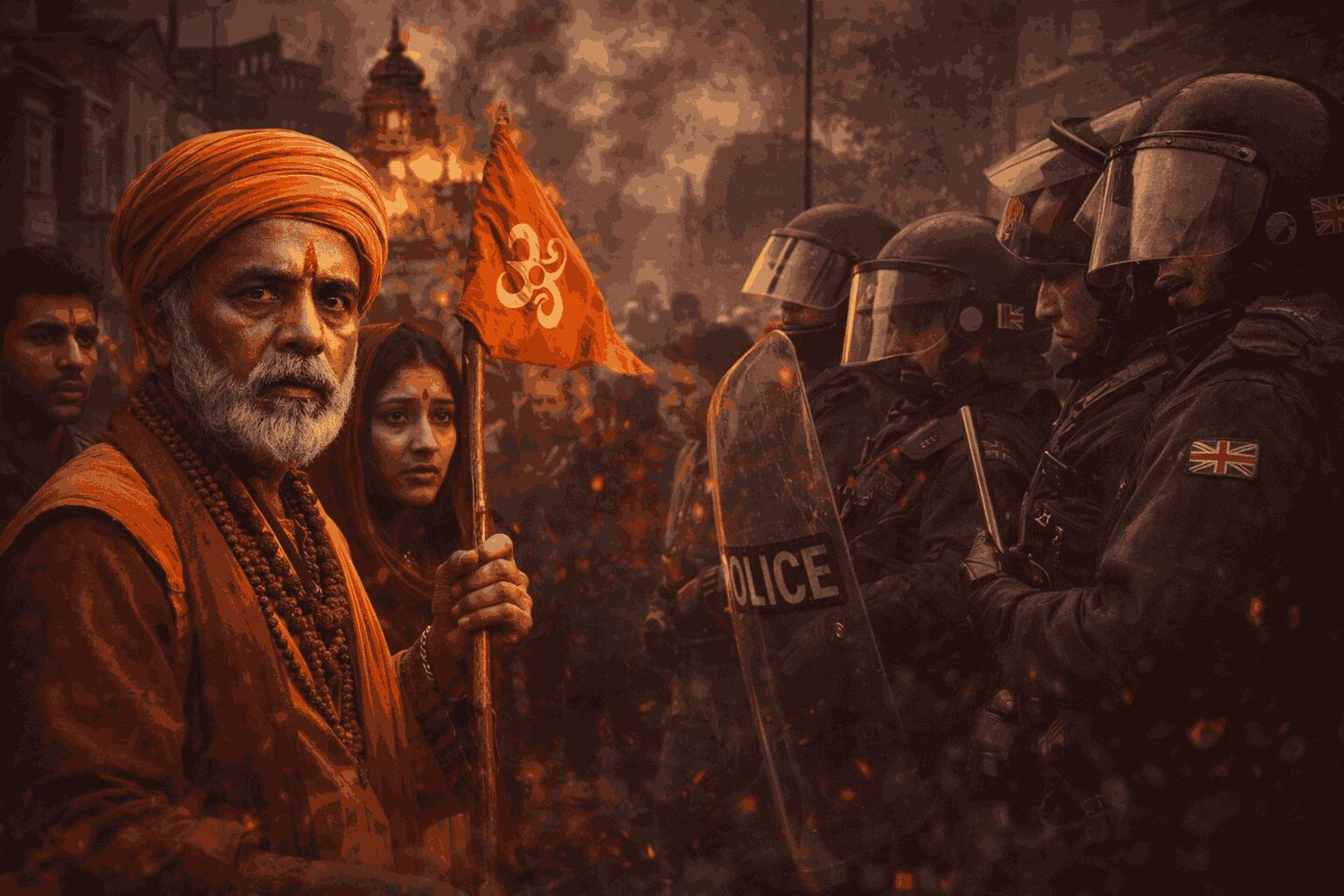
The 2022 Leicester unrest marked one of the most serious episodes of communal tension between Hindu and Muslim communities in modern British history. The clashes occurred between August and September 2022, involving protests, street confrontations, vandalism, and arrests in the city of Leicester, which has large South Asian populations from both communities. Investigations later confirmed that dozens of individuals were arrested and multiple incidents of violence took place during the period of disorder.
For many activists and community groups, the events became a symbol of what they describe as Hindu persecution in diaspora communities. According to reports and commentaries discussing the issue, the unrest left many British Hindus feeling vulnerable and concerned about their safety. Some organisations argue that the riots exposed deeper social tensions and the risk of imported political conflicts from the Indian subcontinent affecting diaspora communities in Europe.
The situation gained renewed attention in early 2026 after an incident in London reportedly disrupted a Holi celebration attended by hundreds of Hindu participants. Reports described a group of youths gathering near the event and creating disturbances around the venue. The episode revived memories of earlier clashes and again raised discussions about Hindu persecution, particularly regarding religious celebrations and community gatherings in public spaces.
Community leaders say that the debate over Hindu persecution should not be seen merely as an isolated reaction to a few incidents but as part of a broader concern about cultural security and equal treatment. Hindu advocacy groups in the UK have repeatedly called for stronger government attention to anti-Hindu sentiment and for better recognition of hate crimes targeting the community. Some organisations argue that the issue has often been overshadowed by broader debates about Islamophobia and racism, leaving Hindu grievances less visible in public discourse.
At the same time, scholars and investigators studying the Leicester clashes have stressed that the unrest involved complex factors and multiple actors. According to research and inquiries into the disturbances, both Hindu and Muslim individuals were involved as victims and perpetrators, and online disinformation played a major role in escalating tensions. Investigators also highlighted leadership failures, communication gaps, and the influence of polarising narratives circulating on social media.
These findings show that the situation cannot be reduced to a single narrative. Yet many activists maintain that the perception of Hindu persecution persists because members of the community believe their concerns have not been adequately addressed. Some critics argue that the aftermath of the riots did not lead to sufficient policy changes or confidence-building measures between communities.
The demographic composition of cities such as Leicester adds further complexity to the issue. The city is known for its highly diverse population, with large South Asian communities that have developed distinct neighbourhoods over decades. By the early 2020s, Muslims made up roughly a third of Leicester’s population while Hindus constituted about a quarter. Such demographic patterns can sometimes intensify identity-based mobilisation during moments of political or cultural tension.
Another factor shaping the debate is the role of narratives spread online. Researchers studying the Leicester events found that misinformation circulated rapidly across social media platforms, contributing to mistrust between communities. Viral posts, provocative messaging, and inflammatory interpretations of local incidents helped transform minor disputes into larger confrontations. In such an environment, allegations of Hindu persecution or counter-accusations can easily gain traction and deepen divisions.
Despite the controversies, many community leaders emphasise that the majority of Hindus and Muslims in the United Kingdom continue to live peacefully and share neighbourhoods, workplaces, and cultural spaces. Local councils and police forces have also attempted to rebuild trust through community dialogues and monitoring of potential flashpoints. However, lingering distrust from past clashes means that restoring full confidence may take time.
Ultimately, the ongoing debate over Hindu persecution reflects the broader challenge of maintaining social cohesion in multicultural societies. As migration and global political narratives increasingly intersect with local community dynamics, governments and civil society organisations face the task of ensuring that all religious groups feel secure and represented.
Whether the lessons of the Leicester unrest lead to stronger safeguards and better dialogue will determine if concerns about Hindu persecution continue to dominate the discussion or gradually give way to a renewed sense of coexistence among Britain’s diverse communities.