
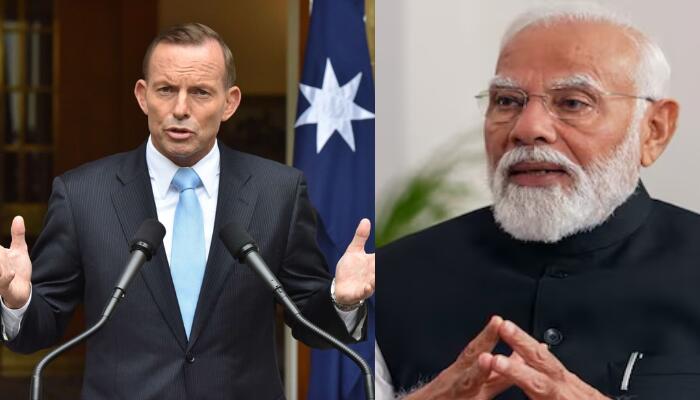
Former Australian Prime Minister Tony Abbott has strongly rejected claims that India has become authoritarian under the leadership of Narendra Modi and the Bharatiya Janata Party, describing such assertions as “total BS” while reflecting on his experience at the globally recognised Raisina Dialogue in New Delhi.
Abbott praised Modi’s leadership style and his conduct at the annual geopolitical forum, arguing that India’s democratic institutions remain vibrant and that the country continues to provide space for open debate and global engagement.
Abbott Praises Modi’s Leadership Style
Speaking about the prime minister’s role at the Raisina Dialogue, Abbott said Modi has consistently demonstrated a rare balance of authority and humility. According to Abbott, the prime minister attends the opening session of the conference each year to listen to the principal guest rather than deliver a speech himself.
“At every dialogue so far, Prime Minister Modi has set the example, attending the opening session to hear the principal guest. Last year it was the Prime Minister of New Zealand and this year the President of Finland. Yet he does not speak himself,” Abbott said.
He added that Modi remains one of the most influential leaders in the world but has shown a willingness to listen. Abbott remarked that after the presidents of the United States and China, Modi is probably the most immediately powerful leader globally, yet he is not too proud to listen as well as lead.
Despite being in office for more than a decade, Abbott said Modi has managed to resist what he described as the hubris that often accompanies political power. He suggested that the prime minister’s early life and disciplined background may have helped him maintain that restraint.
Strong Rejection of Authoritarian Narrative
Abbott also addressed criticism from some quarters that India’s political system has become authoritarian under the Bharatiya Janata Party. He dismissed the allegation outright.
“And as for this notion that India, under the BJP, has somehow become an authoritarian state, that’s total BS,” Abbott said.
He argued that a country with free and fair elections, a vibrant and outspoken media environment, and a robustly independent judiciary cannot realistically be described as moving towards dictatorship.
Abbott further pointed out that a truly authoritarian system would not host a global conference where a wide range of perspectives are openly expressed. The Raisina Dialogue this year, he noted, featured participation from both the Israeli foreign minister, who joined virtually, and Iran’s deputy foreign minister, illustrating the diversity of viewpoints allowed on the platform.
Raisina Dialogue’s Global Importance
The Raisina Dialogue, organised by the Observer Research Foundation in partnership with India’s Ministry of External Affairs, has been held annually in New Delhi since 2016. The forum is widely regarded as India’s flagship conference on geopolitics and geo-economics.
Abbott described the gathering as one of the most significant global platforms for strategic discussions. The conference brings together political leaders, senior military commanders, business executives, journalists and think tank leaders to examine pressing global challenges.
He also compared the dialogue favourably with other international forums, arguing that it encourages genuine debate rather than deference to the host government.
For Abbott, the openness of the Raisina Dialogue itself serves as evidence of India’s democratic strength, reinforcing his view that claims of authoritarianism in the country do not stand up to scrutiny.