
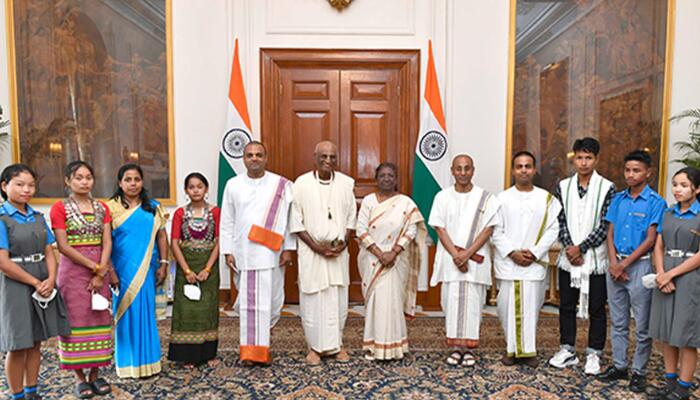
President Droupadi Murmu said, “Access to nutritious food and schooling remains critical to India’s development goals”, marking the milestone of five billion meals served by the Akshaya Patra Foundation at an event held at the Rashtrapati Bhavan Cultural Centre today.
Calling the achievement significant, she said efforts to address hunger in classrooms are closely tied to how children enter, remain in, and benefit from the education system. Referring to the event’s theme, she noted that a well-nourished and educated population is central to the country’s aim of becoming a developed nation by 2047.
Responsibility beyond government
The President said securing a stable future for children requires participation beyond the State. Parents, teachers, social organisations and the private sector all have a role in ensuring that children have the conditions needed to learn and grow.
She pointed to the basic requirements for development, including access to education, adequate nutrition, healthcare, and a safe environment, adding that these are foundational rather than supplementary.
Schooling and opportunity
Describing education as a key factor shaping life opportunities, Murmu said schools equip children with the skills needed to deal with everyday challenges and contribute to society. She said the process of empowerment begins when children enter the classroom.
She also acknowledged the Akshaya Patra Foundation’s work over the past 25 years to address malnutrition and encourage school attendance through mid-day meals.
Outcomes linked to meal schemes
Referring to government initiatives, the President highlighted the School Lunch Programme under the Pradhan Mantri Poshan Yojana, saying it has encouraged parents to send children to school.
She cited findings showing improvements in enrolment, attendance, and retention, along with gains in learning outcomes. She added that the Foundation’s work supports the objectives of the Samagra Shiksha Abhiyan, which aims to ensure inclusive and quality education for all children by 2030.
Focus on long-term gains
Murmu said children should not be seen only as beneficiaries of welfare programmes, noting that investments in their nutrition and education contribute to the country’s human capital.
She said that healthy and educated children will form the future workforce and help achieve the goal of a developed India by 2047.