



















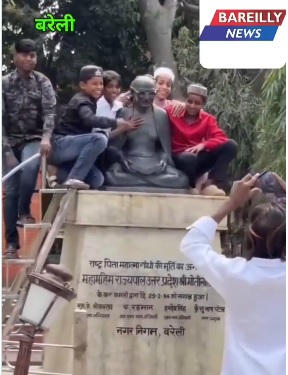
A controversial incident reported from Bareilly has sparked widespread outrage and intense debate across social and political circles. According to claims circulating in public discourse, a photoshoot conducted during Eid celebrations allegedly crossed the boundaries of decency, involving behavior that many have described as deeply disrespectful to shared cultural and moral values. The episode has prompted renewed reflection on the relevance of Gandhi principles in contemporary society.
Eyewitness accounts and social media narratives suggest that the act in question involved inappropriate gestures during what should have been a moment of communal harmony and festivity. While the authenticity and full context of the claims are still being scrutinized, the reaction has been swift and emotional. Citizens from different backgrounds have expressed concern that such incidents undermine the dignity of public spaces and erode mutual respect among communities.
At the center of the debate lies a symbolic invocation of Gandhi, whose philosophy emphasized restraint, respect, and moral discipline in both private and public life. Gandhi’s vision of India was rooted in the idea that freedom must be accompanied by responsibility, and that personal conduct should reflect the highest ethical standards. For many observers, the Bareilly controversy stands in stark contrast to those ideals, raising uncomfortable questions about how far society has drifted from them.
Critics argue that such acts, if verified, not only offend cultural sensibilities but also weaken the social fabric that binds diverse communities together. They contend that Gandhi repeatedly stressed the importance of self-control and dignity, values that seem increasingly challenged in an age of viral content and sensationalism. The incident has therefore become more than just a local controversy—it has evolved into a broader commentary on societal change.
Supporters of stricter accountability are calling for a thorough investigation into the matter. They emphasize that public celebrations, especially those tied to religious occasions, should be conducted with sensitivity and respect. Gandhi believed that harmony between communities was essential for national unity, and many feel that any behavior perceived as provocative or offensive threatens that delicate balance.
At the same time, some voices have urged caution against rushing to conclusions without verified facts. They argue that misinformation and exaggerated narratives can inflame tensions unnecessarily. Even within this perspective, however, there is agreement that the standards of public conduct must remain high. Gandhi’s teachings continue to be cited as a moral compass, reminding citizens that freedom of expression does not mean freedom from responsibility.
The Bareilly episode has also reignited discussions about the role of social media in amplifying controversies. In an era where images and videos can spread instantly, the line between documentation and sensationalism often becomes blurred. Gandhi, who valued truth above all else, would likely have called for careful verification before judgment, while still insisting on accountability where wrongdoing is proven.
Beyond the immediate controversy, the incident serves as a mirror reflecting deeper societal tensions. Questions about cultural respect, individual behavior, and collective responsibility have come to the forefront. Gandhi’s emphasis on ethical living and mutual respect appears increasingly relevant as communities navigate these challenges.
Ultimately, whether the allegations are fully substantiated or not, the reaction they have provoked reveals a shared concern about maintaining dignity in public life. Gandhi’s legacy continues to resonate because it offers a framework for addressing such concerns—not through anger or division, but through reflection and adherence to higher principles.
As Bareilly grapples with the fallout of this controversy, the larger lesson may lie in revisiting the values that once guided the nation. Gandhi’s ideals, though often invoked, demand consistent practice. The incident has reminded many that preserving respect and harmony requires more than words—it requires a collective commitment to uphold the standards that define a civilized society.





