
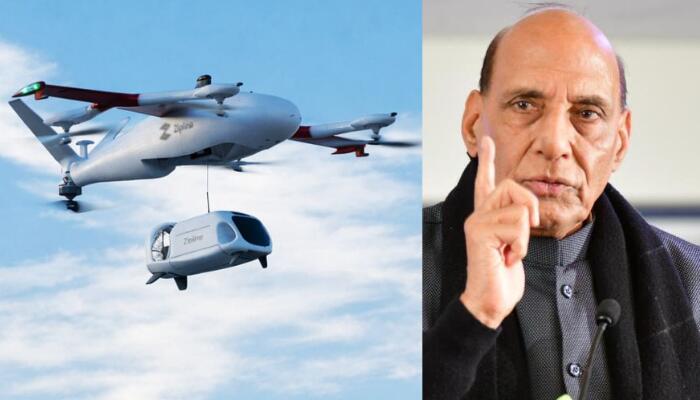
Addressing the National Defence Industries Conclave in New Delhi, Singh underscored the decisive role drones and counter-drone technologies are playing in modern combat, drawing specific attention to the conflicts involving Russia and Ukraine as well as Iran and Israel. He said,”These developments have made it evident that future warfare will be shaped significantly by unmanned systems and their countermeasures.”
He said, ‘As the entire world watches these conflicts unfold, we can clearly see the extremely significant role of drones and counter-drone technologies in future warfare,’ setting the tone for a broader call to action within India’s defence manufacturing ecosystem.
Self-reliance as a strategic necessity
Framing self-reliance as central to India’s defence preparedness and strategic autonomy, Singh emphasised that the country must move towards complete independence in drone production. He stressed that this goal goes beyond assembling finished products and must extend to every layer of manufacturing.
‘Today, there is a need to build such a drone manufacturing ecosystem in India in which we are completely self-reliant,’ he said. He added that achieving this would require domestic capability across all components, from moulds and engines to software and batteries.
The conclave brought together top executives from leading domestic defence manufacturing firms alongside officials from defence public sector undertakings, signalling a coordinated push between government and industry.
Technology reshaping modern warfare
Singh also highlighted the transformative impact of emerging technologies on manufacturing and defence systems. He pointed to automation, artificial intelligence, robotics and simulation technologies as key drivers reshaping global production capabilities and opening new possibilities for innovation.
‘In today’s era, innovations such as automation, artificial intelligence and robotics are transforming manufacturing across the world,’ he noted, adding that simulation technologies are further expanding operational and design capabilities.
Challenges in achieving full indigenisation
While outlining an ambitious vision, Singh acknowledged the complexities involved in achieving complete self-reliance. He pointed out that even in countries with established drone industries, critical components are often sourced from specific foreign suppliers, making full indigenisation a challenging task.
‘This task is not easy because in most countries where drones are made, many critical components are imported from a specific country,’ he said, underlining the structural dependencies that India must overcome.
At the same time, he urged industry leaders to prioritise quality alongside localisation, signalling that global competitiveness must remain a key objective.
The remarks come at a time when defence planners are increasingly recognising that technological superiority, particularly in unmanned and autonomous systems, will define the balance of power in future conflicts. Singh’s call reflects a clear policy direction: India must not only participate in this shift but lead it through innovation and self-reliance.