
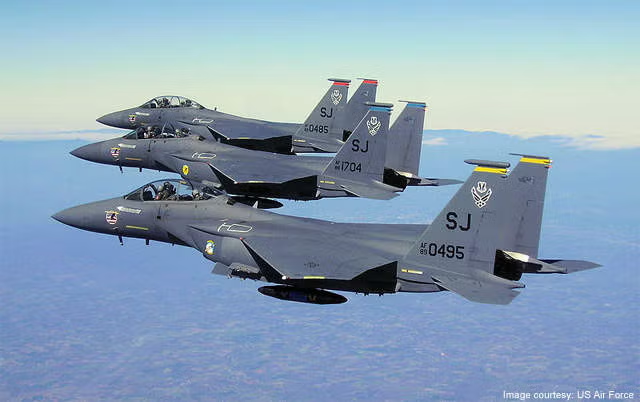
Three US F-15E Strike Eagle fighter jets were shot down over Kuwait in a friendly fire incident during active combat operations linked to the escalating war with Iran, the American military has confirmed. All six aircrew members ejected safely and were recovered in stable condition, preventing what could have been a major loss of life.
The incident occurred at approximately 11:01 p.m. ET on Sunday, as US and allied forces were responding to sustained Iranian aircraft, ballistic missile, and drone attacks across the Gulf. The jets were operating in support of Operation Epic Fury when Kuwaiti air defence systems mistakenly targeted them in a congested and rapidly evolving combat environment.
Military Confirms Friendly Fire During Active Combat
The United States Central Command said three F-15E Strike Eagles went down due to an apparent friendly fire incident while engaged in active combat.
In a statement, the command said the aircraft were operating amid Iranian aerial, missile and drone assaults when Kuwaiti defences mistakenly engaged them. All six aircrew members ejected, were safely recovered, and were receiving medical treatment. Their condition was described as stable.
Kuwait acknowledged the incident and confirmed that joint technical procedures were underway to determine how the misidentification occurred. The Ministry of Defence said emergency teams immediately launched search and rescue operations, evacuated the crews and transferred them to the hospital.
The incident is being treated as the first confirmed loss of US air assets in the current conflict.
Footage, Civilians’ Response and Crash Locations
Videos shared online showed one jet falling from the sky fully engulfed in flames, while another appeared to suffer fire near its right engine. Separate footage captured two parachutes descending and uniformed personnel interacting cautiously with civilians on the ground.
One widely circulated clip showed a pilot still wearing his flight helmet sitting in the boot of a civilian hatchback after being helped by local residents.
Analysis of the footage suggests the crashes occurred near Al Jahra, about six miles from Ali Al Salem Air Base, a major US military hub close to the Iraqi border. The base hosts the 386th Air Expeditionary Wing and has been actively defending against Iranian missile and drone attacks.
The presence of two distinct crash sites, one with total destruction and another with partial engine fire, appears to explain why Kuwaiti authorities initially reported that “several” aircraft had crashed.
Conflicting Claims and Iranian Statements
As official investigations began, competing narratives emerged. Iran’s Khatam al-Anbia Central Headquarters claimed that it had shot down a US F-15 near the Kuwaiti border.
This assertion contrasted sharply with US and Kuwaiti statements, which confirmed the aircraft was downed by allied air defences during friendly fire.
Authorities in Kuwait urged the public to rely only on official sources and warned against unverified social media reports.
Embassy Smoke, Historic Context and Regional Alarm
The downing of the jets coincided with black smoke rising near the US Embassy in Kuwait City. The diplomatic mission issued an urgent security alert warning people not to approach the premises, citing continuing missile and drone threats.
“US Embassy personnel are sheltering in place,” the statement said.
Sirens sounded across Kuwait City, while the interior ministry said multiple drones had been intercepted at dawn.
The embassy compound, a large walled complex near residential districts and Bayan Palace, carries historic sensitivity. In December 1983, it was severely damaged by a truck bomb attack later blamed on Iranian-backed groups.
Explosions were also reported in Abu Dhabi, Dubai, Doha and Manama, underlining the widening impact of Iran’s retaliation.
Wider War and Political Context
Authorities have reported at least five deaths in the Gulf so far from Iranian strikes, including one in Kuwait, with damage to military bases, hotels, airports, ports and residential buildings.
The F-15E Strike Eagle, introduced in the 1980s, is a twin-seat, twin-engine aircraft designed for long-range strike missions. It has served in the Gulf since the first Gulf War and remains a core component of US air power.
The incident comes amid mounting American casualties. Three service members have already been killed and five seriously wounded in recent operations.
President Donald Trump warned that the toll could rise further. “And sadly, there will likely be more,” he said, adding that the conflict could last several weeks, while remaining open to future talks with Tehran.
US and Israeli forces have struck more than 2,000 targets inside Iran following the killing of the country’s supreme leader, Ali Khamenei, triggering Tehran’s unprecedented regional bombardment.
Military officials say investigations into the friendly fire incident are ongoing. While the survival of all six crew members has provided rare relief, the episode has exposed the extreme dangers of coalition warfare in an overcrowded and volatile airspace, where seconds of misjudgement can carry devastating consequences.